



Written by HairMD Content Team | Medically Reviewed by Dr. Dhanraj Chavan On March 30, 2026


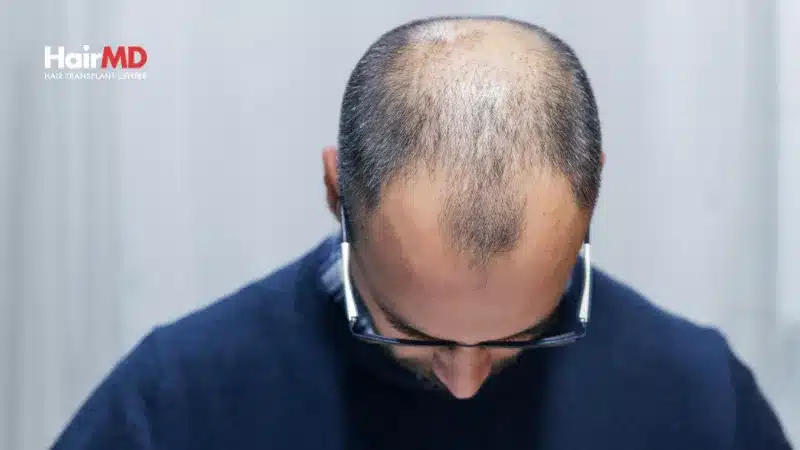
Catching a glimpse of the top of your head in a photograph or mirror can be a startling moment if you notice your hair is not as thick as it once was. For many men, thinning at the vertex, or crown, is the first sign of male pattern baldness.
This discovery often leads to a flurry of questions about the crown baldness progression and what the future holds for your hair. You might wonder how quickly it will spread or if there is anything you can do to stop it.
This article will provide a detailed guide to understanding the stages of crown thinning, the underlying causes, and the advanced medical treatments available to effectively manage and reverse hair loss, helping you to regain control over your appearance and confidence.
Crown baldness progression typically begins with subtle thinning and a reduction in hair density at the vertex of the scalp. Over time, this small patch expands in diameter as more hair follicles miniaturise, eventually leading to a noticeable bald spot. This process is driven by genetics and hormones and can be slowed or reversed with early treatment.
What’s covered in the article?
- Quick Summary
- Understanding Crown Baldness
- The Underlying Causes of Male Pattern Baldness
- The Stages of Crown Baldness Progression
- How Doctors Diagnose Crown Baldness?
- Crown Baldness Treatment in Pune
- Prevention and Management Strategies
- Prevention and Management Strategies
- Expected Results and Recovery Timeline
- Frequently Asked Questions
- Conclusion
Quick Summary
- The Process: A detailed look at the stages of crown baldness, from early thinning to advanced hair loss.
- The Cause: The genetic and hormonal factors behind male pattern baldness.
- The Signs: How to identify the early warning signs of thinning at the crown.
- The Diagnosis: The methods doctors use to assess and measure crown hair loss.
- The Treatments: Effective medical and surgical solutions, including options for crown baldness treatment in Pune.
- Management Tips: Proactive strategies to protect your hair health.
Understanding Crown Baldness
Crown baldness, also known as vertex balding, is a classic manifestation of androgenetic alopecia, or male pattern baldness. It refers to the gradual thinning and loss of hair specifically from the top, back part of the scalp, known as the crown or vertex. While some men experience a receding hairline as their first sign of baldness, many others notice their hair loss beginning at this central point.
The process is driven by a genetic sensitivity to dihydrotestosterone (DHT), a potent male hormone. DHT binds to receptors in the hair follicles at the crown, triggering a process called follicular miniaturisation. With each hair growth cycle, the affected follicles shrink, producing hairs that are progressively finer, shorter, and less pigmented.
Eventually, these follicles can become dormant and cease producing hair altogether, leading to a visible bald spot. The progression rate varies significantly from person to person, depending on their unique genetic makeup and hormonal profile.
The Underlying Causes of Male Pattern Baldness
While the visible sign is a thinning crown, the root causes are internal and largely predetermined. Understanding these factors is key to understanding the condition.
Genetic Predisposition
Your genes are the primary determinant of whether you will experience crown baldness. The predisposition can be inherited from either your mother’s or your father’s side of the family. If male pattern baldness is common among your relatives, your likelihood of developing it is significantly higher. These inherited genes dictate how sensitive your hair follicles are to the effects of DHT.
The Role of Hormones (Androgens)
Androgens are male hormones, and their role is central to this condition. An enzyme called 5-alpha reductase converts testosterone into DHT. In genetically susceptible individuals, DHT is the main culprit behind hair loss. It shortens the anagen (growth) phase of the hair cycle while prolonging the telogen (resting) phase. This hormonal assault on the follicles is what leads to the gradual thinning characteristic of crown baldness.
The Influence of Age
Age is a critical accelerating factor. The longer your hair follicles are exposed to DHT over your lifetime, the more pronounced the miniaturisation becomes. While crown thinning early signs can appear in a man’s early twenties, the prevalence and severity increase with each passing decade. The cumulative effect of DHT over many years is what drives the predictable crown baldness progression.
The Stages of Crown Baldness Progression
Crown baldness does not happen overnight. It follows a predictable, albeit slow, pattern that can be broken down into distinct stages.
Stage 1: The Early Signs of Crown Thinning
The process begins subtly. You might not notice a “bald spot” at first, but rather a general decrease in hair density at the vertex.
- Crown thinning early signs often include hair that looks or feels less full in that specific area.
- Your scalp may become more visible under direct lighting or when your hair is wet.
- You might find it harder to style your hair to cover this area, as the hair shafts themselves are becoming finer and weaker.
Stage 2: The Small, Defined Patch
As miniaturisation continues, the thinning becomes more concentrated, forming a small, noticeable patch.
- This spot is often about the size of a small coin and is typically circular.
- At this stage, a friend, family member, or your barber may be the first to point it out, as it is difficult to see on your own.
- The hair within this patch is visibly finer and sparser compared to the surrounding hair.
Stage 3: The Expanding Bald Spot
Without intervention, the bald spot will continue to grow in diameter.
- The area of complete hair loss expands outwards, and the thinning at the periphery becomes more pronounced.
- The overall hair density on the top of the head decreases, making the scalp highly visible.
- This stage is when most men become concerned enough to seek medical advice.
Stage 4: Merging with the Receding Hairline
In many men, crown baldness occurs simultaneously with a receding hairline. In the advanced stages of male pattern baldness (classified as Stage V and above on the Norwood Scale), the balding at the crown expands forward and merges with the balding at the front. This leaves only a “bridge” of thin hair separating the two areas, which eventually disappears, leaving a large area of baldness across the top of the scalp.
How Doctors Diagnose Crown Baldness?
If you are noticing the early signs of thinning, a consultation with a dermatologist or a hair specialist is the best course of action. A professional diagnosis is crucial to rule out other causes and establish an effective treatment plan.
Patient History and Visual Examination
The diagnostic process begins with a detailed conversation about your hair loss, including when you first noticed it, the rate of progression, and your family history of baldness. The doctor will then perform a careful visual inspection of your scalp, assessing the pattern of thinning and comparing it to the Norwood Scale, which is the standard classification system for male pattern baldness.
Trichoscopy: A Magnified View
To get a more precise look, the doctor will use a handheld magnifying device called a dermatoscope. This procedure, known as trichoscopy, allows them to examine your hair follicles at high magnification. They can directly observe the tell-tale signs of androgenetic alopecia, such as significant variation in hair shaft diameter (some thick, healthy hairs mixed with many fine, miniaturised hairs) and reduced follicular density &there are hairs with multiple diameter
Ruling Out Other Conditions
While crown thinning is most often due to male pattern baldness, the doctor may want to rule out other possibilities. If the hair loss is unusually rapid or patchy, blood tests might be ordered to check for nutritional deficiencies (like low iron or vitamin D) or hormonal imbalances (such as thyroid disorders).doctor should rule out alopecia aereta.
Crown Baldness Treatment in Pune
Fortunately, you do not have to passively watch your crown baldness progress. Modern dermatology offers several highly effective treatments. For those seeking expert crown baldness treatment in Pune, there are excellent clinics equipped with the latest technologies.
One of the leading centres is HairMD Clinic in Pune. Headed by the esteemed Dr. Dhanraj Chavan, a renowned Hair Specialist in Pune, the clinic provides a comprehensive approach to hair restoration. Dr. Chavan and his team specialise in diagnosing the precise stage of your hair loss and creating a personalised treatment strategy.
Address: You can visit HairMD Clinic for a consultation at 201, 2nd Floor, C Wing, KP-aurum, above Star Bazaar, near Mariplex Mall, Kalyani Nagar, Pune.WRONG ADDRESS
Ready to stop the progression and restore your hair? Schedule an appointment with Dr. Dhanraj Chavan at HairMD Clinic to get a customised treatment plan.
Medical Treatments
Medical therapies are the first line of defence, especially when started early.
- Topical Minoxidil: This solution is applied directly to the scalp to stimulate blood flow to the follicles and prolong the growth phase. It is effective at slowing loss and can help regrow hair at the crown.MOSTLY 5 % NEEDED
- Oral Finasteride: This prescription medication works by blocking the production of DHT. It is highly effective at halting the miniaturisation process and can lead to significant improvements in hair density at the crown.
Advanced Therapies
- Platelet-Rich Plasma (PRP) Therapy: The PRP for Hair is a regenerative treatment where your own blood platelets are concentrated and injected into the scalp. These platelets release growth factors that can rejuvenate dormant follicles and thicken existing hair.
- Low-Level Laser Therapy (LLLT): This non-invasive therapy uses red light to stimulate cellular activity in the follicles, promoting healthier and more robust hair growth.
- GFC
- SVF
- QR678
- EXOSOMES
Surgical Solution: Hair Transplantation
For advanced crown baldness, a hair transplant is the only permanent solution to restore hair. In this procedure, DHT-resistant hair follicles are taken from the back and sides of your scalp and meticulously implanted into the thinning crown area.
Prevention and Management Strategies
While you cannot change your genetics, you can take steps to support your hair health and maximise the effectiveness of your treatments.
- Start Treatment Early: The sooner you begin treatment, the more hair you can save. It is far easier to slow down thinning than it is to regrow hair from dormant follicles.
- Maintain a Healthy Lifestyle: A balanced diet rich in protein, vitamins, and minerals provides the essential building blocks for healthy hair. Managing stress is also crucial, as high cortisol levels can accelerate shedding.
- Gentle Hair Care: Avoid harsh shampoos and aggressive styling habits that can damage your hair and scalp. Be gentle when washing and towel-drying your hair.
Expected Results and Recovery Timeline
Patience is a virtue in hair restoration. Hair grows slowly, and treatments need time to work.
- Medical Treatments: With consistent use of Minoxidil and/or Finasteride, you can expect to see a reduction in shedding within 3-4 months. Noticeable improvements in crown density usually become apparent after 6-12 months.
- PRP Therapy: Most patients require an initial series of 3-4 sessions. Improvements in hair thickness and health are often seen within 3-6 months, with ongoing maintenance sessions needed to sustain results.
- Hair Transplant: The transplanted hairs will shed in the first few weeks, but new, permanent growth will begin around the 3-4 month mark. You will see significant results by 9 months, with the final, full density appearing after 12-18 months.
Don’t let crown thinning affect your self-esteem. Consult a specialist to explore your options and take proactive steps today.
Ready to take the first step towards correcting your hair transplant?
Book a private consultation at HairMD in Pune or Pimpri Chinchwad. Let’s discuss your case and build a strategy to achieve the natural result you always wanted.
Frequently Asked Questions
- Does crown baldness always mean I will go completely bald?
No, not necessarily. The progression of male pattern baldness varies greatly. Some men may only ever experience mild thinning at the crown, while for others it progresses to more extensive baldness. Early treatment can significantly alter this progression. - Can stress cause crown baldness?
Stress itself does not cause male pattern baldness, which is a genetic condition. However, severe stress can trigger a temporary shedding condition called telogen effluvium, which can unmask or accelerate the underlying genetic thinning at the crown. - Is hair loss at the crown reversible?
To a large extent, yes. Medical treatments like Finasteride and Minoxidil can reverse the miniaturisation process in follicles that are still active, leading to thicker regrowth. For follicles that have become completely dormant, a hair transplant is the only way to permanently restore hair to the area. - At what age does crown thinning usually start?
While it can start as early as the late teens for some, the most common age for men to notice the first signs of crown thinning is in their late 20s or early 30s. The prevalence increases significantly with each subsequent decade.
DO YOU KNOW?
Nearly 250 Patients Visit HairMD
Everyday For Various Hair Concerns
(15+ Years Of Expertise. 4157+ Successful Hair Transplant)
Meet Our Dermatologists





Conclusion
Understanding the crown baldness progression is the first step toward taking control of your hair’s future. From the subtle early signs of thinning to a more defined bald spot, this process is a clear indicator of androgenetic alopecia at work. While genetics and hormones are the driving forces, you are not powerless. Modern dermatology offers a powerful arsenal of proven medical, regenerative, and surgical treatments that can effectively halt progression and restore density to the crown.
The most critical factor for success is early intervention. By seeking a professional diagnosis as soon as you notice changes, you give yourself the best possible chance to preserve your hair and reverse the damage. Do not wait for the thinning to become advanced. A consultation with a hair specialist can provide clarity, a personalised treatment plan, and a path back to confidence.
Seek Professional Advice
If you are concerned about thinning at your crown, we encourage you to consult an expert. For those in Pune, scheduling a consultation with Dr. Dhanraj Chavan at HairMD Clinic will provide you with an accurate diagnosis and access to the most effective crown baldness treatment options available today.
Further Reading
Does Cold Water Really Help Your Hair? Separating Fact From Myth
You’ve heard that rinsing with cold water makes hair shinier and stronger.
What Should I Do About Dandruff and Scalp Issues?
Dandruff, seborrheic dermatitis, scalp psoriasis, and dry scalp, they look similar but need different treatments. HairMD dermatologists explain how to identify each and what actually works.
Does Heat Damage Really Ruin Your Hair? The Science Explained
Yes, heat damage is real, and mostly permanent. HairMD explains exactly how heat ruins hair at the structural level, at what temperatures damage occurs, and how to minimise it without giving up styling.
How to Get Healthier Hair Without Expensive Treatments?
You don’t need expensive salon treatments for healthier hair. HairMD dermatologists explain what actually improves hair health, from diet and scalp care to habits that protect hair from daily damage.
Have thoughts? Please let us know
We are committed not only to treating you, but also educating you.