

What Is a Hair Transplant? Complete Medical Guide
- Home / What Is a Hair Transplant?

Written by HairMD Content Team | Medically Reviewed by Dr. Dhanraj Chavan On June 23, 2026
- What Is a Hair Transplant?
- How FUE Works: Step by Step
- FUE vs FUT: What Is the Difference?
- Who Is a Candidate?
- After the Procedure: What to Expect Month by Month?
- Realistic Results: What the Numbers Say?
- Quick Reference: Hair Transplant at a Glance
- Frequently Asked Questions
- Sources
A hair transplant is a surgical procedure that moves hair follicles from a donor area (usually the back of the scalp) to thinning or bald areas. FUE (Follicular Unit Excision) is the standard method used at HairMD India. Results are permanent because transplanted follicles are genetically resistant to DHT, the hormone that causes pattern hair loss. Most patients see visible growth at 6-7 months and final density by 12-14 months. Dr. Sachin Pawar leads all FUE surgeries at HairMD, with 2,500+ procedures completed since 2016.
What Is a Hair Transplant?
A hair transplant IS A surgical procedure that relocates healthy hair follicles from a donor area to thinning or bald regions of the scalp, producing permanent, natural-looking hair growth. The procedure works because follicles taken from the back and sides of the scalp are genetically programmed to resist DHT, the hormone responsible for pattern baldness. Once transplanted, they continue to grow in their new location for life.
Hair transplants are performed under local anaesthesia, meaning patients are awake but comfortable throughout. At HairMD India, Dr. Sachin Pawar (MBBS, MS Surgery) has performed 2,500+ hair transplant surgeries with exclusive focus on hair restoration since 2016. The clinic’s FUE graft survival rate is 95-98%.
How FUE Works: Step by Step
Follicular Unit Excision (FUE) is the current gold-standard hair transplant method. Unlike the older FUT strip method, FUE extracts follicles individually using a circular micro-punch tool, leaving no linear scar. Here is what happens during a session:
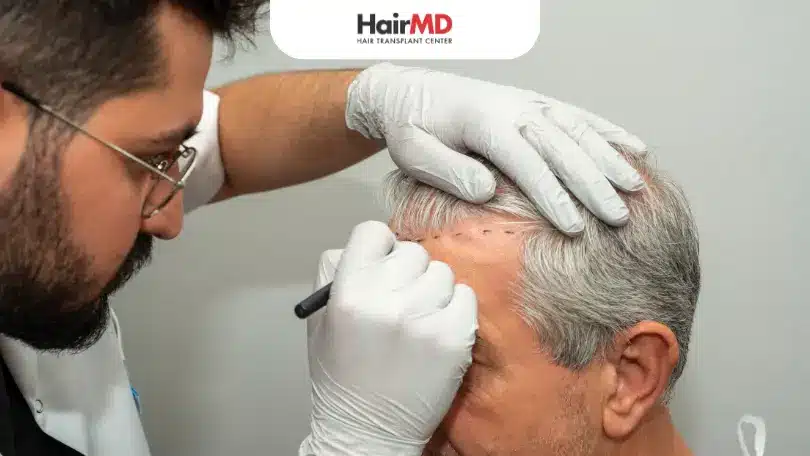
Step 1 – Hairline Design and Surgical Planning.
Before the procedure begins, Dr. Sachin Pawar personally examines the patient and discusses the treatment goals in detail. The hairline and recipient area are then carefully designed while considering:
- The patient’s age and future pattern of hair loss
- Facial proportions and forehead shape
- Existing hairline characteristics
- Density requirements in different areas
- Donor hair availability
- The patient’s expectations and hairstyle preferences
The proposed design is shown to the patient using a surgical marker, and any modifications are made only after obtaining the patient’s approval. This planning stage is crucial because a well-designed hairline determines whether the final result looks natural not only today but also years into the future.
Step 2 – Recipient Site Creation (Premade Slits).
Before graft implantation, Dr. Sachin Pawar personally creates the recipient sites (premade slits) in the thinning or bald areas using fine blades. The angle, direction, depth, and distribution of these tiny slits are carefully designed to match the patient’s existing hair pattern and natural hair exit angles. This surgeon-controlled step is one of the most important determinants of a natural-looking hairline and final aesthetic outcome.
Step 3 – Donor zone preparation.
The back of the scalp is trimmed and numbed with local anaesthesia. The surgeon selects follicles from an area with the highest density and strongest DHT resistance.
Step 4 – Extraction.
Individual follicular units (each containing 1-4 hairs) are extracted using a 0.9-1 mm punch. A typical session extracts 1,500-4,000 grafts depending on the area being covered.
Step 5 – Graft sorting.
Extracted follicles are examined under microscope, and stored in a chilled saline or plasma solution to preserve viability. The chiller temperature is maintained around 4-6 degrees C.
Step 6 – Implantation.
The implantation of grafts is performed by experienced senior hair transplant technicians under the direct supervision and guidance of Dr. Sachin Pawar. Each graft is carefully placed into the premade recipient sites according to the surgical plan established by the surgeon. Single-hair grafts are typically used in the frontal hairline to create a soft, natural appearance, while multi-hair grafts are strategically placed behind the hairline to enhance density. Throughout the implantation process, Dr. Sachin Pawar supervises the procedure, monitors graft placement, and ensures adherence to the planned angle, direction, and density design.
Step 7 – Recovery and First Head Wash.
Tiny crusts or scabs usually begin to form around the transplanted grafts by the 4th to 5th postoperative day as part of the normal healing process. Patients are advised to return to the clinic on the 5th day after surgery for their first supervised head wash. During this visit, the scalp is examined, the donor and recipient areas are assessed, and patients are guided on the correct washing technique to safely soften and remove the scabs over the following few days. Most scabs shed completely by 7-10 days without affecting the transplanted grafts. Most patients can resume light daily activities within a few days, while strenuous exercise should be avoided for the period advised by the surgeon.
Learn more about the procedure in detail in What Happens During FUE Surgery.
FUE vs FUT: What Is the Difference?
Both methods transplant follicles permanently, but the extraction technique differs significantly.
| Attribute | FUE | FUT (Strip) |
|---|---|---|
| Extraction method | Individual punch per follicle | Strip of scalp removed |
| Scarring | Tiny circular dots (not visible with short hair) | Linear scar at back of head |
| Recovery | 5–7 days | 10–14 days |
| Graft count per session | Up to 4,000 | Up to 3,000 |
| Suitability for short hair | Yes | Limited |
HairMD India exclusively performs FUE. The absence of a linear scar and faster recovery make FUE the preferred choice for most patients, including those who keep their hair short.
Read the full comparison in FUE vs FUT: Which Is Right for You?.
Who Is a Candidate?
The best candidates for a hair transplant meet these criteria:
- Stable hair loss pattern. Hair loss should be stable for at least 12 months before surgery, so the transplanted area is not overtaken by ongoing loss.
- Adequate donor density. The back of the scalp must have sufficient healthy follicles. Most patients with Norwood Grade 2-6 (male) or Ludwig Grade 1-3 (female) qualify.
- Good general health. No uncontrolled diabetes, bleeding disorders, or scalp infections.
- Realistic expectations. A transplant restores density to treated areas, it does not stop ongoing loss in untreated areas. A complete plan at HairMD pairs transplant with a medical management protocol (PRP, finasteride, or both) to protect native hair.
Who is not yet a candidate? Patients under 25 with rapidly progressing loss are advised to wait until the pattern stabilises. Active scalp conditions (psoriasis, seborrhoeic dermatitis) must be treated first.
Women are candidates too. Female pattern hair loss at Ludwig Grade 1-3 responds well to FUE. The approach is identical: donor follicles from the back of the scalp are transplanted to the partition line and frontal zone.
See before and after outcomes in our Hair Transplant Results at HairMD.
After the Procedure: What to Expect Month by Month?
Understanding the post-transplant timeline prevents unnecessary anxiety. The most common question surgeons hear is: “Why is my new hair falling out?” The answer is normal: transplanted follicles go through a resting phase before growing permanently.
| Timeframe | What Happens |
|---|---|
| Days 1-5 | Redness, swelling, scabbing at recipient and donor sites |
| Days 5-15 | Scabs shed day by day |
| After 3 weeks | Transplanted hair sheds (shock loss phase – expected and temporary) |
| Months 6-7 | New hair follicles begin active growth phase – first visible growth |
| Months 6-9 | Hair thickens progressively |
| Months 12-14 | Final density achieved |
Patients who do not see growth at 3 months sometimes worry the procedure failed. This is almost always premature. At HairMD, progress is reviewed at the 4-month mark with standardised photographs.
Understand why transplanted hair falls before it grows in Does Transplanted Hair Fall Out?.
Follow the full aftercare protocol in Dos and Don’ts After Hair Transplant.
Realistic Results: What the Numbers Say?
A hair transplant does not restore the hair density of someone who never experienced loss. It fills in areas that are visibly thinning or bald with permanent hair. Here is what patients at HairMD India can realistically expect:
- Graft survival rate: 95-98% of transplanted grafts survive and grow permanently at HairMD
- Density achieved: 30-60 follicular units per cm2 in the treated area (natural scalp averages 60-80)
- Number of sessions: Most patients with Norwood 3-4 complete their result in one session (1,500-2,500 grafts). Norwood 5-6 may require two sessions (4,000-5,000 total grafts)
- Permanence: Transplanted hair does not respond to DHT and is not lost due to male pattern baldness
The most important factor for a natural result is recipient site design – the angle, direction, and distribution of each incision. This is a surgeon-specific skill. Dr. Sachin Pawar designs all recipient sites personally at HairMD.
Quick Reference: Hair Transplant at a Glance
| Attribute | Detail |
|---|---|
| Procedure type | Surgical – FUE (Follicular Unit Excision) |
| Anaesthesia | Local – patient awake throughout |
| Session duration | 6-8 hours |
| Grafts per session | 1,500-4,000 (based on area) |
| Graft survival rate | 95-98% at HairMD India |
| Visible growth begins | 6-7 months post surgery |
| Final results | 12-14 months |
| Permanence | Lifetime – follicles are DHT-resistant |
| Scarring | Tiny circular dots only (not visible at normal hair length) |
| Surgeon at HairMD | Dr. Sachin Pawar, MBBS, MS Surgery – 2,500+ surgeries |
Frequently Asked Questions
Is a hair transplant permanent?
Yes. FUE transplants follicles from the back of the scalp, a zone that is genetically resistant to DHT, the hormone responsible for male and female pattern hair loss. Once transplanted, these follicles retain their DHT resistance and grow permanently. They will not be lost to pattern baldness. Surrounding native hair may continue to thin over time, which is why most surgeons pair a transplant with a medical plan to protect existing hair.
How many grafts do I need?
Graft count depends on the size of the area to be covered and the density goal. As a general guide: Norwood Grade 2-3 typically requires 1,500-2,500 grafts; Grade 4 requires 3,500-4,500 grafts; Grade 5-6 requires 4,000-5,000 grafts. A precise count is determined at consultation using scalp mapping and donor density assessment. At HairMD India, Dr. Sachin Pawar provides a written graft estimate before any booking is confirmed.
Does a hair transplant hurt?
Hair transplant surgery is performed under local anaesthesia. Most patients experience only a brief pricking sensation at the beginning of the procedure while the anaesthetic injections are administered. Once the scalp becomes numb, the remainder of the surgery is generally comfortable, and patients usually do not experience pain during graft extraction, recipient site creation, or implantation. Some mild tenderness or tightness may be present for a day or two after the procedure and is usually well controlled with prescribed medications.
When will I see results?
The transplanted hair sheds between weeks 2 and 6, this is normal and expected. The follicles then enter a resting phase. New growth begins at 6-7 months and continues to thicken, reaching final density at 12-14 months. HairMD schedules a photographic review at the 4-month mark to track progress. At HairMD India, over 95% of patients show measurable density improvement by month 9.
Can women get a hair transplant?
Yes. Female pattern hair loss (Ludwig Grade 1-3) responds well to FUE hair transplant. The technique is the same as for men: follicles from the donor zone at the back of the scalp are transplanted to the partition line, frontal hairline, or diffuse thinning areas. Women with diffuse thinning across the entire scalp may not be suitable candidates if the donor zone is also affected. A consultation at HairMD assesses donor density before any recommendation is made.
Is FUE hair transplant safe for Indian skin?
Yes. Indian patients with Fitzpatrick skin types IV-V tolerate FUE well. At HairMD India, the surgical team has extensive experience operating on darker skin tones. Pigmentation concerns post-surgery are rare because FUE incisions are sub-millimetre in size. The donor area heals to tiny white dots that are rarely visible at normal hair lengths. Patients with darker skin may be asked to avoid direct sun exposure on the scalp for 4-6 weeks post procedure.
Sources
- American Academy of Dermatology Association – Hair Loss: Who Gets It and Causes – Hair loss: Who gets and causes
- International Society of Hair Restoration Surgery – Patient Resources on FUE – INTERNATIONAL SOCIETY OF HAIR RESTORATION SURGERY
- NCBI – Androgenetic Alopecia and DHT-Resistant Follicle Characteristics – Hormonal Effects on Hair Follicles
- Mayo Clinic – Hair Transplant: What to Expect – Genetic testing