

Alopecia Barbae: Causes and Effective Treatments for Bald Patches in Your Beard


Written by HairMD Content Team | Medically Reviewed by Dr. Dhanraj Chavan On October 23, 2026


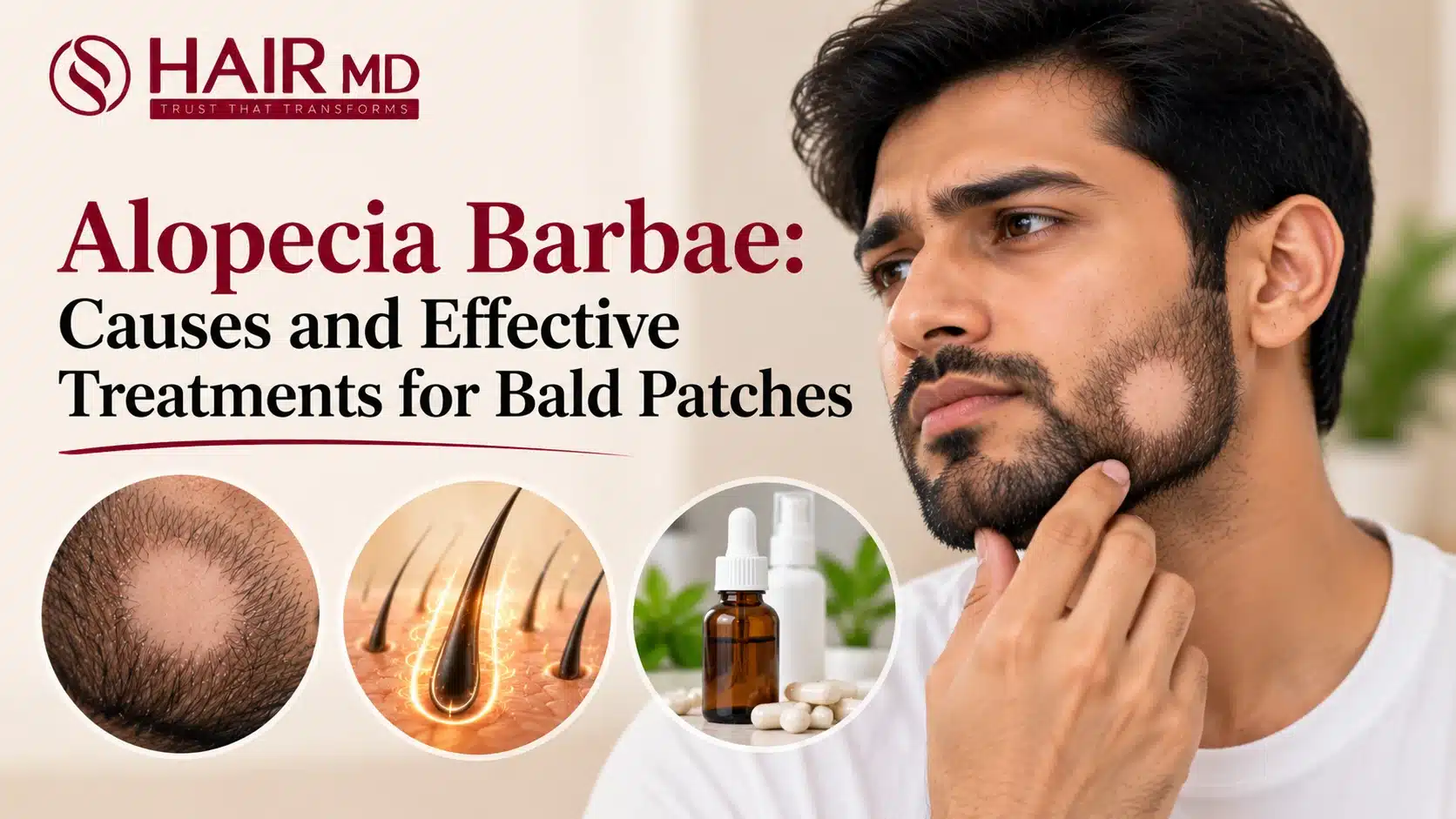
So, you’ve noticed bald patches in your beard for the first time! Ok. We understand that it can be annoying in the first instance. An ugly bald patch in a beard you’ve been nurturing for years can be worse enough to sadden you.
Alopecia barbae is a form of alopecia areata localised to the beard region, caused by CD8+ T-lymphocytes attacking the immune-privileged zone around hair follicles in the anagen (active growth) phase.
The result is discrete, coin-shaped, smooth-bordered bald patches that appear without scarring or scaling. It is not caused by fungal infection, poor hygiene, or nutritional deficiency alone. Most mild cases are self-limiting, with spontaneous regrowth occurring within 3 to 6 months. For persistent or enlarging patches, intralesional corticosteroid injections, topical minoxidil, PRP therapy, and newer JAK inhibitors offer effective treatment without shaving or surgery.
Key Takeaways
- Alopecia barbae is caused by autoimmune collapse of follicular immune privilege: CD8+ T-cells infiltrate the peribulbar region, produce IFN-gamma and IL-15, and force growing follicles out of the anagen phase prematurely
- The characteristic dermoscopic findings are yellow dots (sebum-filled telogen follicles), black dots (retained broken hairs), and exclamation mark hairs (narrow at the base, wider at the tip) at patch margins
- It must be distinguished from tinea barbae (fungal infection): tinea produces erythema, pustules, crusting, and broken hairs with surrounding inflammation; alopecia barbae produces smooth, clean-margined hairless patches without skin inflammation
- Associated conditions are present in a significant proportion of patients: thyroid disease (Hashimoto’s), vitiligo, and atopic dermatitis (eczema) all share an autoimmune basis and co-occur more frequently than in the general population
- Intralesional triamcinolone acetonide injection is the first-line treatment for localised patches; results typically appear within 4 to 8 weeks at the injection site
- Hair regrowth from treatment or spontaneous recovery typically begins at patch margins, is initially fine and unpigmented (vellus), and darkens and thickens over 2 to 4 months
- JAK inhibitors (baricitinib, tofacitinib) targeting the IFN-gamma/JAK-STAT pathway represent a significant advance for extensive or treatment-resistant cases
What’s covered in the article?
- Causes and Triggers of Alopecia Barbae
- Alopecia Barbae vs Other Causes of Beard Hair Loss
- How do Dermatologists Diagnose Alopecia Barbae?
- Treatment Options for Alopecia Barbae
- Treatment Timeline and Expected Outcomes
- When Alopecia Barbae Resolves on Its Own?
- HairMD Treatment Options for Alopecia Barbae
- Frequently Asked Questions
- Conclusion
Causes and Triggers of Alopecia Barbae
The fundamental cause is a genetic predisposition to autoimmune follicular attack. Specific triggers in susceptible individuals include:
Genetic predisposition: Approximately 20% of alopecia areata patients have a first-degree relative with the condition. Multiple HLA genes (particularly HLA-DRB1 alleles) are associated with increased susceptibility. This does not make alopecia barbae directly hereditary in a predictable sense, but family history significantly increases risk.
Stress and the HPA axis: Psychological stress activates the hypothalamic-pituitary-adrenal (HPA) axis, elevating cortisol. Cortisol promotes the release of substance P, a neuropeptide that triggers mast cell degranulation in the perifollicular tissue. Mast cell activation is an early step in the inflammatory cascade that destabilises follicular immune privilege.
Associated autoimmune conditions: Thyroid disease (particularly Hashimoto’s thyroiditis), vitiligo, type 1 diabetes, rheumatoid arthritis, and atopic dermatitis all share underlying immune dysregulation and are significantly more common in alopecia barbae patients. A dermatologist will typically screen for these at first assessment.
Viral triggers: Some cases of alopecia areata onset or flare following viral infections suggest that immune activation (for example, after COVID-19 or influenza) may precipitate episodes in genetically susceptible individuals.
Vitamin deficiencies as cofactors: Vitamin D deficiency has been identified as a cofactor in alopecia areata susceptibility. Vitamin D receptors (VDRs) are expressed in hair follicles and play a role in follicular cycling. Low vitamin D does not cause alopecia barbae independently but may lower the threshold for autoimmune triggering in susceptible individuals. Similarly, ferritin and B12 levels are routinely checked, as deficiency worsens hair loss though through a separate mechanism.
Alopecia Barbae vs Other Causes of Beard Hair Loss
Accurate diagnosis is essential before treatment. Several conditions cause patchy beard hair loss, and each requires a different approach.
|
Feature |
Alopecia Barbae |
Tinea Barbae (Fungal) |
Folliculitis / Kerion |
Trichotillomania |
|
Appearance |
Smooth, clean, coin-shaped patch; no skin change |
Erythema, pustules, crusting, inflamed boggy mass (kerion) |
Inflamed pustules, papules; pus around hair follicles |
Irregular, geometric patches; broken hairs at different lengths |
|
Skin surface |
Normal, no scaling |
Scaling, crusting, discharge |
Inflamed, tender |
Normal or slightly excoriated |
|
Hair break pattern |
Exclamation mark hairs, black dots at margin |
Broken hairs in inflamed skin |
Hairs pulled out with follicles |
Broken at multiple levels |
|
Itch |
Absent or mild |
Moderate to severe; burning |
Moderate; tender to touch |
Often compulsive, not itch-driven |
|
Spread pattern |
Enlarging circular patches |
Spreads within beard zone |
Localised to affected follicles |
Matches behaviour pattern |
|
Associated symptoms |
Nail pitting (25-30%), scalp patches |
Cervical lymphadenopathy, fever in kerion |
Systemic infection symptoms if severe |
Psychological distress, anxiety |
|
Dermoscopy finding |
Yellow dots, black dots, exclamation mark hairs |
KOH scraping positive for fungal hyphae |
Follicular pustules, scaling |
Flame hairs, coiled hairs |
|
Treatment |
Intralesional steroids, immunosuppression |
Oral antifungals (griseofulvin, terbinafine) |
Topical or oral antibiotics; incision for kerion |
Behavioural therapy, habit reversal |
|
Contagious |
No |
Yes (especially to other body sites, barbers) |
Potentially via Staphylococcus |
No |
If the patch has any redness, pustules, crusting, or tenderness, a dermatologist should examine it before any treatment. Applying steroids to a fungal infection (tinea barbae) will suppress the inflammatory response and mask the infection while allowing fungal spread, potentially leading to a severe kerion.
How do Dermatologists Diagnose Alopecia Barbae?
A dermatologist typically diagnoses alopecia barbae through clinical examination supported by dermoscopy. In ambiguous cases or when associated conditions are suspected, additional investigations are ordered.
Dermoscopy (trichoscopy) findings specific to alopecia areata/barbae: Yellow dots, present in follicular ostia, represent empty hair follicles filled with sebum and keratinous material; they are a reliable sign of alopecia areata activity. Black dots are retained broken hairs at the follicular opening. Exclamation mark hairs (thin at the base, thicker distally) at the patch margin indicate actively expanding disease. Short vellus hairs represent early regrowth. Peripilar casts (cylindrical deposits around hair shafts) and upright regrowing hairs confirm the recovery phase.
Blood investigations ordered at HairMD for alopecia barbae: Complete blood count, thyroid function (TSH, free T3, free T4), anti-TPO antibodies, fasting blood sugar, ANA (antinuclear antibody), serum ferritin, vitamin B12, 25-OH vitamin D. These identify associated autoimmune and nutritional conditions that may need concurrent management.
Nail examination: Nail pitting (shallow depressions in the nail plate) is present in 25 to 30% of alopecia areata patients. Onychorrhexis (longitudinal ridging), trachyonychia (rough nail surface), and leukonychia are also associated. Nail findings confirm the autoimmune nature of the diagnosis and influence treatment decisions.
Skin biopsy: Rarely needed for diagnosis but performed when the clinical picture is uncertain. Histopathology shows peribulbar lymphocytic infiltrate (“swarm of bees” appearance) around anagen follicles, with nanogen follicles (miniaturised) and preserved sebaceous glands, confirming autoimmune aetiology.
Treatment Options for Alopecia Barbae
First Line: Intralesional Corticosteroid Injections
Intralesional injection of triamcinolone acetonide (2.5 to 10 mg/mL, adjusted to patch thickness and size) directly into the dermis of the bald patch is the most effective first-line treatment for localised alopecia barbae. It delivers immunosuppression precisely where the T-cell attack is occurring, suppressing IFN-gamma production and interrupting the JAK-STAT activation cascade within the peribulbar tissue.
Injections are given at 4 to 6 week intervals. Hair regrowth typically begins at the injection sites within 4 to 8 weeks. Multiple sessions are usually required for complete patch coverage. The treatment is well tolerated, with temporary skin atrophy (slight depression) at the injection site being the most common side effect, which resolves spontaneously over weeks.
Intralesional steroid injections at HairMD are performed by dermatologists with precise dosing based on patch size and response history.
Second Line: Topical and Oral Corticosteroids
Topical corticosteroids (clobetasol propionate 0.05% foam or solution) are used for patients who cannot tolerate injections or for early, small patches. They are less effective than intralesional injections for established patches because topical penetration through the dermis to the peribulbar zone is limited.
Oral prednisolone (pulse therapy or short tapering courses) is reserved for rapidly progressive or extensive alopecia barbae where multiple large patches are actively expanding. The benefit must be weighed against systemic steroid side effects. Oral steroids do not cure alopecia barbae but can pause rapid progression long enough for other treatments to take effect.
Topical Minoxidil 5%
Minoxidil applied to beard patches stimulates hair regrowth through its KATP channel-opening mechanism (increasing blood flow and growth factor delivery to the follicle) independent of the autoimmune mechanism. It does not treat the underlying immune attack but can stimulate dormant follicles to re-enter the anagen phase. Minoxidil 5% solution or foam, applied twice daily to the affected area, is often used alongside intralesional injections for faster or more complete regrowth.
PRP and GFC Therapy
Platelet-rich plasma (PRP) and growth factor concentrate (GFC) therapy provide concentrated autologous growth factors (PDGF, VEGF, IGF-1, TGF-beta) delivered directly into the affected area. These growth factors promote follicular repair, angiogenesis, and the anagen-promoting environment around follicles under immune attack. PRP and GFC do not suppress the autoimmune mechanism but support follicular survival and recovery during the treatment period. They are used as adjuncts to intralesional steroid treatment, particularly in patients who want to avoid repeated steroid injections.
Excimer Laser and NB-UVB Phototherapy
The excimer laser delivers targeted 308nm UV radiation to bald patches, inducing T-cell apoptosis (programmed cell death) in the peribulbar infiltrate. This mechanism is distinct from corticosteroids: excimer laser kills the attacking T-cells directly rather than suppressing their signalling. It is particularly useful for multiple patches or patches resistant to steroid injections, and for patients who prefer a non-injection treatment modality.
JAK Inhibitors (Baricitinib, Tofacitinib, Ruxolitinib)
JAK (Janus kinase) inhibitors represent the most significant therapeutic advance in alopecia areata treatment in decades. They target the JAK1/JAK2/STAT1 pathway that IFN-gamma uses to collapse follicular immune privilege, blocking the upstream signalling that drives CD8+ T-cell infiltration and MHC class I upregulation in follicular keratinocytes.
Oral baricitinib is FDA-approved for severe alopecia areata (affecting more than 50% of the scalp). While clinical evidence for alopecia barbae specifically is extrapolated from scalp alopecia areata trials, the mechanism is identical. JAK inhibitors are reserved for extensive, rapidly progressive, or treatment-resistant cases due to the cost and requirement for monitoring. Hair loss typically returns when treatment is stopped, positioning these as long-term management drugs rather than cures.
Topical Immunotherapy (DPCP, SADBE)
Diphencyprone (DPCP) or squaric acid dibutylester (SADBE) applied topically causes a controlled contact dermatitis that is thought to redirect the immune response away from hair follicles through immune deviation. Used for extensive alopecia areata/barbae not responding to other treatments. Applied by dermatologists at gradually increasing concentrations to maintain mild controlled inflammation at the treatment site.
Treatment Timeline and Expected Outcomes
|
Phase |
Timeframe |
What to Expect |
|
Treatment initiation |
Week 1 to 2 |
No visible change; intralesional steroid or PRP delivered; baseline photo taken |
|
Initial response |
Week 4 to 8 |
Fine, unpigmented vellus hair may appear at patch margins (harder to see in darker beards) |
|
Visible regrowth |
Month 2 to 3 |
Terminal (pigmented) hairs emerge across the patch; patch size reduces visibly |
|
Full patch coverage |
Month 3 to 6 |
Most localised patches achieve full coverage with continued treatment |
|
Maintenance |
Ongoing |
Monitoring for recurrence; maintenance injections at 6 to 12 week intervals if needed |
Note: outcome timelines vary significantly based on patch size, duration of hair loss before treatment, associated conditions, and individual immune response. Patches present for more than 12 months before treatment typically respond more slowly. New patches can appear while existing ones recover, requiring continued monitoring.
When Alopecia Barbae Resolves on Its Own?
Mild, single-patch alopecia barbae in patients without other autoimmune conditions and without rapid expansion has a reasonable probability of spontaneous remission within 3 to 12 months. Spontaneous regrowth occurs because the autoimmune attack is episodic, not permanent: T-cell infiltration subsides without treatment in many localised cases, and immune privilege re-establishes itself.
However, spontaneous remission is unpredictable. A patch can remain static for months, enlarge, shrink partially and then expand again, or resolve and recur elsewhere. The presence of multiple patches, nail involvement, associated thyroid disease, or a positive family history all reduce the likelihood of complete spontaneous remission and increase the case for earlier treatment.
Waiting for spontaneous recovery is a legitimate choice for early, small, isolated patches without rapid expansion, provided a dermatologist confirms the diagnosis and excludes conditions requiring prompt treatment (such as tinea barbae).
HairMD Treatment Options for Alopecia Barbae
|
Clinical Picture |
Recommended Treatment at HairMD |
Expected Timeline |
|
Single small patch (less than 2 cm), first episode |
Intralesional steroid injection every 4 to 6 weeks |
Hair regrowth in 4 to 8 weeks per session |
|
Multiple patches or slow steroid response |
Intralesional steroids + PRP therapy as adjunct |
Combined response visible by month 2 to 3 |
|
Patch with poor regrowth quality (thin, sparse) |
GFC therapy to enrich follicular growth environment |
Improved density over 2 to 3 GFC sessions |
|
Injection-resistant patches or patient preference |
Excimer laser targeting affected area; 2x weekly sessions |
Response within 6 to 10 sessions |
|
Scalp alopecia areata alongside alopecia barbae |
Combined scalp and beard treatment plan; mesotherapy for nutritional support |
3 to 6 months for combined improvement |
|
All sites combined with nutritional deficiency |
Dermatologist-supervised supplementation + intralesional steroids; bloodwork follow-up |
Improvement as nutritional status corrects (2 to 4 months) |
HairMD dermatologists treat alopecia barbae across 7 centres in Pune. 250+ patients consult daily. Every treatment plan follows individual trichoscopy assessment, not a generic protocol.
Frequently Asked Questions
What is alopecia barbae and is it the same as alopecia areata?
Alopecia barbae is alopecia areata specifically affecting the beard. Both share the same autoimmune mechanism: CD8+ T-cells attack hair follicles during the growth phase, causing patchy hair loss. The only difference is location. Alopecia barbae on the beard and alopecia areata on the scalp respond to the same treatments and follow the same clinical course.
Is alopecia barbae permanent or will the beard grow back?
Most mild, localised cases are not permanent. The follicle structure remains intact during the autoimmune attack, which means regrowth is biologically possible. Without treatment, many single-patch cases resolve spontaneously within 3 to 12 months. With treatment (intralesional steroids, PRP, excimer laser), most patients achieve full regrowth. Extensive or longstanding disease before treatment may respond more slowly.
What is the fastest treatment for bald patches in the beard?
Intralesional corticosteroid injection directly into the bald patch produces the fastest results: most patients see initial vellus hair regrowth within 4 to 8 weeks of the first injection. Combining injections with topical minoxidil 5% applied twice daily accelerates regrowth further. PRP can be added for stubborn patches or poor-quality regrowth.
Can stress cause bald patches in the beard?
Stress does not directly cause alopecia barbae but can trigger it in genetically susceptible individuals. Psychological stress elevates cortisol, which triggers substance P release and perifollicular mast cell degranulation, an early step in the inflammatory cascade that destabilises follicular immune privilege. Many patients identify a stressful period in the weeks before their first patch appeared.
How do I know if my beard bald patch is fungal or autoimmune?
The key difference is the skin surface. Alopecia barbae produces a completely smooth, clean-bordered hairless patch with no redness, scaling, pustules, or crusting. Tinea barbae (fungal infection) produces visible redness, crusting, pustules, and often tenderness or itch. If you are unsure, see a dermatologist: treating a fungal infection with corticosteroids (the treatment for alopecia barbae) will worsen it.
Can alopecia barbae spread to the scalp?
Yes, in some patients alopecia barbae co-exists with or develops into scalp alopecia areata. Both are expressions of the same underlying autoimmune condition. The risk of progression to the scalp is higher in patients with multiple beard patches, a longer duration of disease, associated autoimmune conditions such as thyroid disease or vitiligo, and a positive family history of alopecia areata.
DO YOU KNOW?
Nearly 250 Patients Visit HairMD
Everyday For Various Hair Concerns
(20+ Years Of Expertise. 4157+ Successful Hair Transplant at HairMD)
Meet Our Dermatologists



Conclusion
In conclusion, bald patches in the beard, often caused by alopecia barbae, can be distressing but are usually temporary. Treatments like corticosteroid injections, topical minoxidil, and home remedies such as aloe vera or essential oils may help promote regrowth. However, consulting a dermatologist for proper diagnosis and treatment is crucial for managing the condition effectively. Personalized care and timely intervention can greatly improve outcomes for individuals facing beard hair loss.
Further Reading
Can Stress Cause Alopecia Areata? The Real Relationship, Explained by Dermatologists
Does stress cause alopecia areata? Dermatologists explain the immune mechanism, why stress triggers it, how to identify it, and what treatments actually work for patchy hair loss.
How to Treat Alopecia Areata at Home: Natural Solutions for Hair Growth
Explore home remedies for alopecia areata to promote hair regrowth and boost confidence from home.
What Is The Best Treatment For Alopecia Universalis?
Learn about the best treatments for alopecia universalis, a condition causing total hair loss. Explore expert-recommended therapies and options for hair regrowth at HairMD.
Alopecia Care: Advanced Treatment Options for Men and Women
Explore alopecia treatments for men and women: minoxidil, laser therapy, and expert consultations in Pune. Find effective solutions!
Have thoughts? Please let us know
We are committed not only to treating you, but also educating you.