



Written by HairMD Content Team | Medically Reviewed by Dr. Dhanraj Chavan On July 23, 2026


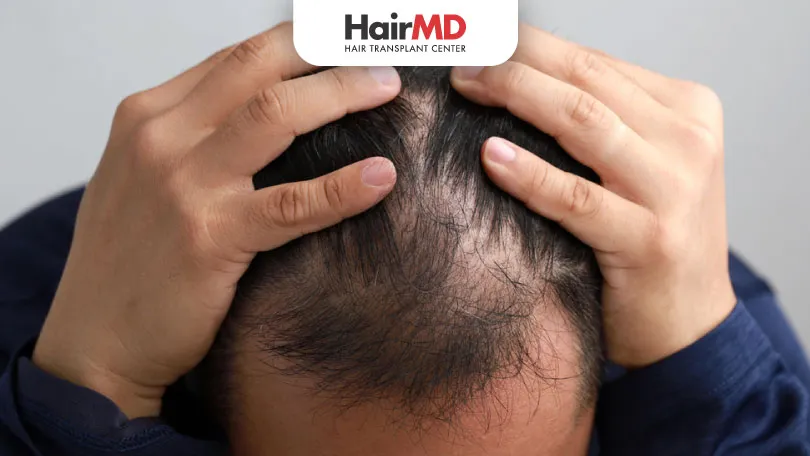
Are you suffering from sudden patchy hair loss problem? Don’t know anything about this time of hair loss. Thus, this type of hair loss is called alopecia areata.
Can stress cause alopecia areata? Stress does not directly cause alopecia areata, but it can trigger or worsen it in people who are genetically predisposed to the condition. Alopecia areata is an autoimmune disease the immune system mistakenly attacks hair follicles. Stress activates the HPA (hypothalamic-pituitary-adrenal) axis, releasing cortisol and neuropeptides like substance P, which can disrupt the immune privilege that normally protects follicles from immune attack. This disruption triggers the autoimmune response in genetically susceptible individuals. Stress alone without genetic predisposition does not cause alopecia areata. Removing stress does not cure it, though stress reduction may reduce the frequency of flares.
What’s covered in the article?
- Relation Between Stress and Hair Loss
- The Immune Mechanism: How Stress Actually Triggers Alopecia Areata?
- Alopecia Areata Remedies
- Treatment for Alopecia Areata
- Alopecia Areata Home Remedies
- Frequently Asked Question
- Conclusion
Relation Between Stress and Hair Loss
Talking about stress, it does not mean it is psychological stress. It is the response of the body to any stimulus. This stimulus can be environmental, medicinal, physical or mental.
In fact, there are three types of hair loss associated with high levels of stress, they are:
- Telogen effluvium: This is a medical condition leading to hair loss in which hair typically falls off in handfuls. It doesn’t actually cause hair to fall, but rather makes it stop growing by pushing large numbers of hair follicles into a resting phase. But which fall out suddenly when simply combing or washing the hair.
- Trichotillomania: This is a disorder that involves a recurrent and irresistible urge to pull out hair from your scalp, eyebrows etc. Hair pulling can be a way of dealing with negative or uncomfortable feelings like stress, anxiety, boredom, loneliness, or frustration.
- Alopecia areata: This is an autoimmune condition in which the body’s immune cells mistakenly attack its own hair follicles, on the scalp or elsewhere on the body, leading to sudden, patchy hair loss. The exact reason for this is not known, but stress, infections, nutritional deficiencies, hormonal imbalance, etc can act as triggers for the immune system to misfire.
The Immune Mechanism: How Stress Actually Triggers Alopecia Areata?
This is the part most articles skip, and it is the part that makes the stress-alopecia areata relationship make sense.
Normal follicle immunity: Hair follicles have a unique relationship with the immune system. Normally, follicles exist in a state of immune privilege, a protected zone where certain immune signals are suppressed, allowing the follicle to produce hair without being attacked by T cells. This is similar to the immune privilege found in the eye and the brain.
The follicle maintains this privilege through specific molecular signals, including reduced expression of MHC class I molecules (which T cells use to recognise cells as “foreign”) and the local production of immunosuppressive factors like TGF-β and α-MSH.
What breaks immune privilege: In genetically predisposed individuals, several factors can disrupt follicle immune privilege. Stress is one of them, but the mechanism is indirect:
- Stress activates the HPA axis: Psychological or physical stress triggers the hypothalamic-pituitary-adrenal axis, releasing cortisol and catecholamines (adrenaline, noradrenaline).
- Cortisol dysregulates immune function: While acute cortisol is anti-inflammatory, chronic stress and chronically elevated cortisol paradoxically dysregulate immune function, impairing regulatory T cells (Tregs) that normally suppress autoreactive responses and shifting immune activity toward a Th1/Th2 imbalance.
- Neuropeptides disrupt follicle immune privilege: Stress also triggers release of neuropeptides, particularly substance P, from nerve endings in the scalp skin. Substance P directly disrupts follicle immune privilege by upregulating MHC class I expression on follicle keratinocytes, making them visible to patrolling T cells that would otherwise ignore them.
- Autoreactive T cells attack the follicle: Once immune privilege is broken, CD8+ cytotoxic T cells which carry autoreactive T cell receptors recognise follicle cell antigens and mount an immune attack on the follicle bulb.
- Hair production stops: The immune infiltrate (mainly CD8+ T cells with some CD4+ cells) surrounds the follicle bulb like a “swarm of bees” a characteristic histological appearance in alopecia areata biopsies. This disrupts follicle matrix cell activity and stops hair production.
The genetic component: This entire cascade only occurs in people who have the genetic predisposition specific HLA alleles and immune regulatory gene variants that make their immune system prone to this autoreactive response. Stress can trigger the cascade in susceptible people, but it cannot create the susceptibility in someone who does not have it.
This is why most people under severe stress do not develop alopecia areata and why alopecia areata sometimes appears without a clear stress trigger at all.
Alopecia Areata Remedies
If you are suffering from alopecia problems, you need to know, the remedies which will be useful for your treatment. Let’s check the remedies of this treatment.
- Educate yourself: That’s always the first step in solving any problem correctly. Learn about the types of hair loss and their relation to stress and other factors. Deliberate on the likely cause for your hair loss.
- Consult the expert: Get your diagnosis and cause for hair loss confirmed by your dermatologist or trichologist. Your doctor will examine, and then recommend you ways to combat the hair fall.
- Be patient: Remember that it will only last as long as the stress does. So instead of worrying and paradoxically making your hair loss another stressor, which will lead to a never-ending cycle, stay calm.
- Sleep well: Lack of sleep can contribute and worsen both physical and mental stress. So follow a regular sleep pattern, and make sure you receive 8-9 hours of your beauty sleep at a stretch.
- Eat well: Do you know that hair is made up of keratin? It is being one of the fastest-growing cells in the body. So follow a healthy diet, that includes the recommended daily allowance for proteins and calories.
Treatment for Alopecia Areata
Alopecia areata and its treatments and along home remedies are very important to get good results. Let’s check the points in details.
- Diet: You need to avoid processed and sugary foods. Eat more fruits, vegetables, whole grains, lean protein, avocados, oily fish, nuts and olives etc.
- Supplements: If your diet is falling short of providing you with the necessary nutrition, your doctor may prescribe multivitamins and other supplements such as omega-3 fatty acids, antioxidants, etc to improve the health of the scalp.
- Exercise regularly: Exercise is greatly beneficial in alleviating emotional and mental stress by causing the release of endorphins, the happy hormones. Choose your own brand of exercise, may it be running, cycling, yoga, dancing, anything, but practice it regularly and welcome in a happier, calmer and more relaxed version of yourself.
- Counselling and therapy: Emotional and psychological stress can be difficult to deal with, especially without any release. Talking about it with a trusted friend or family member, or even to a therapist may feel cathartic and help you find some peace.
- Rest: If your body has been under physical stress, such as surgery, accident, chronic illness, or even giving birth to a child, your body needs time to recover. Be patient and allow your body to heal; once it has, your hair will recover, too.
- Check your medications: Medications like blood thinners, blood pressure medication, some anti-inflammatory drugs, and certain other drugs can promote hair loss and worsen stress-related hair loss. If you discover you are on one of these, you can talk to your doctor about lowering the dosage and whether alternative medicine is possible.
HairMD’s Alopecia areata treatment approach is individualised, the right combination of treatments depends on your severity, duration, and response. Book a consultation to get a protocol designed for your specific case.
Alopecia Areata Home Remedies
Follow a hair care regime using hair care products best suited to your hair type. Learn the right techniques of shampooing and conditioning your hair.
- Avoid washing your hair too often as it can strip it of natural oils, making it dry and brittle. Nourish your hair by massaging your scalp with your hands using oil to boost circulation and encourage growth.
- You have to get trimmed every couple of months to eliminate split ends. Avoid over-styling your hair and minimize the use of styling tools.
Frequently Asked Questions
Can stress alone cause alopecia areata?
Stress alone cannot cause alopecia areata in someone without the genetic predisposition. Alopecia areata is an autoimmune condition, the immune system attacks hair follicles because of an underlying genetic vulnerability. Stress acts as a trigger by disrupting follicle immune privilege through cortisol and neuropeptide pathways, but only in people who already have this genetic susceptibility. Most people under significant stress do not develop alopecia areata.
How is alopecia areata different from stress-related hair loss?
Alopecia areata presents as smooth, clearly defined circular or oval bald patches, the immune system is attacking specific follicle clusters. Stress-related hair loss (telogen effluvium) causes diffuse, generalised thinning across the whole scalp without discrete patches. They have different mechanisms, different appearances, and different treatments. A trichoscopy examination distinguishes them definitively.
Can alopecia areata grow back on its own?
In mild patchy alopecia areata, spontaneous regrowth occurs in many patients within 6–12 months even without treatment. However, recurrence is common. For more extensive disease, treatment significantly improves regrowth outcomes and reduces recurrence frequency. First signs of regrowth are fine, white or unpigmented hairs appearing within the bald patch.
What is the fastest treatment for alopecia areata? Intralesional corticosteroid injections produce the fastest response for patchy alopecia areata, regrowth often becomes visible within 4–8 weeks of the first session. For severe extensive disease, JAK inhibitors (baricitinib) have shown meaningful regrowth in 3–6 months. There is no instant treatment, follicle reactivation takes time regardless of the treatment used.
Does alopecia areata spread?
It can particularly in the early active phase of the disease and in patients with risk factors (childhood onset, atopy, nail involvement, ophiasis pattern). Active disease means the immune attack is ongoing and new follicles can be recruited into the inflammatory response. Early treatment reduces the risk of spread. Some cases stabilise spontaneously without treatment.
Can alopecia areata be cured permanently?
Currently, alopecia areata cannot be permanently cured the genetic predisposition remains and recurrence is possible. However, JAK inhibitors represent the closest approach to long-term disease control in severe cases, and many patients with patchy disease achieve sustained remission with appropriate treatment. The goal of treatment is remission and reduction of recurrence frequency, not a one-time cure.
DO YOU KNOW?
Nearly 250 Patients Visit HairMD
Everyday For Various Hair Concerns
(20+ Years Of Expertise. 4157+ Successful Hair Transplant at HairMD)
Meet Our Dermatologists



Conclusion
In conclusion, while stress may not directly cause alopecia areata, it can act as a trigger for this type of hair loss. It’s essential to manage stress, take care of your body, and consult with a specialist if you’re experiencing sudden hair loss. By following a healthy lifestyle, getting proper treatment, and using the right remedies, you can help improve your hair’s health and reduce the impact of alopecia areata. Stay calm, be patient, and take steps towards healing.
HairMD’s dermatologists specialise in alopecia areata diagnosis and treatment across all severity levels, from first-presentation patchy disease to alopecia totalis.
Book a consultation or call +91 95845 84111.
Further Reading
Alopecia Barbae: Causes and Effective Treatments for Bald Patches in Your Beard
Discover the causes of alopecia barbae and the best treatments for bald patches in the beard. Get expert advice from HairMD clinics, Pune
How to Treat Alopecia Areata at Home: Natural Solutions for Hair Growth
Explore home remedies for alopecia areata to promote hair regrowth and boost confidence from home.
What Is The Best Treatment For Alopecia Universalis?
Learn about the best treatments for alopecia universalis, a condition causing total hair loss. Explore expert-recommended therapies and options for hair regrowth at HairMD.
Alopecia Care: Advanced Treatment Options for Men and Women
Explore alopecia treatments for men and women: minoxidil, laser therapy, and expert consultations in Pune. Find effective solutions!
Have thoughts? Please let us know
We are committed not only to treating you, but also educating you.