

PRP vs Minoxidil for Hair Loss: Which Works Better?


Written by HairMD Content Team | Medically Reviewed by Dr. Dhanraj Chavan On July 25, 2026


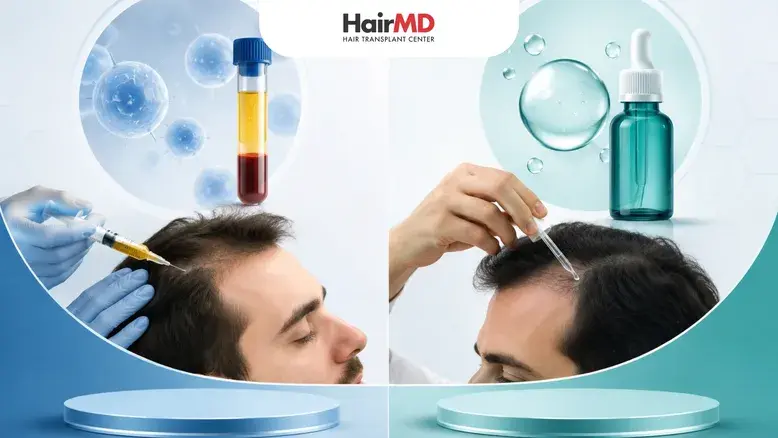
PRP and minoxidil are both non-surgical hair loss treatments that work very differently. Minoxidil is a daily topical or tablet used at home; PRP is a course of in-clinic injections from your own blood. Neither is a permanent cure, and they often work best together.
Quick Answer
- Minoxidil is used daily at home; PRP is a course of in-clinic injections.
- Both slow hair loss and support regrowth, but neither is a cure.
- Minoxidil is cheaper and easier; PRP is a doctor-led procedure.
- Evidence is often strongest when the two are combined.
- A dermatologist can advise which suits your hair loss.
What’s covered in the article?
- Quick Answer
- What Is Minoxidil?
- What Is PRP?
- PRP vs Minoxidil: Key Differences
- Which Should You Choose?
- Frequently Asked Questions
What Is Minoxidil?
Minoxidil is an approved hair loss treatment, sold as a topical or low-dose tablet, that widens scalp vessels and pushes follicles into the growth phase. It has strong evidence in dermatology, is cheap, and can be paired with a dermaroller. The catch is it must be used daily and indefinitely, since stopping reverses the gains.
What Is PRP?
PRP concentrates platelets from your own blood and injects them into thinning areas to stimulate follicles. It is a clinic procedure, usually a short course with occasional maintenance, and the benefits of PRP build gradually. It helps pattern hair loss, though the evidence is less standardised than minoxidil’s.
PRP vs Minoxidil: Key Differences
Minoxidil is applied at home; PRP is delivered in clinic. Minoxidil costs little but is a lifelong daily habit, while PRP costs more but only occasionally. A review comparing PRP with topical minoxidil found both help pattern hair loss, so doctors often combine them. The right fit depends on whether PRP suits you.
Which Should You Choose?
For a low-cost option you manage yourself, minoxidil is the usual starting point. If you want a clinic-led boost, or minoxidil is not enough, PRP can be added. Your causes of hair loss help decide. Book a consultation with HairMD India for a plan.

Frequently Asked Questions
Is PRP or minoxidil better for hair loss?
Neither is simply better, as they work differently and suit different people. Minoxidil has strong evidence and is cheap, while PRP is a procedure that can boost results. For pattern hair loss, using both together often works best.
Can you use PRP and minoxidil together?
Yes, they are frequently used together and complement each other well. Minoxidil gives daily follicle stimulation at home, while PRP adds periodic in-clinic support. Because they act through different mechanisms, dermatologists often combine them for pattern hair loss.
Does minoxidil work better than PRP?
Minoxidil has more standardised, long-term evidence and is approved for hair loss, so it is often the first step. PRP has growing evidence and helps when added, but its results vary more. They usually work best as a combined, doctor-guided plan.
How much do PRP and minoxidil cost?
Minoxidil is inexpensive but an ongoing monthly cost for as long as you use it, usually indefinitely. PRP costs more upfront for a course, then only occasional maintenance. Over time the totals can be similar, so it comes down to preference and response.
Do PRP and minoxidil results last?
Both maintain results only while treatment continues, since neither cures the cause of hair loss. Minoxidil gains reverse within months of stopping, and PRP needs maintenance sessions. Consistent, ongoing treatment is what keeps hair loss controlled.
DO YOU KNOW?
Nearly 250 Patients Visit HairMD
Everyday For Various Hair Concerns
(15+ Years Of Expertise. 4157+ Successful Hair Transplant)
Meet Our Dermatologists





Further Reading
Beard Hair Transplant: Can Beard Hair Be Used for Hair Transplant? | HairMD
Yes, beard hair can be used for hair transplant but only in specific cases. HairMD dermatologists explain when it’s used, how many grafts it yields, its advantages and limitations.
PRP After Hair Transplant: When & Why | HairMD Pune
PRP after a hair transplant protects grafts and strengthens native hair. Learn when to start, how many sessions, and what to expect at HairMD Pune.
FUE Hair Transplant Procedure: What Happens on Surgery Day
A step-by-step guide to the FUE hair transplant procedure at HairMD Pune – from local anaesthesia and graft extraction to implantation and day-1 recovery.
FUE Hair Transplant: The Most Popular Hair Transplant Method
Explore why FUE is the most popular hair transplant method for natural hair regrowth!
Have thoughts? Please let us know
We are committed not only to treating you, but also educating you.