

Single Hair vs Multi Hair Grafts in Hair Transplant


Written by HairMD Content Team | Medically Reviewed by Dr. Dhanraj Chavan On March 25, 2026


Making the decision to undergo a hair restoration procedure is a significant milestone. However, as you begin your research, you are likely to encounter a vast amount of unfamiliar medical terminology.
One of the most common points of confusion for patients is understanding the difference between single hair grafts and multi-hair grafts. People often search for this information because they want to know how surgeons achieve a completely natural-looking result rather than an artificial, “pluggy” appearance.
The secret to a successful hair transplant lies entirely in how these different types of grafts are extracted, separated, and strategically placed across your scalp. In this comprehensive guide, we will have hair grafts explained in detail. You will learn the distinct roles of single and multiple hair grafts, how doctors design a dense, natural hairline, the latest surgical techniques available, and what to expect during your recovery timeline.
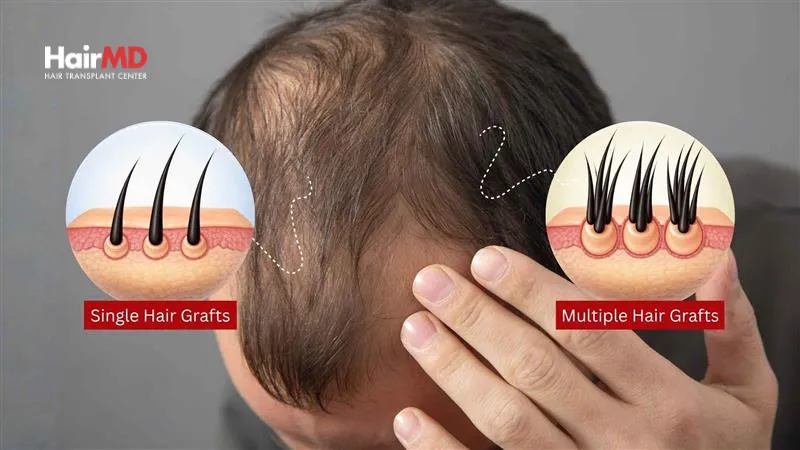
A hair graft is a naturally occurring group of hair follicles. Single hair grafts contain just one strand of hair and are meticulously placed at the very front of the hairline to create a soft, natural edge. Multi-hair grafts contain two, three, or four hairs and are placed behind the hairline and across the mid-scalp and crown to build volume and density.
What’s covered in the article?
- Quick Summary
- What Are Single and Multi Hair Grafts in a Hair Transplant?
- Why Is Graft Density Planning Important for Natural Results?
- How Do Doctors Decide Between Single and Multi Hair Grafts?
- Where Can You Find Expert Graft Density Planning in Pune?
- What Are the Different Hair Transplant Techniques (FUE vs FUT)?
- What Results and Recovery Timeline Can You Expect After a Hair Transplant?
- How Can You Maintain and Protect Your Hair After a Transplant?
- Frequently Asked Questions
- Conclusion
Quick Summary
- The Anatomy of a Graft: How hair naturally grows in groupings called follicular units.
- The Art of Density: Why graft density planning is the most critical step for a natural result.
- Expert Assessment: How specialists determine exactly how many single and multi-hair grafts you need.
- Surgical Techniques: The difference between modern extraction methods like FUE and FUT.
- Recovery and Care: A realistic timeline for seeing your final results and how to protect your new hair.
What Are Single and Multi Hair Grafts in a Hair Transplant?
To fully grasp how a hair transplant works, we must first look at the natural anatomy of human hair. Hair does not grow in individual, evenly spaced strands across your scalp. Instead, it grows in tiny, natural groupings known as “follicular units.” A single follicular unit contains the hair follicles, sebaceous (oil) glands, nerves, a small muscle, and fine blood vessels.
When a surgeon performs a hair transplant, they do not transplant individual hairs one by one; they transplant these intact follicular units. These units are referred to as “grafts.”
What Are Single Hair Grafts?
Single hair grafts are follicular units that naturally contain exactly one strand of hair. While they do not provide a significant amount of volume or scalp coverage, they are arguably the most important grafts in the entire procedure.
These grafts are used exclusively to reconstruct the very front edge of the hairline. If you look closely at a natural, non-balding hairline in the mirror, you will notice that the front edge is not a solid wall of thick hair. Instead, it features fine, single hairs that create a soft, gradual transition into the thicker hair behind it. By using single hair grafts at the frontal boundary, surgeons mimic this natural biological pattern, ensuring the transplant is virtually undetectable.
What Are Multi-Hair Grafts?
Multi-hair grafts are follicular units that naturally contain two, three, or even four strands of hair growing from a single pore.
- Two-hair grafts: These are typically placed immediately behind the single-hair hairline. They help to transition the soft front edge into the denser areas of the scalp smoothly.
- Three and four-hair grafts: These are the heavy lifters of the hair transplant world. They are placed in the mid-scalp and the crown (vertex) areas. Because multiple hairs are emerging from a single graft, they provide maximum coverage and the illusion of thick, dense hair.
Using multi-hair grafts at the front hairline would result in a harsh, unnatural appearance, often referred to as the “doll’s hair” look. Conversely, using only single hair grafts across the entire bald scalp would fail to create any meaningful density, leaving the hair looking incredibly thin. The magic of a modern hair transplant relies on blending these grafts perfectly.
Why Is Graft Density Planning Important for Natural Results?
A successful hair transplant is equal parts medical science and artistic design. Graft density planning is the blueprint the surgeon creates before the first extraction even begins. It involves calculating exactly how many grafts are available in the donor area and mapping out precisely where they need to be placed to achieve the most aesthetically pleasing result.
Creating the Illusion of Density
We have a limited supply of donor hair on the back and sides of the scalp. A surgeon cannot simply replace every single hair that has been lost to male pattern baldness. Instead, they must create the “illusion of density.”
By strategically placing multi-hair grafts in areas where light hits the scalp the most—such as the mid-scalp and crown—the surgeon blocks the light from reflecting off the skin, making the hair look exceptionally thick. Meanwhile, the strategic use of single hair grafts at the front ensures the eye is drawn to a soft, natural frame around the face.
Protecting the Donor Area
Graft density planning is not just about the recipient (balding) area; it is equally about protecting the donor area. If a surgeon over-harvests grafts, the back of the head will look unnaturally thin or patchy. A skilled specialist calculates the precise mathematical ratio of single to multi-hair grafts needed to cover the bald spots without depleting your natural reserves, ensuring your hair looks great from every angle
How Do Doctors Decide Between Single and Multi Hair Grafts?
Every patient’s scalp is entirely unique. There is no one-size-fits-all formula for a hair transplant. So, how do doctors decide how many single hair grafts versus multi-hair grafts you need? The process involves a highly detailed clinical assessment.
Microscopic Scalp Analysis
During a consultation, the doctor will use a specialised magnifying device called a dermatoscope to examine your donor area. This tool allows them to see your follicular units up close. They will assess your natural grouping ratio. Some people naturally have a high concentration of three and four-hair grafts, making it easier to build dense coverage. Others may have mostly one and two-hair grafts, which requires a different strategic approach.
Assessing Hair Characteristics
The physical characteristics of your hair play a massive role in graft planning.
- Hair Calibre (Thickness): Coarse, thick hair covers more surface area than fine hair. A patient with thick hair may require fewer multi-hair grafts to achieve the same visual density as a patient with fine hair.
- Hair Colour and Skin Contrast: High contrast between your hair colour and skin tone (e.g., dark hair on pale skin) makes thinning more obvious. This requires meticulous placement of multi-hair grafts to block the scalp from view. Low contrast (e.g., blonde hair on fair skin) offers more visual forgiveness.
- Hair Texture: Curly or wavy hair naturally bends and overlaps, providing better coverage than dead-straight hair.
Mapping the Recipient Area
The doctor will draw a proposed hairline on your scalp, taking into account your age, facial symmetry, and future hair loss potential. They will then calculate the surface area (in square centimetres) that requires coverage. Based on this, they determine how many single hair grafts are needed for the hairline and how many multi-hair grafts are required to fill the mid-scalp and crown zones.
Where Can You Find Expert Graft Density Planning in Pune?
When investing in a hair transplant, choosing a clinic with a deep understanding of graft dynamics is your most important decision. If you are searching for an expert graft density planning clinic Pune offers some of the best medical facilities in the country.
For those seeking exceptional, natural-looking results, HairMD Clinic Pune is a premier destination. Under the expert leadership of Dr Dhanraj Chavan, a highly respected Hair Specialist in Pune, the clinic focuses heavily on the artistic and mathematical principles of graft density planning. Dr Chavan and his experienced team take the time to meticulously analyse your donor area, carefully selecting and placing each single and multi-hair graft to match your natural hair growth pattern perfectly.
You can receive a completely customised consultation to understand exactly how your unique graft profile will be utilised for the best aesthetic outcome.
Address: 2nd Floor, Shivsagar A, Khadekar Park, 21/B, Mundhwa – Kharadi Rd, above Shivshakti Electronics, near Shivshakti Furniture, Raghoba Patil Nagar, Santipur, Thite Nagar, Kharadi, Pune, Maharashtra 411014
Are you ready to restore your hairline with absolute precision? Book your consultation today at HairMD Clinic Pune, and let Dr Dhanraj Chavan design a hair restoration plan tailored specifically to you.
What Are the Different Hair Transplant Techniques (FUE vs FUT)?
To safely harvest and implant both single and multi-hair grafts, surgeons utilise highly refined surgical techniques. The two primary methods used worldwide are FUE and FUT.
Follicular Unit Extraction (FUE)
FUE is currently the most Popular hair transplant method. In this procedure, the surgeon uses a micro-punch tool (usually between 0.7mm and 1.0mm in diameter) to extract individual follicular units directly from the scalp one by one.
Because the surgeon can see the grafts as they extract them, they can selectively harvest the exact mix of grafts needed for the density plan. They can deliberately target single hair grafts for the hairline and multi-hair grafts for the crown. FUE leaves tiny, dot-like scars that are virtually invisible once the hair grows out, making it ideal for patients who prefer short hairstyles.
Follicular Unit Transplantation (FUT)
Also known as the “strip method,” FUT involves removing a thin strip of skin from the donor area at the back of the head. The surgeon then meticulously closes the area, leaving a linear scar that is easily hidden by surrounding hair.
The removed strip of tissue is taken to a laboratory station where highly trained technicians use stereoscopic microscopes to dissect the tissue into individual follicular units. They carefully separate the single hair grafts from the multi-hair grafts. FUT often yields a very high number of high-quality, plump grafts, making it an excellent option for patients requiring extensive coverage in a single session.
The Implantation Phase
Regardless of the extraction method, the implantation phase is where the artistry happens. The surgeon makes tiny, microscopic incisions in the balding areas, paying close attention to the angle, depth, and direction of natural hair growth. They then gently place the single hair grafts at the very front to create a soft boundary, and densely pack the multi-hair grafts behind them.
What Results and Recovery Timeline Can You Expect After a Hair Transplant?
Patience is a necessary virtue when undergoing a hair transplant. The grafts need time to establish a blood supply and enter their natural growth cycles.
Here is what you can expect during the recovery timeline.
Weeks 1 to 2: Healing
Immediately after the procedure, your scalp will be tender, and you will have tiny scabs around each implanted graft. These scabs typically fall off within 7 to 10 days. By the end of the second week, the donor and recipient areas should be fully healed on the surface.
Weeks 3 to 8: The Shedding Phase
This phase often causes patients anxiety, but it is entirely normal. The trauma of the surgery causes the transplanted hairs to enter a resting phase, and the hair shafts will shed and fall out. Do not panic—the actual follicle remains safely anchored beneath the skin. You will temporarily look just as you did before the surgery.
Months 3 to 6: Early Growth
Around the third or fourth month, new hairs will begin to push through the scalp. Initially, these hairs may be very fine, light in colour, and somewhat unmanageable. By month six, you should see about 40% to 50% of the newly transplanted hair growing in.
Months 9 to 12: Maturation and Final Density
During this period, the hair shafts will thicken, darken, and mature into their normal texture. The multi-hair grafts will begin to overlap, providing the visual density the surgeon planned for. By the 12-to-18-month mark, the final results will be visible, showcasing a soft, natural hairline made of single hair grafts blending perfectly into the thick, voluminous hair behind it.
How Can You Maintain and Protect Your Hair After a Transplant?
A hair transplant is a significant investment. To protect your newly transplanted grafts and ensure the best possible outcome, you must follow strict post-operative and long-term management strategies.
Immediate Post-Operative Care
In the crucial days following your surgery, you must avoid dislodging the delicate new grafts.
- Sleep with your head elevated at a 45-degree angle to minimise swelling.
- Avoid strenuous exercise, heavy lifting, and sweating for at least two weeks.
- Do not scratch or pick at the scabs on your scalp.
- Follow your surgeon’s specific instructions regarding how and when to gently wash your hair.
Long-Term Hair Preservation
It is critical to understand that a hair transplant does not cure the underlying genetic cause of male pattern baldness. While the transplanted hairs from the donor area are resistant to DHT and will not fall out, the native hair surrounding them can still thin over time.
To maintain a uniform density and protect your investment, your specialist will likely recommend ongoing medical management.
- Minoxidil: A topical solution that stimulates blood flow to the scalp and prolongs the hair’s growth phase.
- Finasteride: An oral medication that inhibits the production of DHT, preventing further miniaturisation of your native hair.
- PRP Therapy: Many patients undergo regular Platelet-Rich Plasma sessions to keep the scalp healthy and fortify both the transplanted and native hair follicles.
A healthy lifestyle, balanced diet, and effective stress management also play vital roles in supporting robust hair growth.
Ready to take the first step towards correcting your hair transplant?
Book a private consultation at HairMD in Pune or Pimpri Chinchwad. Let’s discuss your case and build a strategy to achieve the natural result you always wanted.
Frequently Asked Questions
- Can single hair grafts be split from multi-hair grafts?
Yes. In some cases, if a patient has a shortage of naturally occurring single hair grafts, highly skilled technicians using microscopes can carefully divide a two-hair or three-hair graft into single grafts to be used for the hairline. - Are multi-hair grafts more noticeable or pluggy?
They are only noticeable if they are placed incorrectly. If multi-hair grafts are placed at the very front of the hairline, they will look artificial and “pluggy.” However, when placed correctly in the mid-scalp and crown, they are essential for creating natural-looking volume and are completely undetectable. - Do single hair grafts take longer to grow?
No, all transplanted grafts follow the same general timeline. They will all shed within the first month and begin to grow back around the three-to-four-month mark. - How many grafts do I need for a good result?
This entirely depends on the extent of your hair loss, the characteristics of your hair, and your donor area capacity. A minor hairline correction might require 1,000 to 1,500 grafts, while advanced hair loss may require 3,000 to 4,000+ grafts. A consultation with a specialist is the only way to get an accurate graft estimate.
DO YOU KNOW?
Nearly 250 Patients Visit HairMD
Everyday For Various Hair Concerns
(20+ Years Of Expertise. 4157+ Successful Hair Transplant at HairMD)
Meet Our Dermatologists

Conclusion
Understanding the distinct roles of single hair grafts and multi-hair grafts is the key to demystifying the hair transplant process. While multi-hair grafts act as the dense building blocks for the mid-scalp and crown, single hair grafts are the delicate, artistic brushstrokes that frame your face and ensure a completely undetectable, natural-looking hairline. By mastering graft density planning and executing precise surgical techniques, modern hair restoration specialists can effectively reverse the visible signs of baldness.
Protecting your investment requires adhering to a structured recovery timeline and employing long-term management strategies to preserve your native hair. With the right medical team and a comprehensive care plan, you can confidently undergo a hair transplant and enjoy a lifetime of natural, robust hair growth.
Seek Professional Advice
Your hair restoration journey should begin with a thorough, professional assessment of your unique scalp and hair characteristics. If you are considering a procedure and want to ensure a perfectly natural result, reach out to an expert who understands the profound importance of graft density planning.
Take the first step towards restoring your confidence today. Contact HairMD Clinic in Pune to schedule a comprehensive evaluation with Dr Dhanraj Chavan. Together, you can explore the best surgical techniques and develop a customised plan that utilises your grafts to their absolute maximum potential.
Further Reading
Fotona & LLLT Laser Hair Cost in Pune 2026
Fotona and LLLT laser hair treatment cost in Pune 2026 – per-session pricing, packages, and what affects the cost at HairMD Pune.
How to Prevent Hair Loss: The Ultimate Guide
Explore the ultimate guide to preventing hair loss and maintaining healthy, strong hair.
PRP Pre & Post Care Protocol | HairMD Pune
PRP for alopecia areata – what the research says about regrowth, how it compares to other options, and when it may help, from HairMD Pune.
PRP for Alopecia Areata: What Research Says
PRP for alopecia areata – what the research says about regrowth, how it compares to other options, and when it may help, from HairMD Pune.
Have thoughts? Please let us know
We are committed not only to treating you, but also educating you.