

What Aundh Residents Should Expect from a Hair Transplant at HairMD India?
Written by HairMD Content Team | Medically Reviewed by Dr. Dhanraj Chavan
Updated on February 05, 2026
For men and women in Aundh, hair thinning is increasingly common due to stress, pollution, and genetics. Fortunately, modern restoration techniques are available close to home. At HairMD India, every hair transplant combines medical precision with artistic design to deliver long-term, natural-looking results.
This article explains exactly what you can expect before, during, and after your procedure – covering candidacy, steps, recovery, and expected outcomes.
What’s covered in the article?
- Why HairMD India Is Trusted Across Pune?
- The Step-by-Step Process at the Aundh Clinic
- Who Benefits Most from a Hair Transplant in Aundh?
- Setting Realistic Expectations
- Frequently Asked Questions
- What Aundh Residents Should Review Next?
Why HairMD India Is Trusted Across Pune?
HairMD India’s dermatology-led team, headed by Dr. Dhananjay Chavan, has performed thousands of successful FUE (Follicular Unit Extraction) and FUT (Follicular Unit Transplantation) surgeries.
Patients rely on HairMD India for:
- Ethical donor-area planning and graft calculation
- Advanced micro-implantation for natural direction and density
- Transparent pricing and evidence-based care
- PRP and LLLT support therapies for better graft survival
Each treatment is tailored to individual patterns of loss and designed to look natural from every angle.
The Step-by-Step Process at the Aundh Clinic
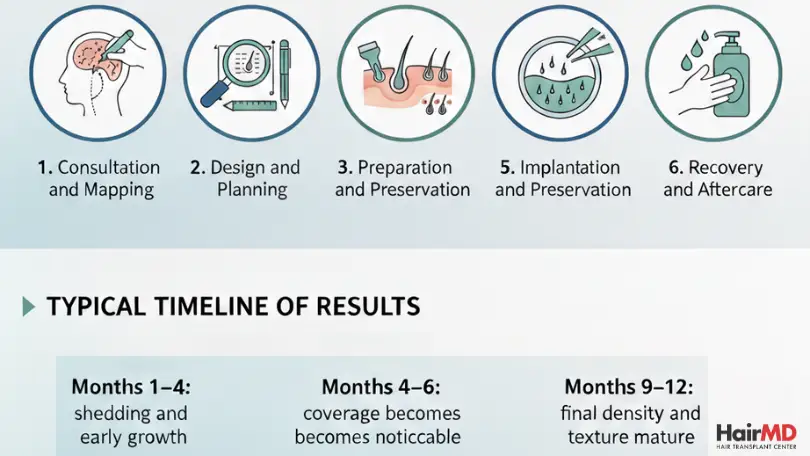
- Consultation and Mapping – Your trichologist reviews your scalp, grades hair loss, and estimates graft count.
2. Design and Planning – The hairline is drawn to complement your face and age profile.
3. Extraction – Follicles are harvested from the donor zone using FUE or FUT.
4. Preparation and Preservation – Grafts are sorted and preserved for viability.
5. Implantation – Micro-sites are created; grafts are inserted at precise angles.
6. Recovery and Aftercare – Swelling subsides within days; most return to work in 5–7 days.
Typical Timeline of Results
- Months 1–3: shedding and early growth
- Months 4–6: coverage becomes noticeable
- Months 9–12: final density and texture mature
Who Benefits Most from a Hair Transplant in Aundh?
Good candidates include those with androgenetic alopecia, stable donor areas, and realistic expectations.
Living in Aundh provides convenient access to follow-ups and monitoring, ensuring better continuity of care through recovery.
For people still comparing surgery with early-stage medical management, this guide to hair loss treatment options in Aundh explains when non-surgical or combination approaches may be more appropriate before transplant planning.
Setting Realistic Expectations
Results depend on donor density, total grafts placed, and adherence to aftercare. HairMD India optimizes outcomes through:
- PRP boosters to stimulate follicle growth
- Nutritional plans and maintenance therapy
- Custom aftercare kits for Pune’s climate
- Regular scalp scans to track progress
With careful planning, graft survival exceeds 95 %, producing visibly thicker, natural hair.
Frequently Asked Questions
Is the procedure painful?
No. Local anesthesia keeps the session comfortable; patients usually report only minor discomfort.
How many grafts will I need?
It depends on your baldness grade and coverage goal. A digital donor analysis during consultation determines the number.
When can I resume work?
Most patients return within a week, avoiding heavy exercise for two weeks.
When will I see results?
New growth starts by the third month, with full density in nine to twelve months.
What is the success rate?
Clinical success averages above 95 % when aftercare guidelines are followed.
What Aundh Residents Should Review Next?
If you are researching hair transplant treatment from Aundh, the most useful next step is to understand whether surgery is appropriate now, how donor availability affects planning, and what realistic timelines apply to your stage of hair loss.
In some cases, a transplant is the right option immediately. In others, supportive approaches such as PRP, medication, or scalp-focused therapies may be discussed first to stabilize thinning and improve long-term planning.
To continue your research, review the Aundh area page, compare non-surgical treatment topics from the same area, or explore the main hair transplant treatment page for a broader clinical overview.
Medical Disclaimer:
This article is intended for educational purposes. Hair loss treatments and outcomes vary by individual, and a consultation is required to determine suitability.