

Home > Pune > Shivaji Nagar > What Shivaji Nagar Patients Should Know Before a Hair Transplant?
What Shivaji Nagar Patients Should Know Before a Hair Transplant?

Written by HairMD Content Team | Medically Reviewed by Dr. Dhanraj Chavan
Updated on February 27, 2026
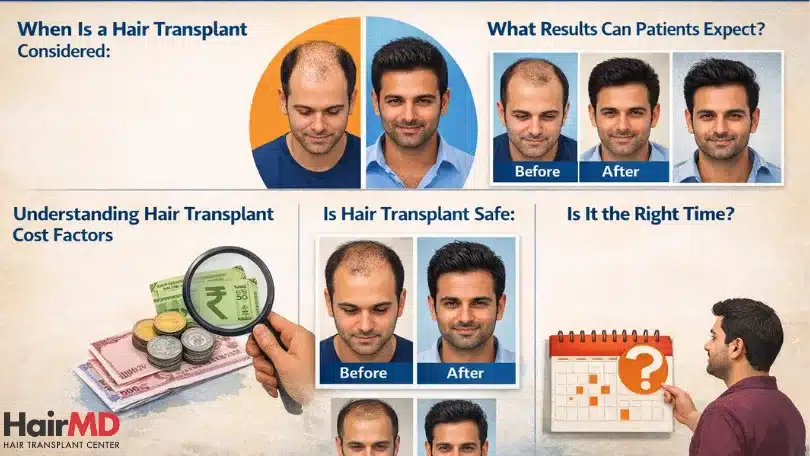
Hair transplant has become one of the most reliable long-term solutions for advanced hair loss. For residents of Shivaji Nagar experiencing significant thinning or visible bald patches, understanding the procedure, expected results, and cost factors is essential before making a decision.
Unlike temporary treatments that support existing follicles, a hair transplant redistributes permanent hair follicles from one area of the scalp to another.
What’s covered in the article?
- When Is a Hair Transplant Considered?
- What Results Can Patients Expect?
- Understanding Hair Transplant Cost Factors
- Is Hair Transplant Safe?
- What to Evaluate Before Choosing a Hair Transplant in Shivaji Nagar?
- Frequently Asked Questions
When Is a Hair Transplant Considered?
Hair transplant is typically considered when:
- Hair thinning has progressed beyond early stages
- Bald patches are clearly visible
- Non-surgical therapies are no longer sufficient
- The donor area (usually the back of the scalp) has adequate density
It is not usually the first step for mild hair thinning. Early-stage hair loss often responds better to stabilisation treatments before surgical restoration is discussed.
What Results Can Patients Expect?
Hair transplant results follow a gradual timeline:
- Initial shedding phase in the first few weeks
- Early regrowth around 3 – 4 months
- Noticeable improvement by 6 – 8 months
- Final density by 9 – 12 months
The outcome depends on:
- Donor hair quality
- Extent of hair loss
- Surgical planning
- Post-procedure care
Transplanted follicles are generally resistant to hormonal hair loss, making results long-lasting when properly maintained.
Understanding Hair Transplant Cost Factors
Hair transplant cost is not fixed because it depends on several variables:
- Number of grafts required
- Area that needs coverage
- Complexity of hairline design
- Density goals
It is important to understand that cost should be evaluated alongside long-term value, natural appearance, and overall planning rather than viewed as a single-number decision.
A personalised consultation determines the exact graft count and treatment plan.
Is Hair Transplant Safe?
When performed with proper evaluation and sterile protocol, hair transplant is considered a safe procedure. Recovery typically involves:
- Mild swelling
- Temporary redness
- Small scabs in the treated area
Most individuals resume routine activities within a week, avoiding strenuous exercise temporarily.
What to Evaluate Before Choosing a Hair Transplant in Shivaji Nagar?
Hair transplant outcomes can vary based on factors such as donor availability, stage of hair loss, and long-term hair loss progression. Cost is only one part of the decision and should be considered alongside expected results and treatment planning.
For many individuals in Shivaji Nagar, a transplant may be one part of a broader strategy that includes medical or regenerative treatments before or after the procedure.
Understanding realistic expectations, timelines, and long-term maintenance is essential before making a decision.
To continue your research, compare transplant options with non-surgical treatments such as PRP or review the main transplant treatment page for a detailed clinical explanation.
Frequently Asked Questions
Is hair transplant permanent?
Transplanted follicles are generally resistant to genetic hair loss and can provide long-lasting results.
Will the results look natural?
Natural appearance depends on hairline design, graft placement, and density planning.
How long does the procedure take?
Depending on graft count, the procedure may take several hours in a single session.
Can women undergo hair transplant?
Yes. Female candidates are evaluated based on pattern and donor availability.
Medical Disclaimer:
This article is intended for educational purposes. Hair loss treatments and outcomes vary by individual, and a consultation is required to determine suitability.
For a broader understanding of hair loss treatments and options available across different areas, you can explore hair restoration services in Pune.