



Written by HairMD Content Team | Medically Reviewed by Dr. Dhanraj Chavan On March 23, 2026


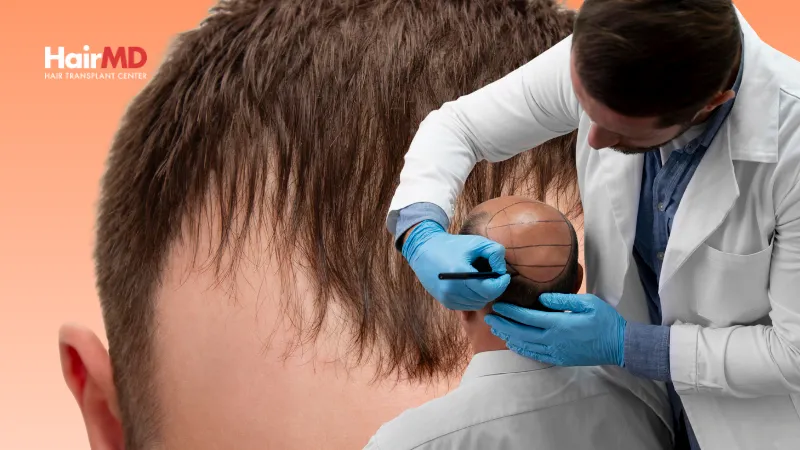
Noticing excessive hair shedding or a receding hairline can cause understandable concern. Many men quickly search for answers, wondering if their hair loss is temporary or the beginning of a permanent condition.
A common question that arises is exactly how doctors measure male pattern baldness to provide an accurate diagnosis. Understanding this clinical process can demystify your visit to the dermatologist and give you confidence in the treatment plan.
This article explains the medical methods used to assess hair loss, the underlying causes, and the targeted treatments available to restore your hair. You will learn what to expect during a professional consultation and how to take proactive steps towards maintaining your hair health.
Doctors measure male pattern baldness through a combination of visual examinations using the Norwood Scale, detailed medical history reviews, and advanced diagnostic tools like a scalp hair density test (trichoscopy). These methods help determine the severity of follicular miniaturisation and guide the appropriate treatment plan.
What’s covered in the article?
- Quick Summary
- Understanding Male Patter
- The Causes and Contributing Factors of Hair Loss
- Symptoms and Early Warning Signs
- The Diagnosis Process: How Doctors Measure Male Pattern Baldness
- Finding a Dermatologist Hair Loss Check in Pune
- Available Treatment Options in Pune
- how to Prevent Hair Loss and Maintain Healthy Hair?
- Expected Results and Recovery Timeline
- Frequently Asked Questions
- Conclusion
Quick Summary
-
- The Basics: What male pattern baldness is and why it happens.
- The Signs: How to spot the early warnings of genetic hair loss.
- The Diagnosis: The specific tools and scales dermatologists use to measure baldness.
- The Solutions: Effective medical and surgical treatments available.
- Local Expertise: Where to find a trusted dermatologist hair loss check in Pune.
Understanding Male Pattern Baldness
Male pattern baldness, medically termed androgenetic alopecia, is the most common cause of hair loss in men. It is a genetically inherited condition that follows a highly predictable pattern. The process typically begins above the temples, creating a characteristic “M” shape, before progressing to thinning at the crown. Over time, these balding areas may merge, leaving only a horseshoe-shaped ring of hair around the sides and back of the head.
This condition occurs due to a genetic sensitivity to a hormone called dihydrotestosterone (DHT). When DHT binds to the androgen receptors in the hair follicles, it triggers a process known as follicular miniaturisation. The affected follicles gradually shrink, producing thinner, shorter, and less pigmented hair with each growth cycle. Eventually, the follicles may stop producing hair entirely.
It is important to recognise that male pattern baldness is a natural biological process for many men, not a disease. However, the psychological impact can be profound, affecting self-confidence and personal well-being. Acknowledging the condition early allows for much more effective intervention and management.
Causes and Contributing Factors of Hair Loss
While genetics are the primary driver, understanding the full scope of contributing factors provides a clearer picture of male pattern baldness.
Genetic Predisposition
Your family history is the strongest predictor of whether you will experience androgenetic alopecia. You can inherit the baldness genes from either your mother’s or your father’s side of the family. If multiple male relatives have experienced significant hair thinning, your chances of developing the condition are considerably higher. These genes dictate how sensitive your hair follicles are to circulating androgens.
Hormonal Influences
The conversion of testosterone into DHT by the enzyme 5-alpha reductase is the central hormonal mechanism behind this type of hair loss. DHT shortens the active growth phase (anagen phase) of the hair cycle. While the resting phase (telogen phase) remains the same or lengthens, the new hairs that grow back are progressively weaker. It is the sensitivity to DHT, rather than an excess of testosterone, that causes the issue.
Age and Time
Age is an unavoidable contributing factor. The longer your genetically sensitive follicles are exposed to DHT, the more pronounced the miniaturisation process becomes. While some men notice thinning in their late teens or early twenties, the prevalence of male pattern baldness increases steadily with each decade of life.
Secondary Factors
While not the root cause of male pattern baldness, certain lifestyle factors can accelerate shedding. Severe stress can trigger telogen effluvium, pushing more hairs into the resting phase. Nutritional deficiencies, particularly a lack of iron, zinc, or protein, can weaken the hair shaft. Managing these secondary factors is crucial for overall hair health, even if it does not cure genetic baldness.
Symptoms and Early Warning Signs
Identifying the signs of male pattern baldness early gives you the best chance of preserving your existing hair. The changes are often gradual, making them easy to miss if you are not paying close attention.
The most classic early sign is a receding hairline. You might notice the hair at your temples thinning or shifting backwards. Comparing a current photograph to one from a few years ago can often highlight this recession clearly.
Another early indicator is thinning at the vertex or crown of the head. This often begins as a small, diffuse patch of lower hair density that gradually widens. You may also notice your hair feeling generally thinner or less voluminous when washing or styling it.
An increase in daily hair shedding can also be a warning sign. While losing 50 to 100 hairs a day is normal, finding excessive amounts of hair on your pillow, in the shower drain, or on your clothes warrants a closer inspection. Furthermore, if the hairs that fall out appear finer and shorter than usual, this points directly to follicular miniaturisation.
The Diagnosis Process: How Doctors Measure Male Pattern Baldness
If you suspect you are losing your hair, consulting a medical professional is essential. You might wonder exactly how doctors measure male pattern baldness to distinguish it from other conditions. Dermatologists use a combination of visual assessment, patient history, and technological tools to provide a precise diagnosis.
Comprehensive Medical History
The consultation begins with a detailed discussion of your health. The doctor will ask when you first noticed the hair loss, how rapidly it has progressed, and whether you have a family history of baldness. They will also inquire about your diet, stress levels, recent illnesses, and any medications you are taking to rule out non-genetic causes of shedding.
The Norwood Scale Classification
To standardise the measurement of hair loss, doctors rely heavily on the Norwood Scale (or Norwood-Hamilton Scale). This visual guide classifies male pattern baldness into seven distinct stages.
Stage 1 represents a normal, un-receded hairline, while Stage 7 represents the most severe form of hair loss, with only a narrow band of hair remaining at the back and sides. By matching your hair loss pattern to this scale, the doctor can accurately measure the progression and recommend stage-appropriate treatments.
Scalp Hair Density Test and Trichoscopy
A visual exam with the naked eye is often not enough. To get a microscopic view of the scalp, a doctor will perform a scalp hair density test using a tool called a dermatoscope. This technique, known as trichoscopy, magnifies the hair follicles and scalp tissue.
It allows the doctor to clearly see the variation in hair shaft diameter, which is the hallmark of miniaturisation. Trichoscopy can accurately measure the ratio of healthy terminal hairs to fine, vellus-like hairs, providing a definitive diagnosis of androgenetic alopecia.
Blood Tests and Additional Diagnostics
In straightforward cases of male pattern baldness, blood tests are rarely necessary. However, if your hair loss pattern is atypical, or if the doctor suspects a co-existing condition, they may order blood work.
These tests can check for thyroid dysfunction, vitamin deficiencies, or autoimmune markers. In very rare and complex cases, a small scalp biopsy might be taken to rule out scarring alopecia or other inflammatory scalp disorders.
Finding a Dermatologist Hair Loss Check in Pune
When dealing with hair loss, seeking advice from a qualified specialist is crucial. If you are looking for an accurate diagnosis, scheduling a dermatologist hair loss check in Pune is your best first step. The city boasts excellent medical infrastructure with highly trained professionals who specialise in trichology and dermatology.
For those seeking exceptional care, HairMD Clinic Pune is a leading destination for hair restoration. Under the expert guidance of Dr. Dhanraj Chavan, an esteemed Hair Specialist in Pune, the clinic offers comprehensive diagnostic services and advanced treatment plans. Dr. Chavan and his team utilise state-of-the-art diagnostic tools, including precise scalp hair density tests, to accurately assess your condition.
The clinic is conveniently located at Unit No. 403/404, 4th floor, Ganeesham ll Govind Yashada Chowk, Phase 1, Empire Estate, Nashik Hwy, Sai Nagar Park, Pimple Saudagar, Pune, Pimpri-Chinchwad, Maharashtra 411027, Call- 9584584111 to book your appointment or visit www.hairmdindia.com for more information.
You can visit HairMD Clinic Pune to receive a customised treatment plan tailored to your specific stage of hair loss. Their approach combines medical expertise with compassionate patient care, ensuring you understand every step of your diagnosis and treatment journey.
Ready to take control of your hair loss? Book your consultation today at HairMD Clinic Pune and let Dr. Dhanraj Chavan design a personalised restoration plan for you
Available Treatment Options in Pune
Once a diagnosis is confirmed, your dermatologist will discuss the various treatment options available. Modern medicine offers highly effective ways to halt hair loss and encourage regrowth.
Medical Therapies
For early to moderate stages of male pattern baldness, medical treatments are usually the first line of defence.
- Topical Minoxidil: Applied directly to the scalp, this solution stimulates blood flow to the follicles and extends the hair growth phase. It is highly effective at slowing down hair loss and can promote new growth.
- Oral Finasteride: This prescription medication inhibits the 5-alpha reductase enzyme, significantly lowering DHT levels in the scalp. It is one of the most effective treatments for halting the progression of genetic hair loss.
Advanced Non-Surgical Treatments
Clinics in Pune also offer advanced therapies to boost hair follicle health and stimulate growth.
- Platelet-Rich Plasma (PRP) Therapy: This treatment involves drawing your blood, isolating the growth factor-rich platelets, and injecting them into the thinning areas of your scalp. PRP for hair helps rejuvenate dormant follicles and increases hair thickness.
- Low-Level Laser Therapy (LLLT): Using red light energy, this non-invasive treatment stimulates cellular activity within the hair follicles, promoting healthier and thicker hair growth over time.
Surgical Hair Restoration
For advanced stages of baldness, surgical intervention offers a permanent solution.
- Hair Transplantation (FUE and FUT): Skilled surgeons extract healthy, DHT-resistant hair follicles from the back of the scalp and meticulously implant them into the balding areas. Pune is home to exceptional clinics that perform these procedures with natural-looking, permanent results.
How to Prevent Hair Loss and Maintain Healthy Hair?
While you cannot rewrite your genetics, you can adopt habits that support a healthy scalp and maximise the effectiveness of your treatments.
First, maintain a balanced, nutrient-rich diet. Ensure you consume adequate amounts of protein, iron, zinc, and vitamins A, C, and E. These nutrients are the building blocks of healthy hair. Stay hydrated and try to manage daily stress through exercise or mindfulness, as chronic stress can exacerbate hair shedding.
Be gentle with your hair. Avoid harsh chemical treatments, excessive heat styling, and aggressive brushing. Use a mild, volumising shampoo that cleanses the scalp without stripping its natural oils. Regular, gentle scalp massages can also help improve blood circulation to the follicles.
Most importantly, consistency is vital. Whether you are using topical treatments, taking oral medications, or undergoing PRP therapy, adhering strictly to your doctor’s protocol is the only way to achieve and maintain results.
Expected Results and Recovery Timeline
Setting realistic expectations is a crucial part of the hair restoration journey. Hair grows slowly, and treatments take time to show visible changes.
If you start medical treatments like Minoxidil or Finasteride, you might initially experience a slight increase in shedding. This is normal and indicates that old resting hairs are being pushed out by new anagen hairs. Visible improvements in hair density usually take between four to six months, with peak results appearing after a year of consistent use.
For PRP therapy, patients typically undergo an initial series of three to four sessions. Noticeable improvements in hair thickness and a reduction in shedding are often seen within three to six months. Maintenance sessions are required to sustain the benefits.
If you opt for a hair transplant, the recovery is relatively quick. The transplanted hairs will fall out within the first month—a normal phase called shock loss. However, the follicles remain secure beneath the skin. New, permanent hair growth will begin around the third or fourth month, with the final, fully matured results visible twelve to eighteen months post-surgery.
Do not wait until your hair loss becomes advanced. Consult a qualified professional today to start your journey towards a fuller head of hair.
Ready to take the first step towards correcting your hair transplant?
Book a private consultation at HairMD in Pune or Pimpri Chinchwad. Let’s discuss your case and build a strategy to achieve the natural result you always wanted.
Frequently Asked Questions
- Is a scalp hair density test painful?
No, a scalp hair density test, or trichoscopy, is completely painless and non-invasive. It simply involves the doctor placing a specialised magnifying device against your scalp to take close-up images of your hair follicles. - Can doctors measure male pattern baldness before it becomes visible to the naked eye?
Yes. Using a dermatoscope, doctors can detect early signs of follicular miniaturisation long before you notice significant thinning or a receding hairline in the mirror. Early detection allows for the most successful treatment outcomes. - Will my hair grow back if I start treatment early?
Treatments like Minoxidil and Finasteride are most effective at halting further hair loss and thickening miniaturised hairs. While they can stimulate some regrowth in dormant follicles, they cannot bring dead follicles back to life. Starting treatment early preserves the hair you currently have. - How long does a dermatologist consultation for hair loss take?
A typical initial consultation takes about 30 to 45 minutes. This allows enough time for the doctor to take a full medical history, examine your scalp, perform a density test, and discuss a tailored treatment plan with you.
DO YOU KNOW?
Nearly 250 Patients Visit HairMD
Everyday For Various Hair Concerns
(20+ Years Of Expertise. 4157+ Successful Hair Transplant at HairMD)
Meet Our Dermatologists




Conclusion
Understanding how doctors measure male pattern baldness is the first step towards demystifying the condition and taking proactive control of your hair health. By utilising detailed medical histories, the Norwood Scale, and precise diagnostic tools like the scalp hair density test, specialists can provide an accurate assessment of your hair loss. Armed with this knowledge, you can confidently explore the highly effective medical and surgical treatments available today.
Remember, androgenetic alopecia is a progressive condition. The earlier you seek a professional diagnosis, the more options you will have to preserve and restore your hair. Do not let hair loss diminish your confidence. Seek expert advice, stick to your prescribed management strategies, and invest in the health of your scalp for long-term results.
If you are experiencing the early signs of thinning, we highly recommend seeking a professional evaluation. Reach out to a certified specialist, such as those at HairMD Clinic Pune, to discuss your concerns and find a treatment path that works for you.
For expert care and personalized advice in Pune, you can visit our clinic at:
Unit No. 403/404, 4th floor, Ganeesham ll Govind Yashada Chowk, Phase 1, Empire Estate, Nashik Hwy, Sai Nagar Park, Pimple Saudagar, Pune, Pimpri-Chinchwad, Maharashtra 411027
Phone: 9584584111
Wed-Monday(Tue:off):10.30 AM to 7.30 PM
Feel free to call us or book your appointment online to schedule a thorough hair loss evaluation and receive expert recommendations tailored to your needs. Taking the first step can make all the difference in regaining your hair confidence.
Further Reading
Is Rosemary Oil Enough for Hair Regrowth? When to Consider Something Stronger
Six months of rosemary oil and still losing hair? HairMD dermatologists explain when rosemary oil works, when it is not enough, and what to try next.
Redensyl vs Minoxidil vs GFC for Hair Loss: Which One Is Right for You?
Redensyl, minoxidil, or GFC therapy for hair loss? HairMD Pune dermatologists explain how each works, who each is for, and how to choose.
Dermapen Scalp Microneedling Results in Pune
Real HairMD Pune patient results from Dermapen scalp microneedling for hair – what to expect, sessions, and before and after outcomes.
Fotona & LLLT Laser Hair Cost in Pune 2026
Fotona and LLLT laser hair treatment cost in Pune 2026 – per-session pricing, packages, and what affects the cost at HairMD Pune.
Have thoughts? Please let us know
We are committed not only to treating you, but also educating you.