

FUE Hair Transplant vs PRP Therapy: Which Should You Choose in Pune?


Written by HairMD Content Team | Medically Reviewed by Dr. Dhanraj Chavan On March 05, 2026


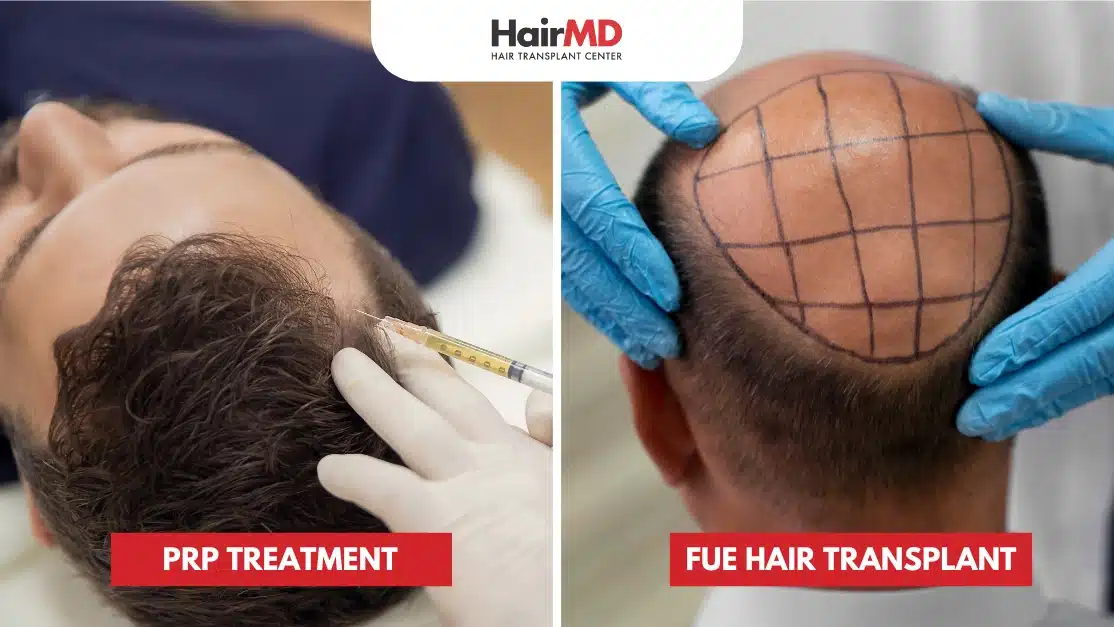
“Doctor, should I get a hair transplant or try PRP first?”
At HairMD India, this is one of the most common questions we hear in consultations – and it’s a great question to ask. Both FUE hair transplant and PRP therapy are clinically proven treatments for hair loss. But they work in completely different ways, suit different stages of hair loss, and lead to very different outcomes.
There is no one-size-fits-all solution. The best choice depends on your Norwood stage, how long your hair loss has been progressing, and what your end goal looks like. This article gives you a clear, neutral decision framework so you can walk into your consultation already informed.
What’s covered in the article?
- Key Takeaways
- What Is FUE Hair Transplant?
- What Is PRP Therapy?
- FUE vs PRP – Side-by-Side Comparison
- Choose PRP If…
- Choose FUE If…
- Consider Both If…
- Quick Self-Assessment: Which Treatment Fits You?
- How HairMD Pune Decides Which Treatment You Need
- Frequently Asked Questions
- The Bottom Line
Key Takeaways
- PRP therapy is best for early-stage hair loss (Norwood 1-3) where follicles are weakening but still active
- FUE hair transplant is indicated for advanced or stable hair loss (Norwood 3-6) with defined bald areas
- FUE is a one-time surgical procedure with permanent results; PRP requires ongoing sessions to maintain
- Both can be combined – PRP after FUE is a well-documented protocol that improves graft survival and speeds up recovery
What Is FUE Hair Transplant?
How FUE Works?
FUE (Follicular Unit Extraction) is a surgical hair restoration procedure. Individual hair follicles are extracted one by one from the donor area – typically the back and sides of the scalp – using a micro-punch instrument. These follicles are then implanted into balding or thinning zones.
Procedure: Takes 6-8 hours, usually under local anaesthesia.
Recovery: Most patients experience mild soreness for 3-5 days; 7-10 days before returning to normal activity.
Costs: ₹60,000 to ₹2,50,000, depending on the number of grafts required.
Pros: Permanent results with DHT-resistant transplanted follicles. Excellent for covering large bald areas or advanced hair loss.
The transplanted follicles are genetically DHT-resistant. This means they retain their original characteristics in their new location and continue to grow permanently. At HairMD India, FUE procedures are performed by Dr. Sachin Pawar, who has 20+ years of experience and has completed over 2,500 hair transplant surgeries with an exclusive focus on hair restoration since 2016.
Who Is FUE Designed For?
FUE works best for people who have reached a stage where hair loss is visible, defined, and relatively stable. The ideal candidate has:
- Norwood stage 3 to 6 with clear bald patches
- Hair loss that has been stable for at least 1-2 years
- An adequate donor area with healthy follicles for extraction
- Realistic expectations about coverage and density outcomes
Both men and women with male patterns or female androgenetic alopecia can be candidates, subject to a scalp assessment.

What Is PRP Therapy?
How PRP Works?
PRP (Platelet-Rich Plasma) therapy is a non-surgical treatment that uses your own blood to stimulate hair follicles. 32 ml of blood is drawn, processed in a centrifuge to concentrate the platelets, and then injected into areas of the scalp experiencing thinning or early hair loss.
The concentrated growth factors in PRP – including PDGF, VEGF, and IGF-1 – stimulate dormant or weakening follicles to re-enter an active growth phase. PRP does not create new follicles where none exist. It strengthens and reactivates follicles that are still present but underperforming.
At HairMD India, we use a double-spin centrifuge protocol to achieve optimal platelet concentration for each session.
Procedure: Takes about 45-60 minutes per session.
Recovery: No downtime – patients can return to normal activity the same day.
Costs: ₹8,000 to ₹13,000 per session, with an initial course of 6 sessions and maintenance every 4-6 months.
Who Is PRP Designed For?
PRP is most effective when follicles are still alive but struggling. The ideal PRP candidate has:
- Norwood stage 1 to 3 with diffuse thinning or a receding hairline
- Hair loss that is still progressing or was noticed relatively recently
- No large defined bald patches where follicles are completely gone
- A preference for a non-surgical starting point
PRP is also commonly used as a supportive treatment post-transplant recovery.

FUE vs PRP – Side-by-Side Comparison
|
Attribute |
FUE Hair Transplant |
PRP Therapy |
|
Treatment type |
Surgical procedure |
Non-surgical injection |
|
Ideal Norwood stage |
3 to 6 |
1 to 3 |
|
Sessions required |
One (occasionally a second session) |
6 sessions initially; maintenance every 4-6 months |
|
Procedure time |
6-8 hours per session |
45-60 minutes per session |
|
Downtime |
7-10 days (avoid strenuous activity) |
None – return to normal activity same day |
|
Results timeline |
Visible growth from 6 months; full results at 12-18 months |
Noticeable improvement from 3-6 months |
|
Permanence |
Permanent – transplanted hair is DHT-resistant |
Maintenance sessions required every 4-6 months |
|
Pain/discomfort |
No pain during procedure (local anaesthesia administered beforehand); mild soreness for 3-5 days post-surgery |
Minimal discomfort from scalp injections; numbing cream applied |
|
Approximate cost (Pune) |
₹60,000 – ₹2,50,000+ depending on graft count |
₹8,000 – ₹13,000 per session |
|
Addresses dead follicles? |
Yes – replaces them with healthy grafts |
No – works only on living but weakened follicles |
|
Best combined with |
PRP post-procedure for faster recovery |
Minoxidil, finasteride, or as a pre-FUE intervention |
Choose PRP If…
Your Hair Loss Is in the Early Stages
PRP therapy delivers its strongest results when follicles are still present but weakening – typically Norwood stages 1, 2, or early 3. At this stage, the follicles haven’t died; they’ve miniaturised. PRP’s growth factors can reverse that miniaturisation and push follicles back into the active growth phase.
A study found that 93.3% of patients reported their hair loss completely stopped as early as two months of treatment, with two-thirds reporting an increase in hair growth. These outcomes are most reliable when treatment starts before significant follicle loss has occurred.
If you’re noticing a receding hairline, thinning at the crown, or general diffuse thinning – but still have good overall hair coverage – PRP is likely where you should start.
Check the baldness condition page for a visual guide to Norwood stages, and the American Academy of Dermatology’s overview of hair loss for a clinically validated description of androgenetic alopecia progression.
You Want a Non-Surgical Starting Point
PRP has no downtime. Sessions take under an hour, and you can return to work the same day. There are no incisions, no stitches, and no recovery period to manage. For people who are not yet ready for a surgical procedure or who are monitoring whether their hair loss stabilises, PRP is an effective, low-commitment entry point.
It also buys time. Starting PRP early can slow or pause progression, which gives you more options – including preserving a better donor area if FUE becomes necessary later.
You Want to Combine It With Medication
PRP pairs well with oral and topical medications for hair loss. Clinical evidence supports combining PRP with minoxidil and finasteride for enhanced outcomes in androgenetic alopecia. This multi-modal approach – treating the same problem from different angles – is a common protocol at HairMD for patients in early to mid stages of loss.
Choose FUE If…
You Have Advanced or Stable Hair Loss
Once hair loss reaches Norwood 4, 5, or 6, large areas of the scalp have lost follicles entirely. PRP cannot help here – there is nothing left to stimulate. FUE physically moves healthy, permanent follicles from your donor area into these zones, restoring coverage that cannot come back any other way.
Hair loss that has been stable for 1-2 years is ideal for FUE planning. Stability means the pattern is predictable enough to design the transplant correctly, ensuring the result still looks natural as you age.
You Want a Permanent, One-Time Solution
Transplanted grafts are permanent. The follicles moved during FUE come from the DHT-resistant donor zone at the back of the scalp – they retain this resistance after transplantation. They will not fall out due to androgenetic alopecia.
This is the fundamental difference between FUE and every non-surgical treatment: FUE resolves the problem in the transplanted area permanently. PRP, medications, and other therapies manage an ongoing condition. A study found over 90% of transplanted hairs survived at 12 months, with more than 85% of patients achieving 95% or higher survival rates.
If you are looking for a one-time intervention with lasting results, FUE – performed by an experienced surgeon with a strong track record – is the appropriate choice. See hair transplant results at HairMD from patients with a range of Norwood stages.
You’ve Already Tried Non-Surgical Options Without Success
For patients who have completed a proper course of PRP and medical therapy but continue to see progression, FUE becomes the logical next step. This is especially true when the donor area remains healthy and graft count is adequate to achieve meaningful coverage. The question at that point shifts from “should I get a transplant?” to “am I a good surgical candidate?” – which a trichoscopy assessment at HairMD can answer.
Consider Both If…
You’re Planning FUE and Want a Faster Recovery
PRP used alongside FUE is a well-established combination protocol with strong clinical backing. In a study, 100% of patients in the PRP-treated group had multiple grafts erupting at 3 months post-transplant, compared to only 60% in the non-PRP group – a statistically significant difference.
PRP also reduces post-procedure redness and speeds up the recovery of the recipient area. A review confirms that adding PRP to transplant procedures is associated with improved outcomes, including increased hair density and enhanced follicle survival. At HairMD, PRP sessions are commonly recommended at 1 month and 3 months after FUE to support graft establishment and activate surrounding dormant follicles. Read PRP patient reviews at HairMD to understand real patient experiences.
You’re in Early Loss but Want to Preserve Your Options
Some patients are at Norwood 2-3 with progressive loss – too early for FUE to be the right first step, but clearly heading toward a stage where it will be needed. In this case, starting PRP now serves two purposes: it may slow progression and reduce how many grafts are eventually needed, and it helps maintain the quality of the donor area.
Dr. Sachin Pawar at HairMD frequently recommends this phased approach – begin with PRP and medical therapy, monitor the trajectory, and introduce FUE at the right stage rather than too early. Mesotherapy and GFC therapy are also options worth considering alongside PRP in this phase.
Quick Self-Assessment: Which Treatment Fits You?
Work through these five questions. Your answers will point you toward a starting position – though a proper diagnosis at HairMD will always be more accurate than any self-assessment.
1. How long have you been losing hair?
Less than 2 years → Lean toward PRP first
2 or more years with visible progression → FUE consultation worthwhile
2. Do you have defined bald patches or general thinning?
General thinning across scalp → PRP is likely your starting point
Defined bald areas with no hair → FUE is likely needed
3. Have you tried any medical treatment (minoxidil, finasteride, PRP) before?
No → Start with non-surgical options and monitor
Yes, with limited results → FUE candidacy assessment is the next step
4. What is your primary goal?
Slow further loss and maintain what I have → PRP + medication protocol
Restore coverage I’ve already lost → FUE
5. Are you open to a surgical procedure?
Not right now → PRP and medical therapy to start
Yes, if I’m a good candidate → Book a FUE candidacy assessment
If you answered mostly “PRP”: Book a PRP consultation at HairMD to start with a scalp analysis and treatment plan. If you answered mostly “FUE”: Book a hair transplant consultation with Dr. Sachin Pawar for a trichoscopy and candidacy assessment. If your answers were mixed: A combination consultation will help map out a phased treatment plan.
How HairMD Pune Decides Which Treatment You Need
At HairMD India, no treatment decision is made without a proper scalp assessment. The first consultation includes trichoscopy – a digital scalp imaging technique that evaluates follicle density, miniaturisation ratio, scalp health, and donor area quality. This data, combined with your hair loss history, gives a clear picture of where you are on the Norwood scale and what your options genuinely are.
Dr. Sachin Pawar’s approach is explicit: the right treatment is the one matched to your stage – not the one that happens to suit a particular session slot or promotional package. For some patients, that means PRP. For others, FUE immediately. For many, a phased plan that starts with PRP and transitions to FUE when the timing is right.
HairMD operates across 6 centres in Pune – Pune Station, Pimple Saudagar, Kharadi, Prabhat Road, Baner, and NIBM – so the clinic closest to you can handle everything from initial assessment to ongoing treatment.
Frequently Asked Questions
Can PRP replace a hair transplant?
No. PRP and FUE hair transplant address hair loss at different stages and through completely different mechanisms. PRP stimulates existing but weakened follicles – it cannot restore hair in areas where follicles are completely gone. FUE physically relocates permanent follicles from the donor area into bald zones, creating coverage that PRP cannot.
If you are at Norwood 1-3 with thinning but no significant bald patches, PRP may be sufficient for now. If you have defined bald areas at Norwood 4 or above, PRP alone will not restore coverage – a transplant assessment is required. For some patients, PRP works effectively as a long-term management tool without ever needing surgery. The right answer depends on your individual stage and goals, which is why a trichoscopy assessment at HairMD is the most reliable starting point.
What Norwood scale stage qualifies for FUE at HairMD?
FUE hair transplant at HairMD is typically recommended for patients at Norwood stage 3 and above who have a stable donor area with adequate graft availability. Dr. Sachin Pawar evaluates each patient individually through trichoscopy before confirming candidacy.
Norwood stage alone is not the only factor – the quality and density of the donor area, the extent of coverage needed, and whether hair loss has stabilised are equally important variables. Some patients at Norwood 3 may benefit from PRP first, while others at the same stage may be ready for FUE immediately.
Is PRP effective for male pattern baldness?
Yes, PRP is clinically effective for male pattern baldness – particularly in the early stages. A study of 30 male patients found that 93.3% reported hair loss completely stopped within two months of starting PRP treatment, with two-thirds also noticing increased hair growth. PRP works by delivering concentrated growth factors directly to miniaturising follicles, which can reverse the early stages of androgenetic alopecia.
However, its effectiveness depends heavily on starting treatment while follicles are still active. PRP is not effective for restoring hair in completely bald areas. It is most powerful as an early intervention and as a maintenance therapy alongside other treatments.
Can I do PRP after my FUE hair transplant?
Yes – and at HairMD, this is a commonly recommended protocol. PRP sessions after FUE support graft survival, reduce post-procedure inflammation, and speed up the activation of transplanted follicles. Clinical research confirms significant benefits: patients who received PRP during and after their FUE transplant showed faster increases in hair density, better skin recovery at the recipient site, and increased activation of dormant follicles.
The typical schedule at HairMD is PRP sessions at approximately 1 month and 3 months post-FUE, though this is adjusted based on individual recovery and response.
How long do PRP results last compared to FUE?
FUE results are permanent for the transplanted area. The relocated follicles are DHT-resistant and will continue to grow for life – they do not fall out due to androgenetic alopecia. However, FUE does not stop natural hair loss in non-transplanted areas, which is why medical therapy is often continued alongside.
PRP results are not permanent. Most patients maintain good outcomes with sessions every 4-6 months after completing the initial course of 6 sessions. Stopping PRP entirely typically results in gradual return of hair thinning over 6-12 months, because the underlying androgenetic alopecia continues to progress. PRP manages the condition rather than resolving it.
Which is more painful – FUE or PRP?
Both procedures involve local anaesthesia or numbing agents, so neither should be significantly painful during the procedure itself. FUE is performed under local anaesthesia, and patients typically report mild soreness after surgery.
Most patients describe a mild pricking sensation with PRP, and any discomfort resolves within a few hours. Both are well-tolerated outpatient procedures.
What is the cost difference between FUE and PRP in Pune?
FUE hair transplant in Pune typically ranges from ₹60,000 to ₹2,50,000 or more, depending on the number of grafts required and the extent of the area to be covered. This is a one-time cost for a permanent result.
PRP therapy at HairMD typically costs ₹8,000 to ₹13,000 per session. The initial course involves 6 sessions, after which maintenance sessions are needed every 4-6 months indefinitely to sustain results. Over a 2-year period, ongoing PRP can represent a significant cumulative investment. For a detailed breakdown of PRP pricing, packages, and EMI options, see the PRP Therapy Cost Guide for Pune 2026. A consultation at HairMD will give you an accurate cost estimate based on your specific requirements.
How do I know which treatment is right for me?
The most reliable way to know is a trichoscopy assessment at HairMD, which evaluates your Norwood stage, follicle density, miniaturisation ratio, and donor area health. Self-assessment can give you a useful starting point – see the decision framework in this article – but the correct treatment decision requires clinical data.
Factors like how long your hair loss has been active, whether it has stabilised, your age, your goals, and your overall health all influence the recommendation. Book a consultation at HairMD Pune and come with your questions – the team will give you a clear, honest recommendation based on what your scalp actually shows, not what you think you might want to hear.
DO YOU KNOW?
Nearly 250 Patients Visit HairMD
Everyday For Various Hair Concerns
(15+ Years Of Expertise. 4157+ Successful Hair Transplant)
Meet Our Dermatologists

The Bottom Line
FUE and PRP are not competing treatments – they solve different problems at different stages of hair loss. PRP is the right starting point when follicles are weakening but still present. FUE is the right choice when bald areas need permanent restoration. And for many patients, a phased approach that uses both – PRP now, FUE when the time is right – is the smartest path.
The decision should be based on your Norwood stage, your goals, and a clinical assessment of your scalp. Not on what your friend had done, not on what costs less upfront, and not on what you read in a forum.
HairMD India offers consultations across 6 Pune centres – Pune Station, Pimple Saudagar, Kharadi, Prabhat Road, Baner, and NIBM – with trichoscopy assessment, Dr. Sachin Pawar’s expertise in FUE, and a full range of non-surgical options including PRP, mesotherapy, Low Level Laser Light Therapy, and Dermapen Microneedling.
Further Reading
Does Cold Water Really Help Your Hair? Separating Fact From Myth
You’ve heard that rinsing with cold water makes hair shinier and stronger.
What Should I Do About Dandruff and Scalp Issues?
Dandruff, seborrheic dermatitis, scalp psoriasis, and dry scalp, they look similar but need different treatments. HairMD dermatologists explain how to identify each and what actually works.
Does Heat Damage Really Ruin Your Hair? The Science Explained
Yes, heat damage is real, and mostly permanent. HairMD explains exactly how heat ruins hair at the structural level, at what temperatures damage occurs, and how to minimise it without giving up styling.
How to Get Healthier Hair Without Expensive Treatments?
You don’t need expensive salon treatments for healthier hair. HairMD dermatologists explain what actually improves hair health, from diet and scalp care to habits that protect hair from daily damage.
Have thoughts? Please let us know
We are committed not only to treating you, but also educating you.