

Does Heat Damage Really Ruin Your Hair? The Science Explained


Written by HairMD Content Team | Medically Reviewed by Dr. Dhanraj Chavan On August 28, 2026


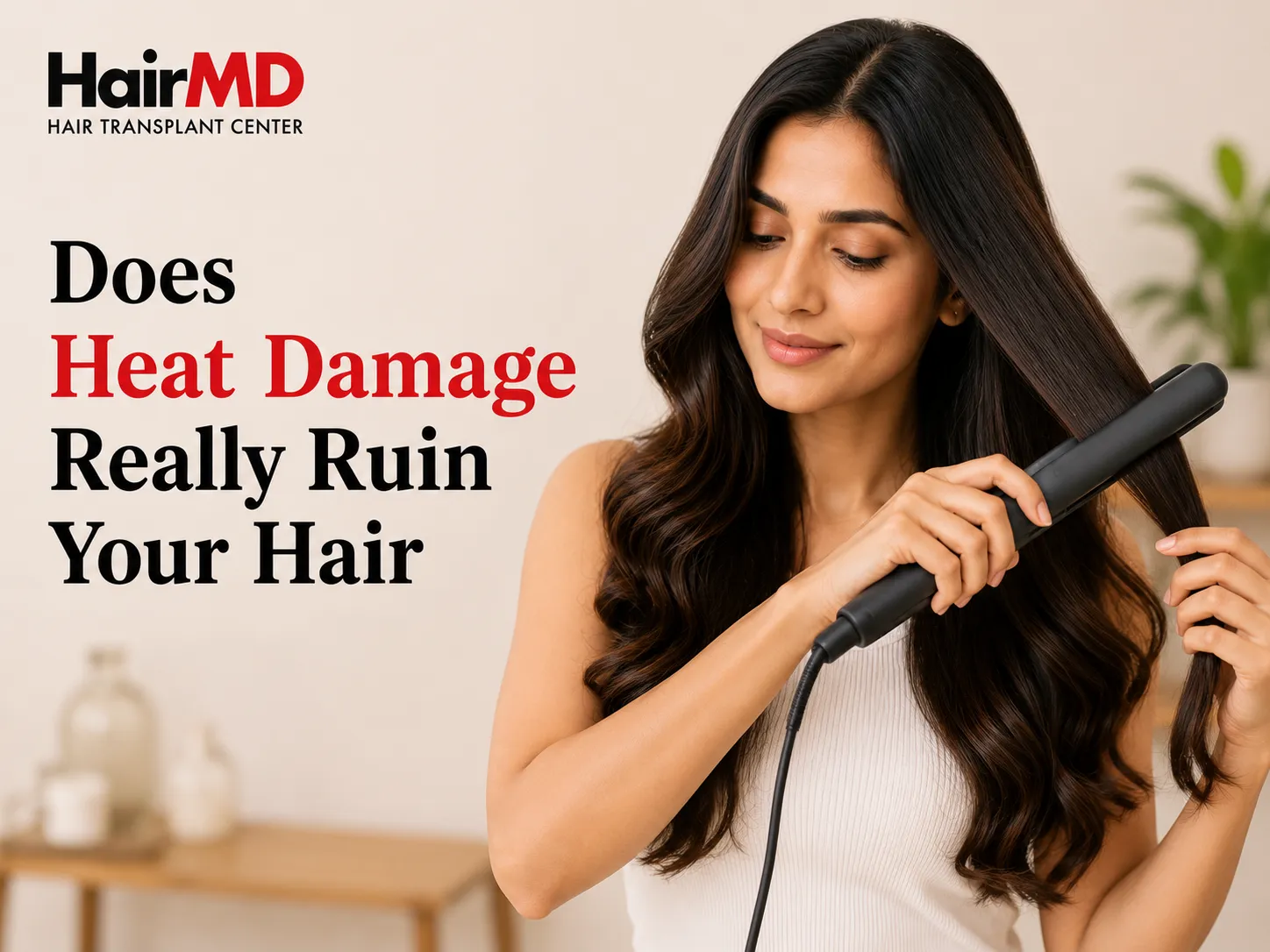
Regular use of straighteners, curling irons, and blow dryers can gradually weaken the hair shaft. Understanding how heat damages hair and how to protect it can help reduce breakage, dryness, frizz, and long-term hair damage..
Few hair questions generate more confusion than this one. Stylists say high heat is unavoidable. Product labels claim their formula “repairs” heat damage. Home remedies promise to reverse it with coconut oil.
Here is what is actually true: heat damage is real, it is cumulative, and once it has occurred in the hair shaft, it cannot be fully reversed, only cut off.
But this doesn’t mean you must give up heat styling. It means understanding what temperature does to hair structure, at what thresholds damage occurs, and what protective measures actually work, so you can make informed decisions about how you use heat tools.
Does heat damage really ruin your hair?
Yes, repeated heat exposure above ~150°C without protection causes permanent structural changes to the hair shaft: the keratin proteins denature (unfold irreversibly), the cuticle cells lift and crack, and the disulphide bonds that give hair its strength are disrupted. This results in increased porosity, dullness, frizz, brittleness, and breakage. The damage accumulates over multiple heat exposures, a single session rarely causes dramatic visible damage, but months of daily high-heat styling without protection produces significantly compromised hair. Heat protectants reduce the rate of damage but do not eliminate it entirely. The only complete reversal of heat-damaged hair is to cut the damaged section and grow new hair.
Summary
- Hair begins to show structural damage at approximately 150°C sustained exposure; significant protein denaturation occurs above 175–200°C.
- The cuticle (outer protective layer) is damaged first, once the cuticle is disrupted, the inner cortex is exposed to moisture loss, friction, and further heat penetration.
- Hair is most heat-vulnerable when wet: applying high heat to damp or wet hair causes rapid steam formation inside the hair shaft (the “bubble” or hygral fatigue effect), causing internal voids and severe structural damage.
- Heat protectant sprays and serums genuinely reduce damage by creating a thermal barrier and reducing friction, but they do not protect indefinitely at very high temperatures.
- Split ends and heat-damaged sections cannot be repaired, the keratin protein bonds that have denatured do not re-form under normal conditions. Trimming is the only solution.
- The best approach is the lowest effective temperature combined with heat protectant, limiting heat frequency, and ensuring hair is fully dry before any heat styling.
What’s covered in the article?
- What Heat Actually Does to Hair?
- Signs Your Hair Has Heat Damage
- Can Heat Damage Be Reversed?
- Heat Protectants: What They Actually Do?
- Practical Heat Styling Guide: Minimising Damage
- Heat Damage and Hair Loss: Clearing Up the Confusion
- Frequently Asked Questions
- Conclusion
What Heat Actually Does to Hair?
Hair is structurally complex. Understanding what heat does requires knowing the three main layers:
Cuticle: The outermost layer, overlapping, scale-like cells (like roof tiles) that protect the inner hair. When healthy and flat, the cuticle reflects light (shine) and retains moisture. Heat causes the cuticle scales to lift and eventually crack or chip away.
Cortex: The main bulk of the hair shaft, made of parallel keratin protein chains cross-linked by disulphide bonds. The cortex gives hair its strength, elasticity, and natural curl pattern. Heat disrupts the disulphide bonds (permanently when excessive) and denatures the keratin proteins.
Medulla: The innermost core, present in coarser hair. Less relevant to heat damage discussion.
What happens at each temperature:
|
Temperature |
What Happens to Hair |
Visible Result |
|
Below 100°C |
Safe, water evaporation, no structural change |
Normal dry styling |
|
100–130°C |
Cuticle begins to lift slightly; acceptable with protectant |
Minimal risk |
|
130–150°C |
Moderate cuticle disruption; early protein stress |
Some increased porosity |
|
150–175°C |
Significant cuticle damage; early protein denaturation begins |
Dullness, increased frizz |
|
175–200°C |
Active protein denaturation; disulphide bond disruption; cortex exposed |
Brittleness, breakage, loss of elasticity |
|
Above 200°C |
Rapid, severe cortex damage; bubble formation; potential carbonisation |
Severe breakage; hair can break mid-shaft |
The “steam bubble” effect (hygral fatigue from heat on damp hair): When heat tools are applied to hair that is still damp or wet, the water inside the hair shaft converts to steam. This steam has nowhere to go, it expands inside the cortex, creating bubbles and voids within the hair structure (visible as irregularities along the shaft under a microscope). This is one of the most destructive forms of heat damage and is why styling on incompletely dried hair causes disproportionate damage relative to the heat level.
Signs Your Hair Has Heat Damage
|
Sign |
What It Indicates |
|
Split ends throughout the lengths (not just the tips) |
Cuticle damage extending up the shaft |
|
Hair that feels rough, straw-like, or crunchy |
Cuticle disruption, surface irregularity |
|
Loss of natural curl pattern (in wavy/curly hair) |
Disulphide bond disruption in the cortex |
|
Increased frizz that wasn’t present before |
Damaged cuticle unable to retain moisture |
|
Hair breaks mid-shaft rather than shedding from the root |
Cortex weakening |
|
Hair that stretches excessively before breaking (over-elastic) |
Disulphide bond disruption |
|
Hair that snaps immediately with no stretch (under-elastic) |
Severely denatured keratin |
|
Colour-treated hair fading extremely fast |
Porous damaged cuticle releasing pigment |
|
Consistent increase in shed hairs after styling sessions |
Breakage from heat + mechanical stress combined |
Distinguishing heat damage from other types of hair loss: Heat damage causes shaft breakage, you will find shorter fragments of hair in your brush or on clothing, not full-length hairs with a white bulb at the root. Full-length hairs with the root bulb intact suggest shedding (telogen effluvium or AGA) rather than breakage. This distinction matters, if you are seeing whole hairs shedding from the root, a dermatology assessment is the appropriate next step, not better heat protection.
Can Heat Damage Be Reversed?
Partially, with a clear limit.
What can be improved (temporarily or cosmetically):
- Smoothing treatments / bond-repair products (Olaplex-type): These products work by attempting to re-link broken disulphide bonds within the cortex. Clinical evidence for their efficacy is mixed, they can improve elasticity and feel in moderately damaged hair. They do not reverse severe structural damage.
- Protein treatments: Hydrolysed keratin or protein-rich masks temporarily fill gaps in the cuticle surface, improving smoothness and reducing breakage in the short term. The effect is not permanent, it washes out over subsequent washes.
- Deep conditioning: Improves moisture retention in porous damaged hair. Reduces frizz and brittleness temporarily. Does not reverse structural damage.
What cannot be improved: Severely denatured keratin does not re-fold into its original structural configuration under normal conditions. A hair shaft with significant protein disruption, cracked cuticle, and internal voids cannot be made structurally equivalent to undamaged hair through any topical treatment. The damaged section must be trimmed; new undamaged hair grows from the follicle.
The timeline: Hair grows approximately 1–1.5 cm per month. If 20 cm of hair is heat-damaged, growing out and trimming it takes 12–16 months of consistent growth, during which reducing further heat damage prevents the problem from perpetuating.
Heat Protectants: What They Actually Do?
Heat protectants are the most important tool for heat styling, but they are also widely misunderstood.
What heat protectants DO:
- Create a temporary thermal barrier between the heat tool and the hair shaft, slowing the rate of heat penetration into the cuticle and cortex
- Reduce friction between the styling tool and the hair surface, friction is a major component of heat styling damage, separate from the temperature itself
- Reduce moisture loss from the shaft during heat styling
- At the best heat protectants (containing silicones or high-molecular-weight polymers), provide meaningful protection up to their stated temperature rating
What heat protectants DON’T do:
- Provide infinite protection at any temperature, no protectant eliminates damage from sustained 230°C curling iron contact
- Work if applied to completely dry hair without redistribution (apply to damp hair, distribute evenly, then allow to partially dry)
- Repair damage that has already occurred
How to choose and use a heat protectant: Look for a product stating protection to a temperature that meets or exceeds the heat tool you plan to use. Silicone-based protectants (containing dimethicone, cyclomethicone) provide the best thermal barrier; lighter water-based options suit fine hair. Apply to damp hair after washing, distribute through sections, and allow to dry at least 70% before applying any heat tool.
Practical Heat Styling Guide: Minimising Damage
Temperature Settings by Hair Type
|
Hair Type |
Maximum Recommended Setting |
Notes |
|
Fine / colour-treated / chemically processed |
150–160°C |
These hair types are most vulnerable; lower is always better |
|
Normal / medium thickness |
170–185°C |
Effective styling range with heat protectant |
|
Thick / coarse / resistant |
185–200°C |
Higher resistance to heat damage but still benefits from protectant |
|
Very coarse / tightly-coiled |
Up to 210°C |
Short contact time critical; sectioning reduces total exposure |
The Frequency Rule
Daily heat styling at 180°C+ without heat protectant will produce visible damage accumulation within 3–6 months for most hair types. Recommended maximum:
- Fine or damaged hair: heat styling 1–2 times per week maximum
- Normal hair: 3–4 times per week with protectant
- Coarse hair: daily use possible with consistent protectant use and proper technique
Technique Matters as Much as Temperature
- Single pass principle: Style each section in one pass if possible. Multiple passes over the same section multiply damage.
- Keep the tool moving: A flat iron held stationary on one spot causes more damage than moving continuously.
- Tension: Excessive tension while styling adds mechanical stress on top of thermal, use enough to smooth, not enough to feel pulling.
- Distance (blow dryer): Keep the nozzle 15–20 cm from the hair and keep it moving.
Heat Damage and Hair Loss: Clearing Up the Confusion
Heat styling does not cause androgenetic alopecia (pattern hair loss), alopecia areata, or telogen effluvium, these are distinct medical conditions with their own mechanisms.
Heat damage causes shaft breakage, the existing hair shaft breaks at its weakest point. This can make hair appear thinner over time (more breakage = shorter, thinner strands), but it does not destroy follicles or prevent new hair from growing.
If you are experiencing root-level hair shedding (whole hairs with the root bulb), a receding hairline, widening parting, or patchy loss, these are not caused by heat styling and will not be resolved by better heat protection. These are medical conditions requiring clinical assessment.
Not Sure What You’re Dealing With? HairMD Can Tell You in 30 Minutes
Many patients come to HairMD frustrated after months of changing products and routines, not knowing whether their hair thinning is from breakage, shedding, androgenetic alopecia, or a nutritional deficiency. They are all visible as “more hair falling.” They require completely different responses.
A trichoscopy assessment at HairMD distinguishes breakage from root-level shedding immediately, and identifies the underlying cause if hair loss is progressive. With this diagnosis, you know whether the solution is a better heat protectant, a blood panel, or a clinical treatment like PRP or GFC therapy.
If progressive hair loss is identified alongside heat damage, HairMD’s treatment options include:
- PRP Therapy, reactivates miniaturising follicles using concentrated growth factors
- GFC Growth Factor Therapy, enhanced follicle stimulation for density recovery
- Exosome Hair Therapy, advanced regenerative treatment supporting follicle health
- FUE Hair Transplant, permanent restoration for established loss
Know the difference before you treat. Book a trichoscopy at HairMD, Pune’s leading hair clinic with 250+ daily patients, 15+ years of expertise, and 4,157+ successful hair transplants.
Frequently Asked Questions
Does heat damage hair permanently?
Yes, once the keratin proteins in the hair shaft have denatured (irreversibly unfolded) from heat, and once the cuticle has cracked and chipped, that damage cannot be reversed with any topical treatment. Products can temporarily improve the appearance and feel of damaged hair, but the structural damage remains in the shaft until it is trimmed. New hair growing from the follicle is undamaged, protecting it from heat going forward is the practical solution.
What temperature damages hair?
Significant structural damage begins above 150–175°C sustained, and accelerates sharply above 200°C. A single brief exposure at high temperature may cause minimal damage; repeated daily exposure at high temperatures without protection produces cumulative damage that becomes visible over months. The exact threshold varies by hair type, fine and chemically treated hair is more vulnerable at lower temperatures than coarse, virgin hair.
Does heat styling cause hair loss?
Heat styling causes shaft breakage, the hair shaft breaks at weakened points, not follicle damage or root-level hair loss. Breakage makes hair appear thinner and shorter over time but does not prevent regrowth. If you are experiencing shedding (hairs falling with the white root bulb attached), hairline recession, or patchy loss, these are medical conditions unrelated to heat styling that need clinical assessment.
Do heat protectants actually work?
Yes, they genuinely reduce the rate and severity of heat damage by creating a thermal barrier and reducing friction. They do not eliminate damage entirely at very high temperatures or with prolonged exposure. The best results come from silicone-containing sprays or serums applied to damp hair before any heat exposure, combined with keeping the tool temperature appropriate for your hair type.
Can I repair heat-damaged hair at home?
You can temporarily improve the appearance and manageability of heat-damaged hair through protein treatments, deep conditioning, and bond-repair products. These do not reverse structural protein denaturation in the cortex. The only complete solution for severely heat-damaged hair is to trim the damaged sections and protect new growth from further damage.
DO YOU KNOW?
Nearly 250 Patients Visit HairMD
Everyday For Various Hair Concerns
(20+ Years Of Expertise. 4157+ Successful Hair Transplant at HairMD)
Meet Our Dermatologists


Conclusion
Heat damage is usually gradual and becomes more noticeable with repeated high-temperature styling. Excessive heat can weaken the hair cuticle and keratin structure, leading to dryness, frizz, brittleness, split ends, and breakage. Once the hair shaft is structurally damaged, treatments can improve its appearance and manageability, but they cannot completely restore severely damaged hair.
The best approach is prevention. Use a suitable heat protectant, choose the lowest effective temperature, avoid repeated passes over the same section, and allow wet hair to dry before using high-heat tools. If you notice significant shedding, hairline recession, or patchy hair loss rather than simple breakage, consult a dermatologist to identify the underlying cause.
Protect your hair before the damage starts, and seek professional advice if hair loss goes beyond everyday breakage.
Further Reading
How to Prevent Hair Loss: The Ultimate Guide
Explore the ultimate guide to preventing hair loss and maintaining healthy, strong hair.
Do Dermatologists Recommend Inositol and Choline for Hair Loss?
Discover the potential of inositol and choline for hair loss. Learn how these nutrients may benefit follicle health & prevent thinning.
Finding the Right Doctor for Hair Loss Solutions
Searching for What Kind of Doctor Treats Hair Loss? Learn how dermatologists at Hairmd diagnose the cause & offer proven treatments for hair thinning.
Stop Hair Thinning: Best Practices for Hair Loss Control
Discover effective tips to stop hair fall and boost hair growth with simple lifestyle changes, proper hair care routines, and proven treatments. Boost hair health with HairMD.
Have thoughts? Please let us know
We are committed not only to treating you, but also educating you.