

What Should I Do About Dandruff and Scalp Issues?


Written by HairMD Content Team | Medically Reviewed by Dr. Dhanraj Chavan On August 29, 2026


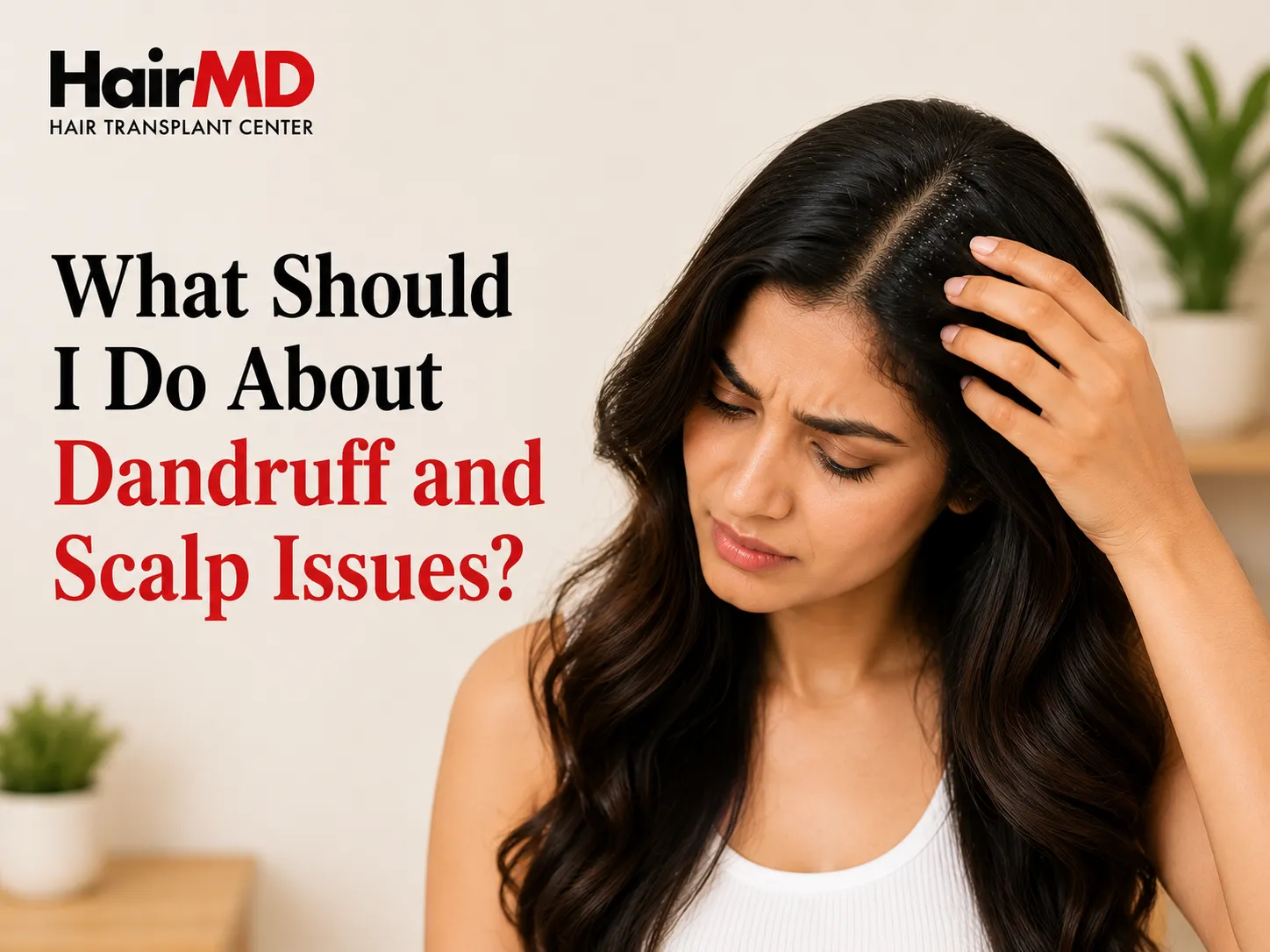
Dandruff, dry scalp, seborrheic dermatitis, and scalp psoriasis can cause similar symptoms such as flakes and itching, but their causes and treatments are different. Knowing which scalp condition you have is the first step toward getting the right care
Scalp problems are among the most frequently mismanaged hair conditions, primarily because they are often self-diagnosed and self-treated with the wrong type of product.
Dandruff, seborrheic dermatitis, dry scalp, scalp psoriasis, and folliculitis all produce some combination of flaking, itching, and scalp discomfort. They look similar. They are not the same condition. And they do not respond to the same treatments, using an anti-dandruff shampoo on a dry, irritated scalp without Malassezia involvement, for example, will worsen the condition rather than improve it.
This article explains the most common scalp problems, how to distinguish between them, what each requires, and, critically, when scalp issues begin to affect hair growth and what to do about it.
What should I do about dandruff?
Dandruff (pityriasis capitis) is caused by overgrowth of Malassezia yeast on the scalp, triggered by an inflammatory response that accelerates skin cell turnover, producing the visible white or yellowish flakes. The correct treatment is an anti-fungal or anti-inflammatory shampoo: zinc pyrithione, ketoconazole 2%, selenium sulphide, or coal tar, used 2–3 times weekly for at least 4–6 weeks. If your scalp flaking is accompanied by severe redness, thick plaques, or flaking extending to the eyebrows, ears, or chest, you likely have seborrheic dermatitis, a more severe form that may require prescription treatment. If you have scaly, silvery-white plaques (not loose flakes) with a defined border, scalp psoriasis is more likely and needs a dermatologist assessment.
Summary
- Dandruff and dry scalp look similar but are different conditions with different causes, anti-dandruff shampoo helps dandruff but worsens dry scalp.
- Dandruff is driven by Malassezia yeast overgrowth and scalp inflammation, not poor hygiene. Washing alone does not resolve it.
- Seborrheic dermatitis is a chronic inflammatory condition, a more severe form of dandruff, that also affects the eyebrows, nose creases, and ears in addition to the scalp.
- Scalp psoriasis produces thick, silvery-white plaques with defined edges, different from the loose, powdery flakes of dandruff.
- Chronic scalp inflammation (from any cause) can impair follicle function in affected areas, contributing to hair thinning over time if untreated.
- Most mild-to-moderate dandruff responds to over-the-counter medicated shampoos within 4–6 weeks of consistent use. Severe, persistent, or atypical scalp conditions need dermatologist assessment.
What’s covered in the article?
- The Common Scalp Conditions: How to Tell Them Apart
- Dandruff: What It Is and What Actually Treats It?
- Seborrheic Dermatitis: When Dandruff Becomes Something More?
- Dry Scalp: Different Problem, Different Solution
- Scalp Psoriasis: When You Need a Dermatologist?
- Does Dandruff Cause Hair Loss?
- When to See a Dermatologist, And How HairMD Treats Scalp Conditions?
- Frequently Asked Questions
- Conclusion
The Common Scalp Conditions: How to Tell Them Apart?
|
Condition |
Flake Appearance |
Scalp Appearance |
Itch |
Other Areas Affected |
Cause |
|
Dandruff (mild) |
Fine, dry, white flakes |
Slightly oily scalp |
Mild-moderate |
Scalp only |
Malassezia yeast + mild inflammation |
|
Seborrheic dermatitis |
Greasy, yellow-white flakes |
Red, inflamed, oily |
Moderate-severe |
Eyebrows, nasolabial folds, ears, chest |
Malassezia + strong inflammatory response |
|
Dry scalp |
Fine, dry, white flakes |
Dry, tight, no oiliness |
Mild |
Scalp only; may have dry skin elsewhere |
Dehydration, harsh shampoo, low humidity |
|
Scalp psoriasis |
Thick, silvery-white plaques |
Defined red plaques with silver scale |
Moderate-severe |
May have psoriasis elsewhere (elbows, knees, nails) |
Autoimmune, T-cell dysregulation |
|
Contact dermatitis |
Variable |
Red, inflamed, may be blistered |
Severe, burning and itching |
Area of contact with irritant/allergen |
Reaction to hair dye, shampoo, or product ingredient |
|
Folliculitis |
Pustules around hair follicles |
Red bumps / pimples on scalp |
Painful |
Scalp |
Bacterial (Staphylococcus) or fungal infection of follicles |
|
Tinea capitis |
Scaly patches with hair loss within the patch |
Ring-shaped lesion; hair breaks off |
Variable |
Scalp |
Dermatophyte fungal infection |
Dandruff: What It Is and What Actually Treats It?
Dandruff is not caused by poor hygiene, dry scalp, or infrequent washing. It is caused by an inflammatory response to Malassezia furfur, a lipophilic yeast normally present on all human skin, but which overgrows in some individuals’ scalps in the presence of excess sebum. This overgrowth triggers inflammation, which accelerates the scalp’s skin cell turnover (normally 28 days, shortened to 7–14 days in dandruff), producing the visible white flakes.
Who gets dandruff: Malassezia thrives in oily environments. Dandruff is most common in those with naturally oily scalp types, tends to worsen in winter (lower humidity, more indoor heating), is worsened by stress, and is associated with higher sebum production, which is why it is more common in puberty and early adulthood.
What treats dandruff:
| Active Ingredient | How It Works | Use |
| Zinc pyrithione (ZPT) | Anti-fungal + antibacterial; reduces Malassezia growth | 2–3x weekly; mainstay of mild-moderate dandruff |
| Ketoconazole 2% | Potent anti-fungal; most effective at eliminating Malassezia | 2–3x weekly for 4–6 weeks; then 1x weekly maintenance |
| Selenium sulphide 1–2.5% | Anti-fungal + reduces skin cell turnover rate | 2x weekly; very effective but has a strong smell |
| Coal tar | Slows skin cell turnover; anti-inflammatory; mild anti-fungal | 2x weekly; stains light-coloured hair |
| Ciclopirox | Anti-fungal; effective alternative to ketoconazole | Prescription-strength formulations |
| Salicylic acid | Keratolytic, dissolves the flake scale; not anti-fungal | Best used as adjunct to anti-fungal, not alone |
How to use anti-dandruff shampoo correctly: Apply to a wet scalp, massage in, and leave for 3–5 minutes before rinsing, this contact time is critical. Most people shampoo and rinse immediately, which eliminates most of the anti-fungal effect. The active ingredient needs time on the scalp to work.
Consistency over 6–8 weeks is required before concluding a shampoo isn’t working. Rotating between two different active ingredients every few weeks (e.g., zinc pyrithione and ketoconazole) can prevent Malassezia developing partial resistance to a single agent.
Check This:- How to Remove Dandruff in One day with Home Remedies?
Seborrheic Dermatitis: When Dandruff Becomes Something More?
Seborrheic dermatitis is a chronic inflammatory skin condition, a more severe form of dandruff, involving the same Malassezia-triggered mechanism but with a significantly stronger inflammatory response. It is not the same as dandruff and does not respond as reliably to over-the-counter anti-dandruff shampoos alone.
Key distinguishing features:
- Greasy, yellowish flakes (not the fine dry white flakes of mild dandruff)
- Visible scalp redness and inflammation
- Extends beyond the scalp, characteristically affects the eyebrows (inner thirds), the sides of the nose/nasolabial folds, the ears (outer canal and behind the ear), and the centre of the chest
- Can affect the eyelids (seborrhoeic blepharitis)
- Tends to flare with stress, sleep deprivation, illness, or cold weather
Treatment: Prescription or stronger-concentration ketoconazole shampoo (2%), topical corticosteroid (for acute flares, not long-term), and maintenance anti-fungal therapy. Seborrheic dermatitis is chronic and recurs, the goal is control, not cure. A dermatologist-prescribed regimen prevents the condition from becoming severely inflamed.
Seborrheic dermatitis and hair loss: Chronic scalp inflammation from seborrheic dermatitis can impair follicle function in heavily affected areas, contributing to hair thinning in those zones over time. This is distinct from androgenetic alopecia but can co-exist with it. Managing seborrheic dermatitis is an important part of maintaining scalp health in patients with any concurrent hair loss condition.
Dry Scalp: Different Problem, Different Solution
Dry scalp is commonly mistaken for dandruff, both produce white flakes and itching. The distinction:
- Dandruff flakes are often slightly oily or yellowish; the scalp itself may feel oily
- Dry scalp flakes are fine, dry, and white; the scalp skin itself feels tight, dry, and may be sensitive to touch
Dry scalp is caused by moisture deficiency, not Malassezia overgrowth. Using an anti-dandruff shampoo (which is typically drying and designed to reduce oil) on a dry scalp will worsen the condition.
Causes of dry scalp:
- Harsh sulfate-heavy shampoos stripping the scalp lipid barrier
- Very hot water opening the cuticle and drying the scalp skin
- Over-washing for a dry scalp type
- Low humidity (air conditioning, winter)
- Dehydration
- Nutritional deficiency (particularly essential fatty acids)
Treatment: Switch to a gentle, sulfate-free or low-sulfate shampoo; reduce wash frequency; use cool/lukewarm water; apply a scalp oil (jojoba, sweet almond) 30 minutes before washing. No anti-fungal agent is indicated for true dry scalp.
Scalp Psoriasis: When You Need a Dermatologist?
Scalp psoriasis is an autoimmune condition, overactive T-cells drive rapid skin cell proliferation, producing the characteristic thick, silvery-white plaques. It is significantly different from dandruff in appearance and mechanism, and does not respond to anti-dandruff shampoos.
Distinguishing features:
- Thick, adherent, silvery-white plaques rather than loose flakes
- Well-defined lesion borders
- Intense itching and sometimes pain
- May extend beyond the hairline onto the forehead, temples, and neck
- Often accompanied by psoriasis at other sites (elbows, knees, lower back, nails, nail pitting is a hallmark)
Treatment: Topical corticosteroids, coal tar preparations, salicylic acid for scale removal, vitamin D analogues (calcipotriol). Severe or widespread scalp psoriasis may require systemic therapy (methotrexate, biologics). Scalp psoriasis requires dermatologist diagnosis and management, self-treatment with over-the-counter dandruff products is ineffective and delays appropriate care.
Does Dandruff Cause Hair Loss?
This is a common question with a nuanced answer.
Dandruff itself does not directly destroy follicles. However:
- Chronic scalp inflammation from persistent, untreated dandruff or seborrheic dermatitis can impair follicle function in affected areas over time, contributing to hair thinning.
- Scratching damages the scalp skin barrier and can traumatise follicles directly.
- Co-existing androgenetic alopecia: Many patients presenting with dandruff and hair loss have both conditions concurrently, not because the dandruff caused the AGA, but because both are common in the same demographic (young adult men) and frequently co-exist. Treating the dandruff does not reverse AGA, but it removes one avoidable source of follicle stress.
The correct approach if you have both dandruff and hair loss: treat the dandruff as a separate condition, then assess the hair loss pattern specifically with trichoscopy to determine whether androgenetic alopecia or another condition requires its own treatment.
When to See a Dermatologist, And How HairMD Treats Scalp Conditions?
See a dermatologist if:
- Flaking, itching, or scalp inflammation does not improve after 6–8 weeks of consistent appropriate treatment
- You have thick plaques rather than loose flakes (may indicate psoriasis)
- Scalp inflammation extends to the face, ears, or chest
- You notice hair loss within patches of scalp inflammation
- Scalp pustules or painful bumps appear (folliculitis or fungal infection)
- You develop scalp lesions that bleed, crust, or change in appearance
Why scalp conditions need specialist assessment: Self-treating the wrong condition delays recovery and in cases like seborrheic dermatitis or scalp psoriasis, allows ongoing inflammation to continue damaging follicles in the affected areas. A trichoscopy identifies the exact condition and its impact on the follicle, information that determines the right treatment.
HairMD Scalp Treatment, What We Offer
HairMD’s dermatologists in Pune diagnose and treat the full spectrum of scalp conditions, managing both the scalp condition itself and any associated hair loss, because these frequently co-exist and require separate, coordinated treatment.
|
Scalp Condition |
HairMD Treatment |
|
Dandruff / mild seborrheic dermatitis |
Medicated shampoo protocol + scalp-specific treatment |
|
Severe seborrheic dermatitis |
Prescription anti-fungal + anti-inflammatory topical therapy |
|
Scalp psoriasis |
Topical corticosteroids, coal tar, Vitamin D analogues; systemic if severe |
|
Scalp folliculitis |
Antibiotic or anti-fungal therapy depending on causative organism |
|
Seborrheic dermatitis + AGA (co-existing) |
Combined scalp inflammation management + PRP or GFC therapy for hair recovery |
|
Trichoscopy-confirmed early AGA with scalp inflammation |
Medical treatment (minoxidil) + scalp anti-inflammatory protocol |
Our Intralesional Steroid Injections are also used for inflammatory scalp conditions including alopecia areata, providing targeted anti-inflammatory treatment directly at the follicle level.
Persistent scalp issues need a diagnosis, not a different shampoo. Book a scalp assessment at HairMD, 250+ patients seen daily across 7 Pune clinics, with trichoscopy at every new patient consultation.
Frequently Asked Questions
What is the difference between dandruff and dry scalp?
Dandruff is caused by Malassezia yeast overgrowth and scalp inflammation, it produces oily or yellowish flakes and the scalp itself tends to be oily. Dry scalp is caused by moisture deficiency, it produces fine, dry, white flakes and the scalp feels tight and sensitive. The treatments are different: dandruff needs an anti-fungal shampoo (zinc pyrithione, ketoconazole); dry scalp needs a gentle shampoo and scalp moisturisation. Using anti-dandruff shampoo on dry scalp makes it worse.
Can dandruff cause permanent hair loss?
Dandruff itself does not directly destroy follicles or cause permanent hair loss. However, chronic, untreated scalp inflammation from severe dandruff or seborrheic dermatitis can impair follicle function over time. Many patients with both dandruff and hair loss have co-existing androgenetic alopecia, two separate conditions that both need treatment. Treating dandruff is important for scalp health but does not reverse AGA.
How long does dandruff treatment take to work?
Most anti-dandruff shampoos require consistent use, 3–5 minutes of contact time on the scalp, 2–3 times per week, for at least 4–6 weeks before significant improvement is seen. The most common reason anti-dandruff shampoos “don’t work” is insufficient contact time (applied and immediately rinsed) or inconsistent use. If there is no improvement after 6–8 weeks of correct use, the diagnosis may need reconsideration, dry scalp, seborrheic dermatitis, or psoriasis respond differently.
Is dandruff contagious?
No. Dandruff is not contagious. Malassezia yeast is present on virtually all people’s skin, it is not transmitted from person to person. Some individuals develop dandruff because of the way their immune system and scalp environment respond to the yeast, not because they “caught” it.
Does stress cause dandruff?
Stress does not directly cause dandruff but is a well-documented trigger for dandruff flares. Stress affects immune function and increases sebum production, both of which create conditions that favour Malassezia overgrowth. Patients with seborrheic dermatitis frequently report that flares coincide with periods of high stress, poor sleep, or illness.
DO YOU KNOW?
Nearly 250 Patients Visit HairMD
Everyday For Various Hair Concerns
(20+ Years Of Expertise. 4157+ Successful Hair Transplant at HairMD)
Meet Our Dermatologists


Conclusion
Dandruff and other scalp conditions can look similar, but they do not always need the same treatment. Dandruff is commonly linked to Malassezia and scalp inflammation, while dry scalp, seborrheic dermatitis, psoriasis, and folliculitis have different causes and treatment approaches.
If flaking, itching, redness, thick plaques, or scalp discomfort continues despite appropriate care, a dermatologist can help identify the exact condition. Persistent scalp inflammation can also affect hair health, especially when another hair loss condition is present.
If your scalp problem is not improving, get a proper scalp assessment instead of repeatedly changing shampoos.
Further Reading
How to Prevent Hair Loss: The Ultimate Guide
Explore the ultimate guide to preventing hair loss and maintaining healthy, strong hair.
Do Dermatologists Recommend Inositol and Choline for Hair Loss?
Discover the potential of inositol and choline for hair loss. Learn how these nutrients may benefit follicle health & prevent thinning.
Finding the Right Doctor for Hair Loss Solutions
Searching for What Kind of Doctor Treats Hair Loss? Learn how dermatologists at Hairmd diagnose the cause & offer proven treatments for hair thinning.
Stop Hair Thinning: Best Practices for Hair Loss Control
Discover effective tips to stop hair fall and boost hair growth with simple lifestyle changes, proper hair care routines, and proven treatments. Boost hair health with HairMD.
Have thoughts? Please let us know
We are committed not only to treating you, but also educating you.