

Hair Loss: How to Protect Hair from Hard Water?


Written by HairMD Content Team | Medically Reviewed by Dr. Dhanraj Chavan On November 22, 2023


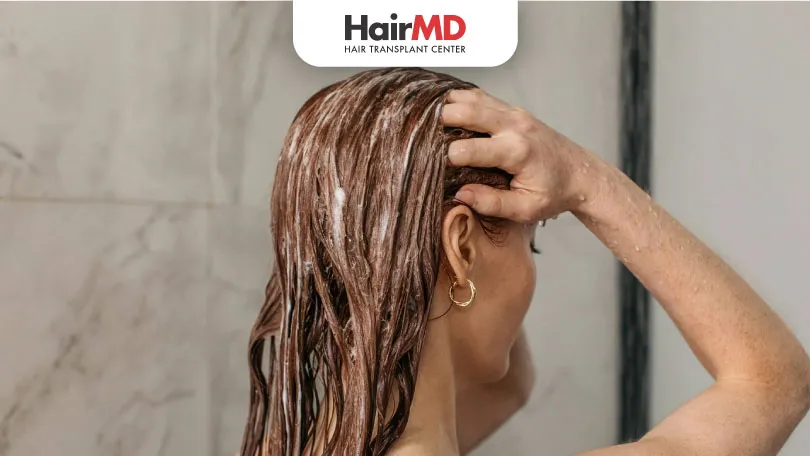
One cannot differentiate between regular and hard water until one sees the latter’s symptoms. So, how to prevent hair loss due to hard water, and is hard water hair loss reversible? Let’s answer these questions.
What’s covered in the article?
- What is Hard Water?
- Signs of Hard Water on Hair
- How to Prevent Hair Loss Due to Hard Water?
- Conclusion
What is Hard Water?
Hard water is a mineral-rich type with an excess of calcium, iron, copper, zinc, magnesium bicarbonates, and carbonates.
The water’s hardness could be temporary or permanent. One can remove temporary hardness by boiling the water. But permanent hardness requires a range of treatment procedures to remove the hardness.
Hard water’s calcium and magnesium content isn’t considered potentially harmful. But it can affect the hair’s health. Besides, chloride, copper, silica, iron, lead, manganese, and cadmium in water, usually seen in groundwater near industrial or coastal zones. These minerals affect the scalp and hair, resulting in hair loss over a period.
Signs of Hard Water on Hair
Hard water doesn’t show signs and symptoms on hair after the first shower. It affects the hair after repeated use. Some signs and symptoms include the following.
- Dry and itchy scalp
- Dandruff
- Dull, frizzy, and dry hair
- Split ends
- Discoloured strands vulnerable to breakage and tangles
- Blockage of hair follicles
- Loss of volume
How to Prevent Hair Loss Due to Hard Water?
Here are some ways to prevent hair loss due to hard water.
- Water Softener: Water softeners help exchange calcium and magnesium ions with sodium to soften water. Thus, using a water softener can help significantly.
- Moisturizing Masks: Moisturizing masks with argan oil, jojoba, or almond oil can help moisturize the hair. Using a leave-in conditioner can moisturize the hair and provide a smooth finish.
- Shower Filter: Installing shower filters is another prevention measure. Shower filters reduce the mineral and chlorine content in water. Consequently, they reduce the damage that hard water causes.
Note: Consult a dermatologist before going for any of the above preventive measures.
DO YOU KNOW?
Nearly 250 Patients Visit HairMD
Everyday For Various Hair Concerns
(15+ Years Of Expertise. 4157+ Successful Hair Transplant)
Meet Our Dermatologists





Conclusion
Further Reading
What is FUE Hair Transplant? Everything You Need to Know
Discover FUE hair transplant: procedure, pain management, costs, and expert insights from HairMD, Pune. Get the facts in one place
Hair Transplant Cost in Pune for 2026
Find affordable 2026 hair transplant costs in Pune with expert results by Dr. Dhanaraj Chavan. Transparent pricing and flexible payments.
Does Cold Water Really Help Your Hair? Separating Fact From Myth
You’ve heard that rinsing with cold water makes hair shinier and stronger.
What Should I Do About Dandruff and Scalp Issues?
Dandruff, seborrheic dermatitis, scalp psoriasis, and dry scalp, they look similar but need different treatments. HairMD dermatologists explain how to identify each and what actually works.
Have thoughts? Please let us know
We are committed not only to treating you, but also educating you.