

Biotin IV Drip vs Oral Supplements vs GFC Therapy: What Actually Works for Hair Loss?


Written by HairMD Content Team | Medically Reviewed by Dr. Dhanraj Chavan On October 27, 2026


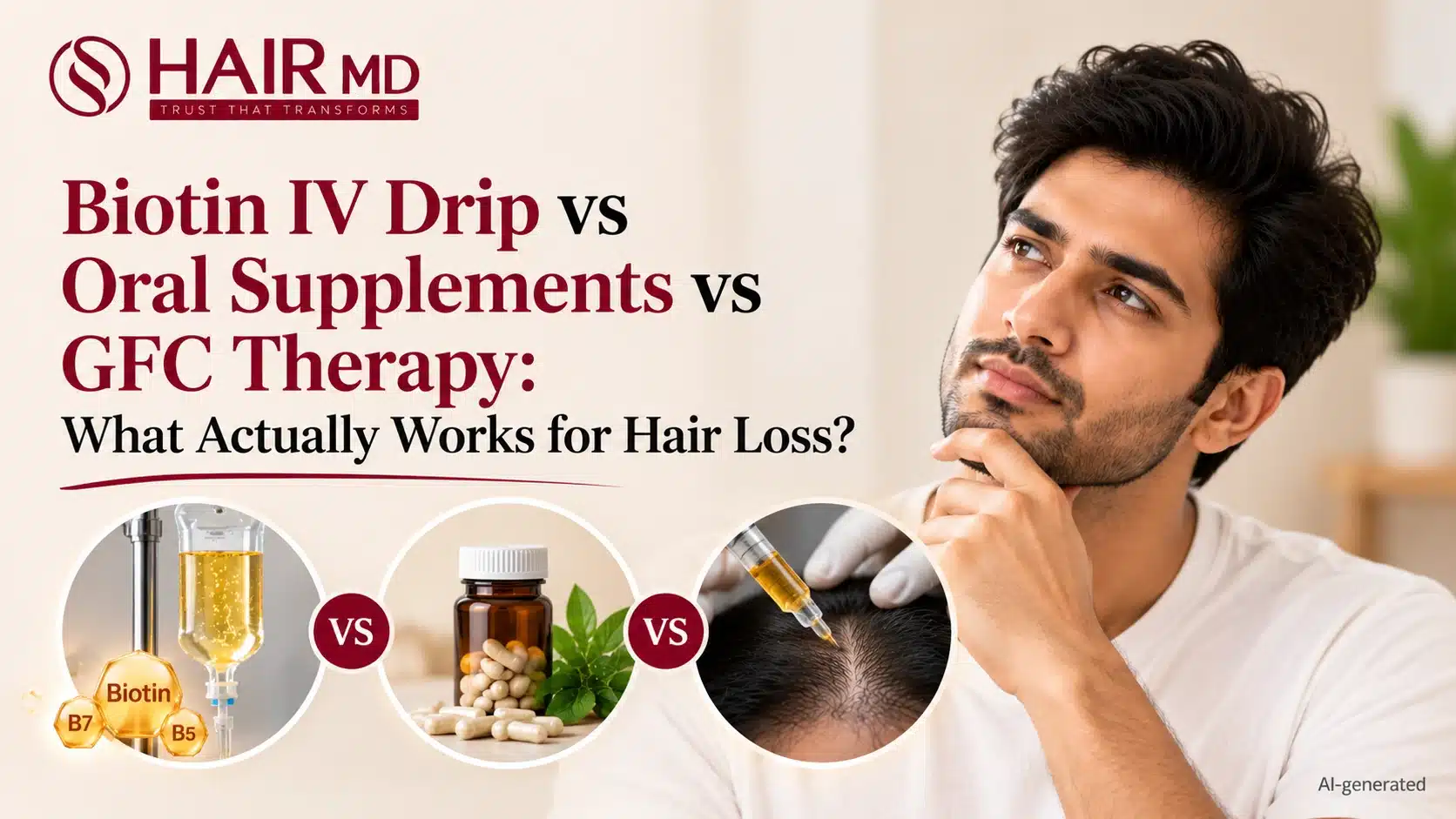
Biotin IV drips, oral hair supplements, and GFC therapy are often discussed as options for hair loss, but they work in different ways. Biotin may help when hair loss is linked to a confirmed biotin deficiency, while GFC (Growth Factor Concentrate) is an in-clinic procedure that delivers growth factors to the scalp.
For most people, taking more biotin does not mean better hair growth. High-dose biotin can also interfere with certain blood test results, including thyroid tests. This guide compares biotin IV drips, oral supplements, and GFC therapy, explaining their potential benefits, limitations, safety concerns, and when each option may be appropriate.
Biotin IV drips and high-dose oral biotin supplements help with hair loss only in confirmed biotin deficiency, which is rare in healthy adults. For most people with hair loss, biotin supplementation in any form does not address the actual cause. There is also a clinically important safety concern: high-dose biotin interferes with thyroid blood tests, potentially producing misleading results at a critical diagnostic moment.
GFC therapy operates in a different category entirely — it is a clinical procedure that delivers growth factors directly to follicle cells to stimulate regrowth, not a supplement. Matching the intervention to the diagnosis is more important than choosing between delivery methods.
At a Glance
| Biotin IV Drip | Oral Biotin/Supplements | GFC Therapy | |
| What it delivers | Biotin + vitamins (IV) | Biotin + vitamins (oral) | Growth factors (your own blood) |
| Acts on follicle directly | No | No | Yes |
| Evidence for hair loss | Only in deficiency | Only in deficiency | Growing clinical evidence |
| Biotin deficiency needed | Yes (for benefit) | Yes (for benefit) | No |
| Lab test interference | Yes (high-dose biotin) | Yes (high-dose biotin) | No |
| Procedural risk | Yes (IV risks) | Minimal | Low (own blood) |
| Requires diagnosis | Rarely performed | Rarely recommended | Yes |
| Cost estimate | Rs. 3,000 to 15,000/session | Rs. 200 to 800/month | Rs. 9,000 to 12,000/session |
The hair supplement market has positioned biotin as the answer to hair loss so effectively that many people take high-dose biotin without ever confirming whether they are deficient in it. Wellness clinics have extended this further by offering biotin IV drips, arguing that intravenous delivery achieves higher concentrations and faster results. GFC therapy sits in a separate clinical space but is frequently discussed alongside these options as an “in-clinic hair treatment.”
These three approaches are not variations of the same solution. They operate through fundamentally different mechanisms, have different evidence bases, carry different risks, and are appropriate for different clinical situations. This article gives you the clinical framework to assess which, if any, is relevant to your hair loss.
Taking high-dose biotin for hair and about to get a thyroid test? Stop the biotin at least 48 hours before. High-dose biotin interferes with thyroid lab results. HairMD’s blood panel evaluation includes a supplement review for exactly this reason. Call or find us on Google Maps.
What’s covered in the article?
- What Biotin Actually Does for Hair?
- The Safety Concern Most Articles Skip: Biotin and Lab Test Interference
- Oral Biotin and Multivitamin Supplements: Realistic Expectations
- GFC Therapy: A Fundamentally Different Category
- The Right Framework: Match the Intervention to the Cause
- What Dermatologists at HairMD Observe?
- When Each Option Has a Place?
- Treatment at HairMD
- Summary
- Frequently Asked Questions
- Conclusion
What Biotin Actually Does for Hair?
Biotin (vitamin B7) is a water-soluble B vitamin that acts as a coenzyme in several carboxylase reactions involved in fatty acid synthesis, amino acid metabolism, and glucose metabolism. Its relevance to hair comes from its role in keratin infrastructure: biotin deficiency impairs the synthesis of keratin, the primary structural protein of hair.
When biotin deficiency is the problem, correcting it resolves the hair loss associated with it. This is not in dispute. The question is whether most people with hair loss have a biotin deficiency that supplementation would correct.
Who Actually Has Biotin Deficiency?
True biotin deficiency in healthy adults is uncommon. It occurs in specific circumstances:
- Biotinidase deficiency: A rare inherited metabolic disorder affecting biotin recycling
- Extended consumption of raw egg whites: Avidin, a protein in raw egg whites, binds biotin and blocks absorption. This requires sustained, large intake of raw eggs.
- Long-term anticonvulsant use: Certain anticonvulsant medications impair biotin absorption
- Prolonged intravenous nutrition without biotin supplementation: A clinical scenario in hospital settings
- Inflammatory bowel disease: Crohn’s and ulcerative colitis can impair biotin absorption
In a 2016 study by Trüeb et al., biotin levels were measured in women presenting with hair loss complaints. The majority had normal serum biotin levels. The study concluded that routine biotin supplementation in this population was not supported by the data.
Most adults eating a varied diet containing eggs, meat, fish, nuts, and legumes maintain adequate biotin levels without supplementation.
The Safety Concern Most Articles Skip: Biotin and Lab Test Interference
This is a clinically important point that is rarely discussed in hair supplement content: high-dose biotin interferes with immunoassay-based laboratory tests.
Many common blood tests use biotin-streptavidin technology as part of their detection method. When large amounts of biotin are present in a blood sample, they can compete with test reagents and produce falsely abnormal results.
Tests most affected by high-dose biotin:
- Thyroid function tests (TSH, free T4, free T3): Can produce falsely low TSH, which mimics hyperthyroidism
- Troponin (cardiac enzyme): Can produce falsely low troponin, potentially masking heart injury
- Vitamin D, B12, and folate tests: May be falsely elevated or reduced
- Hormone panels: Testosterone, LH, FSH, and estrogen tests can be affected
The US FDA issued a safety communication in 2017 warning about this interaction after reports of clinically significant test interference from patients taking high-dose biotin supplements. Standard hair supplement doses range from 5,000 to 10,000 micrograms — far above the recommended daily intake of 30 micrograms and well within the range that causes interference.
Practical implication: If you are taking high-dose biotin supplements (as most “hair vitamins” contain) and need a blood test — particularly thyroid, hormone, or cardiac tests — stop the biotin for at least 48 hours before the test and inform the testing laboratory. Failure to do so can produce results that lead to unnecessary further investigation or missed diagnoses.
This is not a reason to avoid biotin entirely. It is a reason to take it only when deficiency is confirmed and to be transparent with your dermatologist and physician about supplementation.
Biotin IV Drip: Who It Is and Is Not For?
A biotin IV drip delivers biotin and typically other B vitamins, vitamin C, magnesium, and amino acids directly into the bloodstream at concentrations substantially higher than oral supplementation achieves. The argued benefit is faster, more complete delivery to tissues including hair follicles.
When IV Biotin May Be Clinically Indicated
- Confirmed severe biotin deficiency in a patient with impaired oral absorption (malabsorption syndrome, post-bariatric surgery)
- Confirmed severe B12 deficiency in a patient with pernicious anemia or intrinsic factor deficiency
- Post-surgical patients on parenteral nutrition who require IV micronutrient support
In these cases, IV supplementation is administered under physician supervision with specific dose guidance based on blood levels.
When IV Biotin Is Not the Appropriate Choice
- Hair loss without a confirmed biotin deficiency
- Androgenetic alopecia (pattern hair loss) — not caused by biotin deficiency
- Telogen effluvium from stress, hormonal change, or other nutritional deficiency — IV biotin does not address these
- General “hair health maintenance” without a diagnosed deficiency
IV delivery of nutrients that are not deficient does not produce hair growth. The route of delivery does not change this.
(Related: IV Drip for Hair Loss in Pune: Is It Worth the Cost?)
Oral Biotin and Multivitamin Supplements: Realistic Expectations
Oral biotin supplementation is appropriate in confirmed deficiency and is the standard corrective approach for most cases. For confirmed biotin deficiency, oral doses of 1,000 to 5,000 micrograms daily are clinically used under physician guidance.
The “hair vitamins” market sells supplements containing biotin at 5,000 to 10,000 micrograms per tablet alongside zinc, vitamins D and C, and various herbal extracts. These products are marketed broadly for hair growth regardless of the purchaser’s deficiency status.
What Oral Supplements Actually Help
Oral supplementation is genuinely effective for hair loss when it corrects a specific documented deficiency:
- Ferrous bisglycinate: For confirmed iron deficiency (low ferritin) — the most common nutritional cause of hair loss in Indian women
- Zinc bisglycinate: For confirmed zinc deficiency
- Vitamin D3 + K2: For confirmed vitamin D deficiency — common in urban Indian adults
- Methylated B12: For confirmed B12 deficiency
- Methylated folate: For confirmed folate deficiency
The key word is “confirmed.” Supplementing nutrients without knowing your levels may correct a deficiency you have, miss the one that matters, and add nutrients your body is already adequate in.
GFC Therapy: A Fundamentally Different Category
GFC (Growth Factor Concentrate) therapy is not a nutritional supplement delivered by a different route. It is a clinical procedure that acts on follicle biology directly.
A sample of the patient’s own blood is processed to isolate and concentrate specific growth factors: PDGF (platelet-derived growth factor), VEGF (vascular endothelial growth factor), EGF (epidermal growth factor), and FGF (fibroblast growth factor). These are then injected into the scalp at follicle depth by a dermatologist.
These growth factors do not correct nutritional deficiency. They signal dermal papilla cells in the follicle to re-enter the active growth phase, promote new blood vessel formation around follicles, and reduce the inflammatory signaling associated with androgenetic alopecia.
GFC addresses follicle-level biology. Biotin addresses follicle-level nutrition when a specific deficiency is the problem. They solve different problems and are not interchangeable.
(Related: GFC vs PRP: Which Is Better for Reducing Hair Fall?)
(Related: How Many Sessions of GFC Are Needed for Hair Regrowth?)
The Right Framework: Match the Intervention to the Cause
The question “which delivers results” only makes sense once you know what is causing your hair loss.
|
Hair Loss Cause |
Appropriate Intervention |
|
Androgenetic alopecia (AGA) |
Minoxidil, oral finasteride/dutasteride, GFC therapy |
|
Confirmed biotin deficiency |
Oral biotin supplementation (rarely an IV drip) |
|
Low ferritin (iron stores) |
Oral iron supplementation guided by ferritin level |
|
Zinc deficiency |
Oral zinc bisglycinate guided by serum zinc level |
|
Vitamin D deficiency |
Oral vitamin D3 guided by 25-OH vitamin D level |
|
Telogen effluvium from stress |
Address the trigger, support with GFC if significant shedding |
|
Hypothyroid-related hair loss |
Thyroid management by endocrinologist |
None of these causes require an IV drip in most cases. Most can be addressed with oral supplementation after confirmation, combined with clinical treatment for AGA or follicle-level intervention where needed.
What Dermatologists at HairMD Observe?
Dr. Dhanraj Chavan, senior dermatologist at HairMD, explains the clinical reality: “A very common situation in my clinic is a patient who has been taking a hair vitamin supplement with 5,000 or 10,000 micrograms of biotin for several months and is frustrated that their hair has not improved. When I test their blood panel, their biotin level is fine — it was fine to begin with.
What is often not fine is their ferritin, which nobody has tested, or their TSH, which can look abnormal on paper because the high biotin is interfering with the thyroid test. So the supplement may be masking a thyroid-related diagnosis while not addressing the actual hair loss at all. This is why I always take a detailed supplement history before ordering labs, and why I tell patients to stop high-dose biotin before their blood draw.”
Taking hair vitamins for months with no visible improvement? Your supplement may not be addressing the actual cause of your hair loss. HairMD Pune’s trichoscopy and blood panel identifies what is genuinely driving your hair fall. Clinics in Aundh, Baner, Kothrud, Wakad, Viman Nagar, Hadapsar, and Pimple Saudagar. Book at HairMD today.
When Each Option Has a Place
Oral supplementation has a place when blood tests confirm a specific deficiency. Start with ferritin, zinc, vitamin D, and thyroid as minimum. Supplement the specific deficient nutrient at an appropriate dose with physician guidance.
Biotin IV drip has a limited clinical place for people with severe confirmed deficiency and documented absorption problems. For most people with hair loss, it is neither necessary nor supported by evidence.
GFC therapy has a place when the hair loss is androgenetic in nature or when significant telogen effluvium has resulted in meaningful follicle dormancy that needs clinical stimulation to resolve. It is delivered by a dermatologist after a trichoscopy-based diagnosis.
(Related: Benefits of Growth Factor Concentrate (GFC) Hair Treatment)
(Related: Redensyl vs Minoxidil vs GFC: Which Hair Treatment Is Right for You?)
Treatment at HairMD
At HairMD, the supplement question is addressed within a full diagnostic evaluation. Before any supplementation is recommended, a blood panel establishes which nutrients are genuinely low. Before GFC therapy is recommended, a trichoscopy confirms the hair loss type and follicle status. The treatment plan is built on what the data shows, not on supplement marketing.
Hair Loss Assessment at HairMD
Step 1: Visit any HairMD clinic in Pune — Aundh, Baner, Kothrud, Wakad, Viman Nagar, Hadapsar, or Pimple Saudagar.
Step 2: Get a trichoscopy and blood panel with Dr. Dhanraj Chavan. Stop high-dose biotin supplements at least 48 hours before your blood draw for accurate thyroid results.
Step 3: Start a treatment plan based on your actual deficiency profile and hair loss type, not on supplement labels.
Call | Find HairMD on Google Maps
Summary
Biotin supplementation, whether by IV drip or oral tablet, helps hair loss only when biotin deficiency is confirmed — which is uncommon in healthy adults. High-dose biotin used without blood-panel confirmation carries a clinically significant risk of interfering with thyroid and other lab tests, potentially producing misleading diagnostic results.
GFC therapy is in a different category: it is a clinical procedure that delivers concentrated growth factors to follicles to stimulate the growth phase, appropriate for androgenetic alopecia and significant telogen effluvium under dermatologist supervision. Matching the intervention to the actual diagnosis is more productive than comparing delivery methods for a nutrient your follicles may not be deficient in.
Frequently Asked Questions
Does biotin IV drip work for hair loss?
Biotin IV drips can address hair loss caused by confirmed biotin deficiency in people with impaired oral absorption. For people without documented biotin deficiency — the majority of adults — IV biotin delivers a nutrient already present at adequate levels and does not produce additional hair growth. There are no independent clinical trials supporting biotin IV therapy for hair loss in the general population.
Is oral biotin or IV biotin better for hair?
For people with confirmed biotin deficiency, oral supplementation is the standard first-line approach and is appropriate for most cases. IV biotin is reserved for people with severe deficiency and documented oral absorption problems. For people without confirmed biotin deficiency, neither form produces meaningful hair benefit, and both carry the risk of interfering with laboratory test results at high doses.
Can high-dose biotin affect my blood test results?
Yes. This is a well-documented and clinically significant concern. High-dose biotin (5,000 to 10,000 micrograms, found in most “hair vitamin” supplements) interferes with immunoassay-based blood tests including thyroid function (TSH, free T4), troponin, vitamin D, and hormone panels. The US FDA issued a safety communication about this in 2017. Stop high-dose biotin at least 48 hours before any blood test and inform your laboratory or dermatologist that you are supplementing.
How is GFC different from a biotin IV drip?
A biotin IV drip delivers vitamins and nutrients to the bloodstream. GFC therapy extracts growth factors from your own blood and injects them directly into the scalp at follicle level, where they signal follicle cells to re-enter the growth phase. GFC acts on follicle biology. Biotin IV acts on nutritional status. They address different causes of hair loss and are not substitutes for each other.
How do I know if I actually need biotin for my hair?
A serum biotin test can confirm whether your levels are within the normal range. However, this test is not routinely included in standard blood panels. More clinically useful tests for hair loss are ferritin, serum zinc, vitamin D, and thyroid — the deficiencies most commonly found in people with hair loss in India. Your dermatologist can guide which tests are relevant based on your clinical picture.
Is GFC therapy appropriate if I also have nutritional deficiencies?
GFC therapy and nutritional correction address different aspects of hair loss and can be used together. Nutritional deficiencies are corrected first, since an inadequate nutritional environment limits how well any follicle stimulation therapy can work. Once nutritional status is addressed, GFC therapy for follicle-level stimulation can be added where clinically indicated.
How many sessions of GFC are needed? A standard GFC course involves 4 to 6 sessions spaced 4 to 6 weeks apart. Maintenance sessions every 3 to 6 months help sustain results. Improvement in shedding is often noticed after the second or third session. The full course is needed to assess clinical response.
What supplement should I take if I am losing hair?
The correct supplement is the one that corrects a documented deficiency. Get a blood panel checking ferritin, serum zinc, vitamin D, thyroid (TSH and T3/T4), and B12. Supplement specifically what is low, at the dose guided by your result, under physician supervision. Do not take broad-spectrum hair vitamins in place of a targeted assessment — they may miss the specific deficiency that matters and add nutrients you do not need.
DO YOU KNOW?
Nearly 250 Patients Visit HairMD
Everyday For Various Hair Concerns
(20+ Years Of Expertise. 4157+ Successful Hair Transplant at HairMD)
Meet Our Dermatologists



Conclusion
Biotin IV drips, oral biotin supplements, and GFC therapy are not interchangeable hair loss treatments. Biotin supplementation is most useful when a deficiency is confirmed, while GFC may be considered for selected types of hair loss following a dermatologist’s assessment. IV biotin is generally not necessary for people who can absorb nutrients normally.
Before spending money on hair supplements or in-clinic procedures, identify the cause of your hair loss. A dermatologist may recommend scalp examination, trichoscopy, and relevant blood tests based on your symptoms and medical history. If you take high-dose biotin, tell your healthcare provider before any blood test because it can interfere with certain laboratory results.
Considering treatment for hair loss in Pune? HairMD can help assess your scalp and discuss options based on your diagnosis. Choose a treatment plan based on clinical findings rather than supplement marketing.
Further Reading
Redensyl vs Minoxidil vs GFC for Hair Loss: Which One Is Right for You?
Redensyl, minoxidil, or GFC therapy for hair loss? HairMD Pune dermatologists explain how each works, who each is for, and how to choose.
How to Prevent Hair Loss: The Ultimate Guide
Explore the ultimate guide to preventing hair loss and maintaining healthy, strong hair.
Do Dermatologists Recommend Inositol and Choline for Hair Loss?
Discover the potential of inositol and choline for hair loss. Learn how these nutrients may benefit follicle health & prevent thinning.
Finding the Right Doctor for Hair Loss Solutions
Searching for What Kind of Doctor Treats Hair Loss? Learn how dermatologists at Hairmd diagnose the cause & offer proven treatments for hair thinning.
Have thoughts? Please let us know
We are committed not only to treating you, but also educating you.