

Is Dandruff Hereditary or Genetic? Uncovering the Facts


Written by HairMD Content Team | Medically Reviewed by Dr. Dhanraj Chavan On July 16, 2023


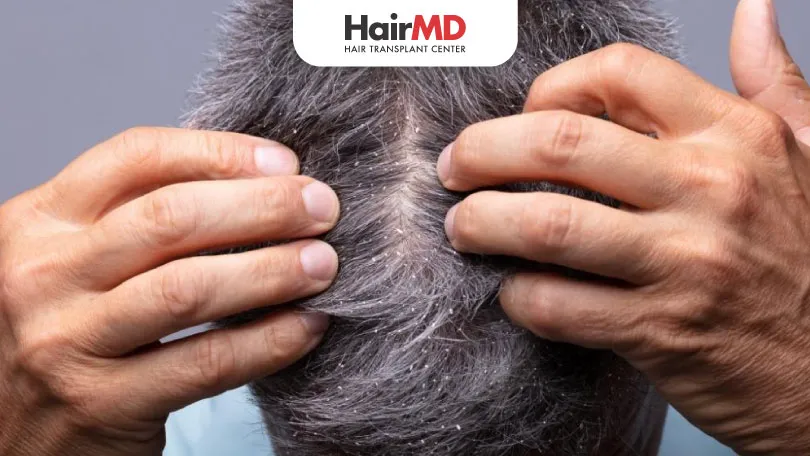
The microbe is usually present on everyone’s scalp. Dandruff isn’t contagious or threatening. Yet, dandruff visible on the hair or shoulders can prove an embarrassing site. That indeed makes dandruff concerning for many. Many people suffer from itching and irritation on the scalp.
We receive many patients who ask us some common questions like, is dandruff hereditary, is dandruff genetic, and how to treat dandruff in hair. Hence, here’s a blog that talks about the causative factors of dandruff. Additionally, it also highlights some of the anti-dandruff treatment options.
What’s covered in the article?
- Is Dandruff Hereditary or Genetic?
- Dandruff Due to Hormonal Imbalance
- How to Get Rid of Dandruff Permanently?
- Conclusion
Is Dandruff Hereditary or Genetic?
Dandruff is not hereditary. Rather, it is a hormone influenced condition. It often features flaky skin on the scalp. But how is dandruff related to genetics?
Hormones have a crucial role in producing natural oils (sebum) for the head. The glands under the skin’s surface produce these oils that moisturize the scalp and hair. Now, this is where the microbe Malassezia steps in. This microbe thrives on the head’s natural oils. The feeding process produces an acid called oleic acid.
Now, it is the individual’s hormones that control the production and secretion of oils on the scalp which increases after puberty of. Day to day release of dead cells from the scalp, oversecretion of oils in the scalp, increased flakes due fungi thriving on scalp are all responsible for dandruff. Sensitivity of the scalp to oleic acid and fungal elements lead to symptoms of dandruff.
Dandruff Due to Hormonal Imbalance
Most teenagers and adults suffer from dandruff due to hormonal imbalances. Often, the preliminary symptoms of dandruff appear during adolescence, when the body experiences hormonal changes. The hormonal imbalance produces excess oil and makes the scalp greasier, causing the dandruff flakes to stick together.
How to Get Rid of Dandruff Permanently?
Dandruff is something undesirable. So, it is obvious that our patients ask us how to get rid of dandruff permanently. But that’s not possible. Dandruff creation is a natural process caused due to the body’s reaction and sometimes aggravated leading to severe form seborrheic dermatitis . Hence, you cannot cure dandruff permanently. However, you can control it by frequent use of shampoo. Shampoos containing ketoconazole and zinc pyrithione are commonly prescribed to reduce fungal activity and inflammation. As the scalp oil secretion is increased in adolescents and young adults, it is important to avoid excess oiling of the scalp. Use of coconut oil, if required, can be restricted to a few minutes before shampoo.
Note: Consult a dermatologist to know the suitability of a particular natural or clinical treatment to treat dandruff.
DO YOU KNOW?
Nearly 250 Patients Visit HairMD
Everyday For Various Hair Concerns
(15+ Years Of Expertise. 4157+ Successful Hair Transplant)
Meet Our Dermatologists



Conclusion
Further Reading
What is FUE Hair Transplant? Everything You Need to Know
Discover FUE hair transplant: procedure, pain management, costs, and expert insights from HairMD, Pune. Get the facts in one place
Hair Transplant Cost in Pune for 2026
Find affordable 2026 hair transplant costs in Pune with expert results by Dr. Dhanaraj Chavan. Transparent pricing and flexible payments.
Does Cold Water Really Help Your Hair? Separating Fact From Myth
You’ve heard that rinsing with cold water makes hair shinier and stronger.
What Should I Do About Dandruff and Scalp Issues?
Dandruff, seborrheic dermatitis, scalp psoriasis, and dry scalp, they look similar but need different treatments. HairMD dermatologists explain how to identify each and what actually works.
Have thoughts? Please let us know
We are committed not only to treating you, but also educating you.