

Low-Cost Hair Transplant Clinics in Pune – Risks & Warnings


Written by HairMD Content Team | Medically Reviewed by Dr. Dhanraj Chavan On November 27, 2025


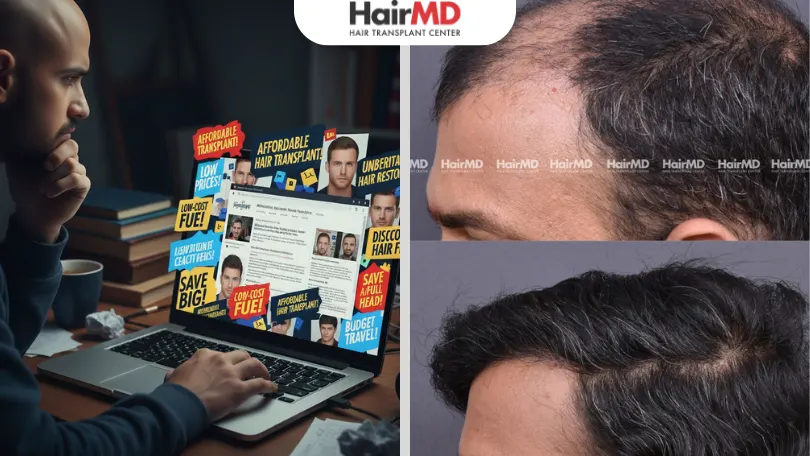
When you see advertisements for hair transplants at ₹15,000 or ₹20 per graft in Pune, your first instinct might be relief. Finally, an affordable solution to your hair loss. But before you book that consultation, consider this: one patient’s “bargain” ₹40,000 procedure ended up costing him ₹1.5 lakhs in corrective surgery, months of emotional distress, and permanent scarring that could never be fully repaired.
The hair transplant industry in India performs approximately 350,000 procedures annually, making it a global hub for hair restoration. But this growth has brought a troubling reality: unqualified practitioners, compromised safety protocols, and patients who leave clinics with results worse than when they walked in.
This guide explains why ultra-low-cost clinics are dangerous, what you should actually pay for quality care, and how to protect yourself from becoming another repair surgery statistic.
What’s covered in the article?
- Key Takeaways
- Understanding the Hair Transplant Cost Landscape in Pune
- The Hidden Dangers of Low-Cost Hair Transplants
- Real Consequences: What Can Go Wrong
- Price Comparison: Budget vs. Quality Clinics
- Red Flags to Identify Risky Clinics
- What You Should Pay for Quality in Pune?
- Frequently Asked Questions
- Conclusion
Key Takeaways
- Ultra-low pricing (₹5-20 per graft) typically means technicians, not doctors, perform your surgery – a practice that’s illegal in India but poorly enforced.
- 37% of patients at reputable clinics are seeking repairs from failed budget procedures, often spending 2-3 times more than quality care would have cost initially.
- Your donor hair supply is finite and irreplaceable – once damaged by poor extraction techniques, those follicles are gone forever.
- Legitimate clinics in Pune charge ₹30-50 per graft for FUE because they invest in trained surgeons, sterile equipment, and proper graft handling that ensures survival.
- India’s Association of Hair Restoration Surgeons (AHRS) states clearly: Only MD Dermatology, MS ENT, MS General Surgery, or MCH Plastic Surgery specialists are qualified to perform hair transplants.
Understanding the Hair Transplant Cost Landscape in Pune
What Legitimate Clinics Charge and Why
At HairMD India Pune, a typical FUE hair transplant costs ₹30-50 per graft. For a standard 2000-graft procedure, that’s ₹60,000 to ₹1,00,000.
This pricing isn’t arbitrary. It reflects genuine costs that cannot be cut without compromising your safety and results.
Quality hair transplant pricing includes sterile surgical environments with proper OT facilities, MBBS MD-qualified surgeons with specialized training (Dr. Sachin Pawar at HairMD has 20+ years experience with 2,500+ successful surgeries), FDA-approved equipment and instruments, proper graft storage solutions that keep follicles viable, comprehensive pre-operative blood work and scalp analysis, and genuine post-operative care with multiple follow-ups.
The industry standard in Pune ranges from ₹30-60 per graft for FUE, depending on clinic reputation and surgeon expertise. Anything significantly below ₹25 per graft should immediately raise red flags.
The Warning Signs of Ultra-Low Pricing
When you see clinics advertising ₹5-20 per graft or complete procedures for ₹20,000-30,000, ask yourself: what are they cutting to offer these prices?
The answer is always the same: they’re cutting corners that directly affect your results and safety.
According to the Association of Hair Restoration Surgeons of India (AHRS-India), these ultra-budget clinics typically operate through one or more of these illegal practices. They hire unqualified technicians to perform the actual surgery while an MBBS doctor is nominally “present.” The procedure might be performed by homeopaths, Ayurvedic practitioners, or even OT technicians with just weeks of training.
Many use “fly-by-night” surgeons who travel from other cities, perform surgeries, and disappear before you need post-operative care. Some reuse supposedly “disposable” instruments or skip proper sterilization to save on costs.
The National Medical Commission (NMC) requires hair transplant clinics to be registered as day-care centers with proper OT facilities, recovery rooms, and emergency equipment. Budget clinics often skip this registration entirely.
Unqualified Technicians Performing Surgery
This is the single biggest problem in India’s hair transplant industry. The International Society of Hair Restoration Surgery (ISHRS) and AHRS-India have repeatedly warned about this illegal practice.
Here’s what’s actually happening: OT technicians, people with bachelor’s degrees in unrelated fields, and even individuals who watched YouTube videos are performing hair transplant surgeries across India. Some clinics openly hire “freelancing technicians” who travel from clinic to clinic performing procedures.
The Association of Hair Restoration Surgeons of India is clear about who can legally perform hair transplants. Only physicians with these qualifications can perform hair restoration surgery: MD Dermatology, MS ENT (Ear, Nose, Throat), MS General Surgery, or MCH Plastic Surgery.
MBBS doctors without surgical specialization, homeopaths, Ayurvedic doctors, dentists, and technicians of any kind are NOT legally qualified to perform hair transplants in India.
Yet due to lax enforcement, this illegal practice continues. A recent case saw Telangana’s medical board bar an MBBS doctor from practicing hair transplants for two years because he lacked proper post-graduate qualifications.
The Delhi High Court has expressed serious concerns about untrained hands conducting hair transplants in Delhi salons, especially after the death of a 35-year-old patient. In 2023, Delhi authorities closed several facilities operating out of private apartments without proper sanitation.
When technicians perform your surgery, you face dramatically higher risks of poor hairline design that looks obviously artificial, wrong hair angle and direction creating an unnatural appearance, excessive donor area damage from improper extraction techniques, low graft survival rates due to mishandling, infections from poor sterile technique, and no recourse if complications arise (technicians don’t carry malpractice insurance).
Substandard Sterilization and Safety Protocols
Proper surgical sterilization isn’t optional. It’s the difference between a successful procedure and a life-threatening infection.
Budget clinics cut costs by reusing supposedly disposable needles and instruments, skipping proper autoclave sterilization between patients, operating in non-certified spaces that don’t meet surgical standards, lacking emergency medical equipment in case of reactions, and using expired or substandard local anesthesia.
The National Medical Commission requires hair transplant clinics to have proper OT beds, surgical lighting, oxygen cylinders, and post-operative recovery rooms. These aren’t suggestions – they’re mandatory safety requirements.
When you walk into a budget clinic that operates from a converted apartment or small shop, those requirements simply aren’t met.
Poor Graft Handling and Survival Rates
This is where ultra-low pricing directly destroys your results. Hair follicles are living tissue that must be handled with extreme care from the moment they’re extracted until they’re implanted.
Proper graft handling requires temperature-controlled storage solutions (grafts must stay at specific temperatures), holding solutions with growth factors to keep follicles viable, skilled technicians working under microscopes for graft dissection, and limited time between extraction and implantation (ideally under 4-6 hours).
Budget clinics can’t afford these systems. Grafts sit at room temperature in basic saline. Extraction takes too long because untrained staff work slowly. No one monitors graft quality under magnification.
The result? Your grafts die before they’re even implanted. You pay for 2000 grafts but maybe 800 actually survive and grow.
Real Consequences: What Can Go Wrong?
Failed Grafts and Wasted Donor Hair
This is the most heartbreaking outcome because it’s permanent and irreversible.
Your donor area – typically the back and sides of your scalp – has a finite number of follicles. Once extracted, those follicles are gone from that location forever.
When a budget clinic poorly extracts grafts or handles them improperly, those precious follicles die. You’ve permanently used up donor hair for zero results.
According to DHI India, 37% of their patients are seeking repairs from failed procedures done at cheaper clinics. These patients face a devastating reality: their donor area is already depleted, limiting what can be achieved in corrective surgery.
Some patients require body hair transplants (harvesting from chest or back) because facial scalp donor areas are exhausted. This is more expensive and produces inferior results.
Unnatural Hairlines and Visible Scarring
A natural hairline requires artistic skill and deep understanding of hair growth patterns. Qualified surgeons spend years learning hairline design principles.
Technicians following cookie-cutter templates create obviously artificial results like perfectly straight hairlines that look “drawn on,” abrupt transitions with no feathering at the front, wrong hair angles creating a “pluggy” appearance, mismatched temple angles, and hairlines placed too low that look feminine or unnatural.
These mistakes are permanent. Correcting an unnatural hairline often requires extracting poorly placed grafts (destroying them) and re-implanting new grafts – if you have enough donor hair remaining.
Visible scarring is another common issue. FUE should leave tiny dot scars that are virtually invisible. But when performed incorrectly, you get white, raised scars across the donor area, “cobblestoning” texture from too-deep extractions, obvious bald patches where over-harvesting occurred, and strip scars (from FUT) that are wide and visible even with short hair.
Medical Complications
Beyond aesthetic problems, budget procedures carry genuine medical risks: scalp infections requiring antibiotics and sometimes hospitalization, folliculitis (inflamed, infected follicles) that’s painful and disfiguring, necrosis (death of scalp tissue) in severe cases of poor technique, allergic reactions to substandard anesthesia without proper emergency equipment available, excessive bleeding from poor surgical technique, and nerve damage causing permanent numbness or altered sensation.
A case that made headlines involved a patient who died following a hair transplant performed in a Delhi salon by unqualified personnel. The Delhi High Court subsequently demanded stricter regulations.
The psychological toll is equally damaging. Patients report depression, social withdrawal, and severe anxiety after botched procedures. Some say they’d rather be bald than live with the obvious results of a failed transplant.
Price Comparison: Budget vs. Quality Clinics
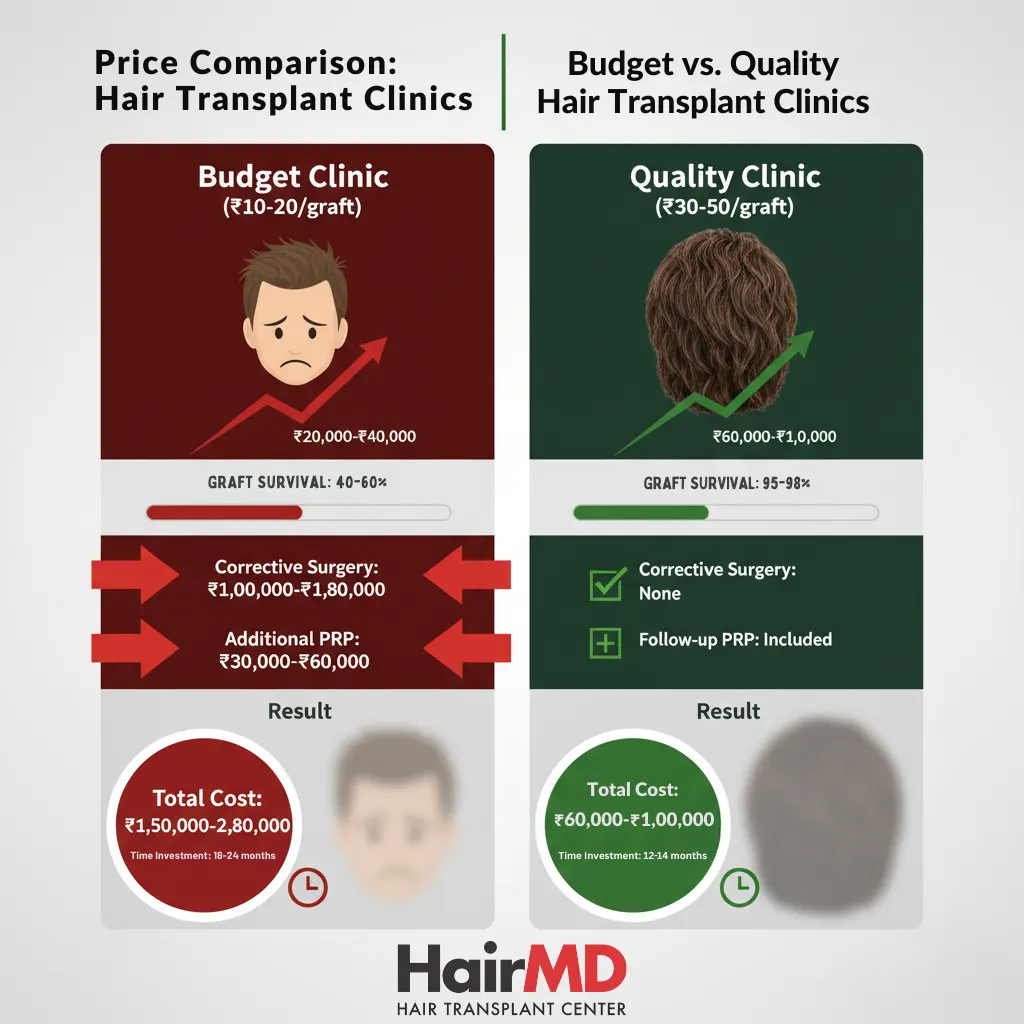
Here’s what the numbers will look like for a 2000-graft FUE procedure:
Ultra-Budget Clinic (₹10-20 per graft):
- Initial cost: ₹20,000 – ₹40,000
- Typical graft survival: 40-60% (800-1200 grafts actually grow)
- Corrective surgery needed: ₹1,00,000 – ₹1,80,000
- Additional PRP sessions for damage: ₹30,000 – ₹60,000
- Total lifetime cost: ₹1,50,000 – ₹2,80,000
- Time investment: 18-24 months (initial procedure + waiting + correction)
- Result: Often still suboptimal due to depleted donor area
Quality Clinic like HairMD India (₹30-50 per graft):
- Initial cost: ₹60,000 – ₹1,00,000
- Typical graft survival: 95-98% (1900-1960 grafts grow)
- Corrective surgery needed: Usually none
- Follow-up PRP included: Often 1-2 sessions
- Total lifetime cost: ₹60,000 – ₹1,00,000
- Time investment: 12-14 months to final results
- Result: Natural-looking, permanent restoration
The “savings” from budget clinics is an illusion. You don’t save money – you just delay when you pay it, and often end up paying much more.
Red Flags to Identify Risky Clinics
Warning Signs in Advertising
Be immediately skeptical of any clinic that makes these claims:
“Guaranteed results” or “100% success rate” (no ethical surgeon guarantees results in cosmetic procedures), “Unlimited grafts in one session” (medically impossible and dangerous), “Painless and scarless” (all surgery involves some discomfort and marking, however minimal), “World-class technology” with prices 70% below market rate (technology is expensive to acquire and maintain), overly dramatic before/after photos that look heavily edited, celebrity endorsements without verifiable credentials.
Pressure tactics are another red flag. If a clinic pushes you to book “today only” discounts or claims “limited slots available” to rush your decision, walk away. Reputable clinics welcome you taking time to research and compare options.
Questions They Can’t (or Won’t) Answer
A legitimate clinic will transparently answer these critical questions:
- Who will actually perform my surgery – not just “supervise,” but hands-on perform extraction and implantation?
- What are that person’s specific qualifications? (Demand to see MD/MS certificates.)
- How many procedures has the surgeon personally performed?
- Can I speak to previous patients for references?
- What is your complication rate and how do you handle complications?
- Is your facility registered with local medical authorities as required?
- What specific equipment do you use for extraction and implantation?
- How do you store grafts between extraction and implantation?
- What is your policy if I need corrective work?
Budget clinics will dodge these questions with vague answers like “our experienced team” or “we use the latest technology” without specifics. They’ll claim doctor confidentiality prevents patient references. They’ll say their techniques are “proprietary” to avoid discussing specifics.
Legitimate clinics welcome these questions and answer directly. For example, HairMD India openly shares verified patient reviews and testimonials from actual procedures performed by Dr. Sachin Pawar and the team.
Missing Credentials and Certifications
Before booking any procedure, verify that the surgeon has one of these qualifications: MD Dermatology, MS ENT, MS General Surgery, or MCH Plastic Surgery from a recognized Indian medical institution. Membership in AHRS-India (Association of Hair Restoration Surgeons of India) or ISHRS (International Society of Hair Restoration Surgery) verifies the surgeon is recognized by professional bodies.
The facility should be registered with local health authorities as a day-care surgical center. Check for proper business licenses and medical registration certificates displayed in the clinic.
Be wary of certificates from private “training institutes” or device manufacturers. These don’t constitute medical credentials.
What You Should Pay for Quality in Pune?
HairMD India’s transparent pricing reflects what ethical, safe hair transplant actually costs. For FUE (Follicular Unit Extraction), the cost is ₹30-50 per graft. For a typical 2000-graft session, the total is ₹60,000 – ₹1,00,000.
Don’t just take our word for it – read verified patient experiences and results from hundreds of successful hair transplant procedures at HairMD India Pune.
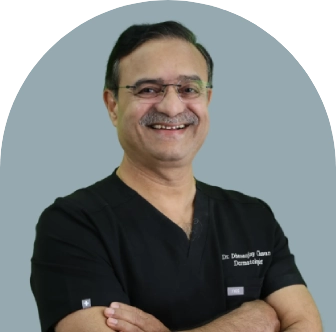
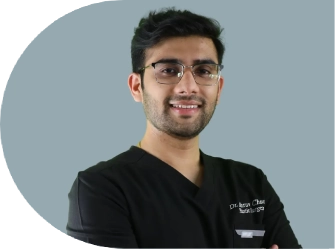
This pricing includes comprehensive consultation with Dr. Dhanraj Chavan (MBBS MD Dermatology) or Dr. Sachin Pawar (Chief Hair Transplant Surgeon with 20+ years experience), pre-operative blood work and scalp analysis, the procedure performed entirely by qualified surgeons (not technicians), FDA-approved equipment and sterile disposable instruments, proper graft storage with temperature control and growth factors, post-operative medications and care kit, 1-2 complimentary PRP sessions to enhance results, multiple follow-up consultations at 1 week, 1 month, 3 months, 6 months, and 12 months, and lifetime guidance for your hair health.
HairMD also offers no-cost EMI options through partners, making quality care accessible without compromising on safety or expertise. This allows you to pay in manageable installments while receiving proper treatment from qualified surgeons.
Remember: your scalp and hair are permanent. Choosing a surgeon based solely on price is like choosing a pilot based on who offers the cheapest flight. When it comes to surgery on your body, expertise must come first.
Frequently Asked Questions
Why are some hair transplant clinics in Pune so much cheaper than others?
Ultra-low pricing (₹5-20 per graft) indicates corners being cut that directly affect your safety and results. These clinics typically use unqualified technicians instead of trained surgeons, skip proper sterilization protocols, operate without required medical facility registration, rush procedures to complete more patients per day, or provide no meaningful post-operative care. Quality clinics charge ₹30-50 per graft because they invest in qualified surgeons, sterile equipment, proper graft handling systems, and comprehensive patient care that ensures results.
Can I trust low-cost hair transplant clinics advertising online?
Many budget clinics have sophisticated websites and social media presence that look professional, but this doesn’t verify their qualifications or practices. The International Society of Hair Restoration Surgery (ISHRS) warns that “black market” clinics often have slick marketing but use unlicensed technicians. Before trusting any clinic’s online presence, verify the surgeon’s medical qualifications directly, check facility registration with local health authorities, ask for verifiable patient references (not just testimonials on their website), and confirm who will actually perform your procedure (not just “supervise” it).
What’s the real cost of fixing a failed hair transplant in Pune?
Corrective surgery typically costs ₹1,00,000 – ₹2,00,000 or more depending on damage severity. But the financial cost is only part of the burden. You’ll also lose an additional 12-18 months waiting for correction and recovery, permanently deplete your finite donor hair supply (making future procedures more limited), potentially require body hair transplants if the scalp donor area is exhausted, and still may not achieve optimal results if initial damage was severe. This is why choosing quality care initially is actually the economical choice.
How do I verify a hair transplant surgeon’s credentials in India?
First, confirm the surgeon holds one of these qualifications from a recognized medical institution: MD Dermatology, MS ENT, MS General Surgery, or MCH Plastic Surgery. MBBS alone is insufficient – the surgeon needs post-graduate surgical specialization. Check membership in AHRS-India (Association of Hair Restoration Surgeons of India) or ISHRS (International Society of Hair Restoration Surgery). Verify the clinic is registered with local health authorities as a day-care surgical center. Ask to see certificates directly and verify them with issuing institutions if needed.
What questions should I ask before booking a hair transplant?
Ask these critical questions and insist on specific answers: Who will personally perform the extraction and implantation (names and qualifications)? What are the surgeon’s medical degrees and years of hair transplant experience? Can I speak with previous patients who had similar procedures? What is your graft survival rate? What is your complication rate and how are complications handled? How do you store grafts between extraction and implantation? Is the facility registered as a surgical day-care center? What post-operative care is included? What recourse do I have if the results are unsatisfactory? Budget clinics will dodge these with vague answers. Legitimate clinics answer directly and welcome your due diligence.
Is price the only factor I should consider for hair transplant in Pune?
Price should actually be one of the last factors in your decision. Prioritize these first: surgeon qualifications (MD/MS in relevant specialty), surgeon’s experience and portfolio of results, facility registration and safety standards, clinic’s reputation and patient testimonials, comprehensive pre and post-operative care, and transparent communication about realistic expectations. Only after verifying these factors should you compare pricing among qualified options. A hair transplant affects your appearance permanently. Choosing based primarily on cost is like choosing a surgeon for heart surgery based on who charges the least. Your results, safety, and long-term satisfaction depend on expertise, not finding the lowest price.
DO YOU KNOW?
Nearly 250 Patients Visit HairMD
Everyday For Various Hair Concerns
(15+ Years Of Expertise. 4157+ Successful Hair Transplant)
Meet Our Dermatologists

Conclusion
The lure of ultra-low-cost hair transplants is understandable. Hair loss is emotionally challenging, and the prospect of affordable restoration feels like a lifeline. But the reality is harsh: budget clinics offering ₹15,000-40,000 procedures are gambling with your scalp, your donor hair supply, and your results.
The patients who walk into HairMD India seeking corrective surgeries all share similar stories. They believed they’d found a “deal.” They ignored warning signs because the price was too good to pass up. Now they’re spending 2-3 times what quality care would have cost initially, living with emotional distress and self-consciousness, dealing with permanent scarring and unnatural results, and facing limited options because their donor area is depleted.
Don’t become another repair statistic. Your hair and scalp are permanent. The consequences of a failed transplant last a lifetime.
HairMD India offers free consultations with Dr. Dhanraj Chavan and Dr. Sachin Pawar. Take that first step. Ask questions. Verify credentials. See the difference between a quality clinic and budget operators.
Your future appearance is worth the investment in expertise.
Schedule your free consultation at HairMD India Pune: Contact HairMD India
Further Reading
Does Cold Water Really Help Your Hair? Separating Fact From Myth
You’ve heard that rinsing with cold water makes hair shinier and stronger.
What Should I Do About Dandruff and Scalp Issues?
Dandruff, seborrheic dermatitis, scalp psoriasis, and dry scalp, they look similar but need different treatments. HairMD dermatologists explain how to identify each and what actually works.
Does Heat Damage Really Ruin Your Hair? The Science Explained
Yes, heat damage is real, and mostly permanent. HairMD explains exactly how heat ruins hair at the structural level, at what temperatures damage occurs, and how to minimise it without giving up styling.
How to Get Healthier Hair Without Expensive Treatments?
You don’t need expensive salon treatments for healthier hair. HairMD dermatologists explain what actually improves hair health, from diet and scalp care to habits that protect hair from daily damage.
Have thoughts? Please let us know
We are committed not only to treating you, but also educating you.