

RF Microneedling for Hair Loss: A Dermatologist’s Guide for Pune Patients


Written by HairMD Content Team | Medically Reviewed by Dr. Dhanraj Chavan On June 21, 2026


Medical Disclaimer: This article is for informational purposes only. Consult a qualified dermatologist for personalised medical advice.
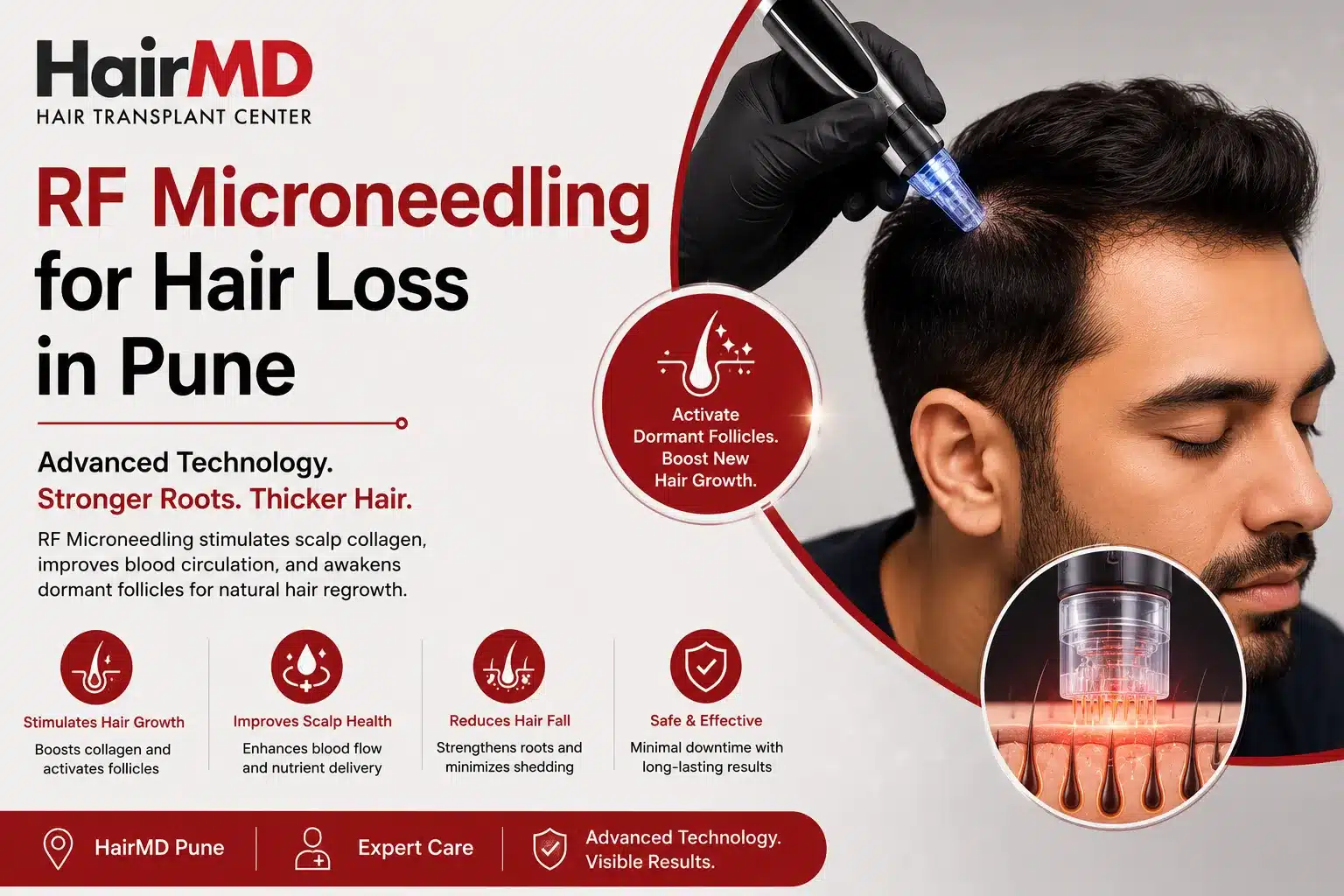
Looking for a non-surgical hair loss treatment beyond PRP or GFC? RF Microneedling combines advanced radiofrequency technology with microneedling to improve hair density, strengthen existing follicles, and support healthier hair growth.
If you’ve tried PRP or GFC therapy and want to explore a newer option, or if you’re in the early stages of hair thinning and want an evidence-backed non-surgical treatment, radiofrequency microneedling may be worth a serious look. This guide covers exactly how the procedure works for hair loss, who it’s suited for, what a real session looks like at HairMD Pune, and what kind of results you can realistically expect.
What’s covered in the article?
- What Is RF Microneedling, and How Is It Different from Regular Microneedling?
- How RF Microneedling Promotes Hair Regrowth?
- Are You a Good Candidate?
- What to Expect During Your Session at HairMD Pune?
- How Many Sessions Do You Need? What Results Look Like
- RF Microneedling vs PRP vs GFC: How Do They Compare?
- Cost of RF Microneedling for Hair Loss in Pune
- Recovery and Aftercare (Practical Advice for Pune’s Climate)
- Risks and Side Effects: An Honest Assessment
- Frequently Asked Questions
- Conclusion
What Is RF Microneedling, and How Is It Different from Regular Microneedling?
Microneedling for hair loss has been available for several years. The basic version uses a roller or motorised pen to create tiny punctures in the scalp, which stimulates the body’s healing response and encourages dormant follicles to re-enter the growth phase.
Radiofrequency microneedling takes this a step further. Instead of just physical micro-injury, the device delivers controlled radiofrequency (RF) energy through the tips of insulated needles directly into the dermis, at the exact depth where hair follicles live. This generates localised heat, which triggers a stronger and more targeted regenerative response than needling alone.
The key advantage: the RF energy is delivered to a very specific depth (typically 1.5 to 3.5 mm), which avoids heating the surface of the skin while concentrating energy precisely around the follicular bulge and dermal papilla. These are the structures responsible for follicle cycling and hair shaft production.
The most commonly used platforms in Indian clinics for hair applications include Morpheus8, Potenza, and Vivace, among others.
How RF Microneedling Promotes Hair Regrowth?
The mechanism works through several overlapping pathways:
- Heat-induced collagen remodelling around follicle structures improves the tissue environment for hair growth
- Increased blood flow to the scalp through angiogenesis (formation of new capillaries)
- Activation of Wnt signalling pathways, which play a direct role in triggering the anagen (active growth) phase of the hair cycle
- Upregulation of growth factors including VEGF and IGF-1, both of which support follicle health
- When combined with topical actives (such as GFC, PRP, minoxidil, or growth factor serums), RF microneedling dramatically increases their absorption into the dermis through the temporary microchannels created
Dr. Dhanraj Chavan, founder and lead dermatologist at HairMD Pune, explains the rationale this way: “Most patients who come to us with early-to-moderate hair thinning have follicles that are miniaturised but not yet dead. What RF microneedling does is create a physiological environment that signals those follicles to wake up. Combined with the right topical treatment applied immediately after, we see significantly better responses than with microneedling or PRP alone in suitable patients.”
Are You a Good Candidate?
RF microneedling is not a solution for every type or stage of hair loss. At HairMD, we evaluate candidacy carefully during the initial consultation, which includes a trichoscopy examination of your scalp.
Who tends to respond well:
- Men and women with early to moderate androgenetic alopecia (Norwood 1-4 in men, Ludwig 1-2 in women)
- Patients with diffuse hair thinning across the crown or parting
- Individuals with telogen effluvium (stress-related or post-illness shedding) who have not responded to medication alone
- Those who want to combine RF microneedling with medical therapy (minoxidil, finasteride) to accelerate response
- Patients who have plateaued on PRP or GFC and want to try a combination approach
Who is generally not suited:
- Individuals with active scalp infections, seborrheic dermatitis flare-ups, or open wounds
- Patients with scar-type (cicatricial) alopecia, where follicles have been permanently destroyed by scarring
- Those with bleeding disorders or on anticoagulant medications
- Women who are pregnant or breastfeeding
- Individuals with pacemakers or other implanted electronic devices
- Patients with very advanced baldness (Norwood 5-7) where very few follicles remain. In such cases, a hair transplant consultation is a more realistic path forward.
Book a trichoscopy consultation at your nearest HairMD clinic.
Our dermatologist will assess your hair loss pattern, stage, and scalp health to confirm whether RF microneedling is the right treatment for you.
What to Expect During Your Session at HairMD Pune?
Understanding the procedure step by step helps reduce anxiety and sets realistic expectations.
Before the session
A topical numbing cream (EMLA or equivalent) is applied to the scalp approximately 45 to 60 minutes before the procedure. This is important because RF microneedling on the scalp is more uncomfortable than on facial skin. Most patients find it tolerable with proper numbing, describing the sensation as a warm pressure rather than pain.
Your scalp will be cleaned and any styling products removed before the cream is applied.
During the procedure
The device is passed systematically over the treatment zones in a grid pattern. The treating dermatologist adjusts needle depth and RF energy level based on the area being treated. The crown and temples typically need slightly different settings than the frontal hairline.
A single session covers the full scalp in approximately 30 to 45 minutes.
Immediately after needling, if a combination treatment has been planned (GFC, PRP, or a customised growth factor serum), it is applied while the microchannels are still open. This is one of the most effective windows for topical absorption.
After the session
Expect mild redness, a warm sensation, and occasional pinpoint bleeding that resolves within a few hours. The scalp may feel slightly tender for 24 to 48 hours. Most patients from Pune who visit us at our Kothrud, Deccan, Wakad, Viman Nagar, PCMC, Hadapsar, and Hinjewadi clinics are comfortable returning to desk work the same day or the following morning.
How Many Sessions Do You Need? What Results Look Like
This is the question most patients ask first, and the honest answer is: it depends on the severity of your hair loss and whether you’re combining RF microneedling with other treatments.
Typical protocol at HairMD:
- Initial course: 4 to 6 sessions spaced 4 weeks apart
- Maintenance: 1 to 2 sessions every 3 to 6 months once initial results are achieved
Results timeline:
|
Timeframe |
What to Expect |
|
After session 1-2 |
Reduced shedding, scalp feels healthier |
|
After session 3-4 |
Fine regrowth visible in thinning areas |
|
3-6 months |
Measurable improvement in hair density and shaft thickness |
|
6-12 months |
Optimal results with consistent treatment and medical therapy |
Results vary significantly based on the stage of hair loss, underlying cause, and compliance with recommended medications. RF microneedling is most effective as part of a complete hair loss management plan, not as a standalone treatment.
During your consultation, ask about combination protocols. At HairMD, we often pair RF microneedling with GFC therapy or customised topical growth factors applied immediately post-procedure for enhanced results.
RF Microneedling vs PRP vs GFC: How Do They Compare?
Many of our patients arrive having already tried PRP or GFC therapy. Here is a straightforward comparison to help you understand where RF microneedling fits:
|
Treatment |
Mechanism |
Invasiveness |
Combination Friendly |
|
PRP |
Injects your own platelet-rich plasma |
Injections |
Yes |
|
GFC |
Concentrated growth factors from blood |
Injections |
Yes |
|
RF Microneedling |
RF energy + physical micro-injury |
Surface + dermal heating |
Yes, enhances absorption of PRP/GFC |
|
RF Microneedling + GFC |
Combined protocol |
Moderate |
Best of both |
RF microneedling is not necessarily better than PRP or GFC in isolation. Its real strength is as an amplifier. When we apply GFC immediately after an RF microneedling session, the absorption and tissue response are considerably better than with either treatment alone, because the heated microchannels deliver growth factors directly to follicular depth.
Cost of RF Microneedling for Hair Loss in Pune
Pricing varies across clinics depending on the device used, the treatment area covered, and whether it is combined with PRP or GFC.
At HairMD Pune, RF microneedling for hair loss is typically priced per session, with package options available for the standard 4 to 6 session course. Combination sessions (RF microneedling paired with GFC) cost more than standalone microneedling but are often more cost-effective in the long run because fewer total sessions may be needed.
We recommend getting a written treatment plan at your consultation that outlines the number of sessions recommended and total expected cost, rather than committing to a single session without a full protocol in mind.
Recovery and Aftercare (Practical Advice for Pune’s Climate)
Pune’s climate presents a few specific considerations during recovery.
- Avoid direct sun exposure on the scalp for at least 48 to 72 hours after each session. This is especially important during the April to June summer period, when UV intensity is high. A loose-fitting cap (not a tight helmet) is acceptable after 24 hours.
- Avoid swimming pools for at least 5 to 7 days, as chlorinated water can irritate the treated scalp.
- Do not apply hair oil, styling products, or chemical treatments for the first 48 to 72 hours.
- Wash your hair gently with a mild sulphate-free shampoo 24 hours after the procedure. Do not scrub the scalp.
- If you are on minoxidil, your dermatologist will advise whether to pause it for 24 to 48 hours around each session.
- During Pune’s monsoon months, keep the scalp dry immediately after treatment and avoid exposure to rainwater for the first 24 hours, as the microchannels are temporarily open.
Risks and Side Effects: An Honest Assessment
RF microneedling on the scalp is generally safe when performed by a trained dermatologist using calibrated equipment. However, it is not risk-free.
Common and expected side effects (resolve in 24 to 72 hours):
- Redness and warmth
- Mild swelling at the hairline
- Pinpoint scabbing at needle entry points
Less common side effects:
- Post-inflammatory hyperpigmentation (more likely in darker skin tones if energy settings are too high)
- Temporary increased shedding in the first 2 to 3 weeks after starting treatment (this is usually a sign of follicular activation, not worsening hair loss)
Rare risks:
- Infection if post-procedure care is not followed
- Burns or scarring from incorrect device settings (not seen with proper technique)
The key to safety is using a properly calibrated device and having the treatment performed by someone who understands hair follicle anatomy. This is not a procedure that should be done at a salon or by non-medical staff.
FAQs
Is RF microneedling painful on the scalp?
With proper numbing cream applied 45 to 60 minutes before, most patients find it uncomfortable but manageable. The scalp is more sensitive than facial skin, so do not skip or rush the numbing step.
Can RF microneedling regrow hair on a completely bald area?
Only if there are still living (though dormant) follicles present. Completely bald areas where follicles have been permanently lost cannot be regenerated by any non-surgical treatment. A trichoscopy can determine whether living follicles are present in a bald patch.
Can women with PCOS-related hair loss benefit from this treatment?
Yes, particularly when combined with medical management of the underlying hormonal imbalance. RF microneedling addresses the scalp environment but will be less effective if the hormonal cause is untreated.
How soon can I colour or chemically treat my hair after a session?
Wait a minimum of 7 to 10 days before any chemical hair treatment. This includes colouring, perming, or relaxing.
Is there a shedding phase after RF microneedling?
Some patients notice slightly more hair fall in the first 2 to 4 weeks. This is a known and usually temporary phenomenon related to follicle cycling being triggered. It should resolve and be followed by regrowth if the treatment is working.
Can I combine RF microneedling with oral finasteride or minoxidil?
Yes. In fact, medical therapy and RF microneedling are complementary. Medications reduce the hormonal cause of hair loss; RF microneedling improves the scalp environment and stimulates follicular activity.
How is RF microneedling different from LLLT (laser therapy)?
LLLT uses low-level laser light to stimulate cells at the surface and near-surface level. RF microneedling uses heat energy delivered deep into the dermis through needles. The two treatments work through different mechanisms and can be used in combination.
How do I know if it’s working?
Your dermatologist will perform a trichoscopy assessment before your first session and at 3 to 4 months into treatment. This allows an objective comparison of hair density and shaft thickness rather than relying on perception alone.
DO YOU KNOW?
Nearly 250 Patients Visit HairMD
Everyday For Various Hair Concerns
(20+ Years Of Expertise. 4157+ Successful Hair Transplant at HairMD)
Meet Our Dermatologists

Conclusion
Visit any of our HairMD clinics are located across Pune, including Kothrud, Deccan, Wakad, Viman Nagar, PCMC, Hadapsar, and Hinjewadi.
Our dermatologists will conduct a thorough scalp assessment, discuss your hair loss history, and design a personalised treatment plan combining RF microneedling with the right supportive therapy for your specific hair loss pattern.
To schedule, call or WhatsApp: www.hairmdindia.com
Further Reading
Is Rosemary Oil Enough for Hair Regrowth? When to Consider Something Stronger
Six months of rosemary oil and still losing hair? HairMD dermatologists explain when rosemary oil works, when it is not enough, and what to try next.
Redensyl vs Minoxidil vs GFC for Hair Loss: Which One Is Right for You?
Redensyl, minoxidil, or GFC therapy for hair loss? HairMD Pune dermatologists explain how each works, who each is for, and how to choose.
Dermapen Scalp Microneedling Results in Pune
Real HairMD Pune patient results from Dermapen scalp microneedling for hair – what to expect, sessions, and before and after outcomes.
Fotona & LLLT Laser Hair Cost in Pune 2026
Fotona and LLLT laser hair treatment cost in Pune 2026 – per-session pricing, packages, and what affects the cost at HairMD Pune.
Have thoughts? Please let us know
We are committed not only to treating you, but also educating you.