

What is the Right Way to Use Dermaroller for Hair Loss?


Written by HairMD Content Team | Medically Reviewed by Dr. Dhanraj Chavan On March 25, 2026


What’s covered in the article?
- Key Takeaways
- What is a Derma Roller for Hair Loss?
- What are the Benefits of Derma Roller for Hair Loss?
- How to Choose the Right Dermaroller?
- How to Use a Dermaroller in 4 Steps
- Tips for Maximum Results
- Avoid these Common Mistakes
- Frequently Asked Questions
- Conclusion
Key Takeaways
Before you start dermarolling, here’s what you need to know:
- Use 1.0-1.5mm needle length: This size penetrates deep enough to stimulate hair follicles without causing permanent damage – the range our Pune dermatologists have found most effective across 15+ years of practice.
- Roll once weekly maximum: Your scalp needs 5-7 days to heal between sessions; rolling more often causes inflammation and can worsen hair loss.
- Sterilize before every use: Cleaning your dermaroller with 70% isopropyl alcohol before and after each session prevents infections that derail regrowth.
- Combine with topical treatments: Dermarolling creates micro-channels that boost minoxidil absorption by up to 4 times, making topical treatments significantly more effective.
- Be patient for 3-4 months: Visible improvements appear after 12-16 weeks of consistent weekly sessions – most patients notice changes between months 3 and 4.
What is a Dermaroller for Hair Loss?
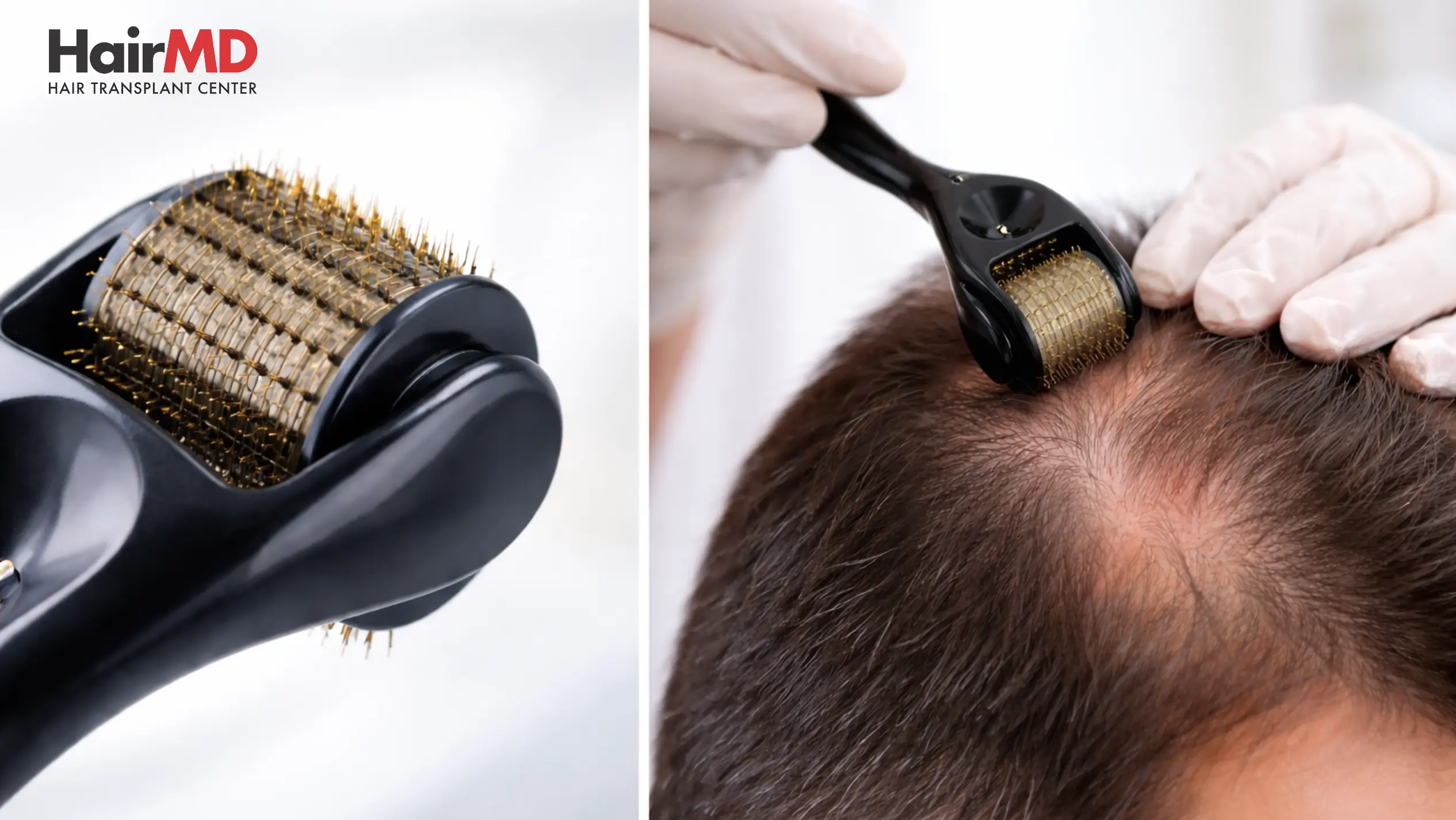
A dermaroller is a handheld device covered with tiny medical-grade needles that you roll across your scalp to stimulate hair growth. The needles create microscopic punctures in the dermal layer where your hair roots live, triggering your body’s natural healing response.
The controlled micro-injuries boost blood circulation to your scalp, increase growth factor production, and stimulate collagen around your hair follicles. It’s the same principle used in professional dermapen microneedling, but adapted for home use.
HairMD India has been offering dermaroller treatment for hair loss in Pune since 2010, starting from our Prabhat Road clinic and expanding to six locations across the city. It remains one of our most recommended non-invasive hair restoration options.
Early cases of androgenetic alopecia – the primary driver of male hair loss – respond very well when treatment starts within 1-3 years of thinning and follicles are still active. Dermarolling helps bring dormant follicles back into the growth phase.

What are the Benefits of Dermaroller for Hair Loss?
Massages Your Scalp and Boosts Circulation
When you roll those tiny needles across your scalp, you’re giving yourself a deep-tissue massage at the cellular level. This mechanical stimulation increases blood flow to your hair follicles, delivering more oxygen and nutrients to your hair roots.
The increased circulation also removes waste products from around the follicles, creating a healthier environment for hair to grow.
Prevents Hair Thinning and Strengthens Follicles
When those microneedles create tiny injuries, your body rushes to heal those areas. This triggers the production of growth factors – specifically PDGF and VEGF – which rebuild collagen and elastin around your follicles.
The result is a stronger foundation for hair to grow from. Existing hair becomes thicker, and thinning areas begin to fill in.
Dramatically Improves Product Absorption
When you apply minoxidil or hair growth serums normally, only about 3-5% penetrates deep enough to reach hair follicles. After dermarolling, those micro-channels allow topical treatments to penetrate up to 4 times deeper.
One HairMD India patient from Baner had used minoxidil for six months with minimal results. After adding dermarolling before each application, he saw noticeable regrowth within 8 weeks.
Reduces Seasonal Hair Fall
At HairMD India’s Kharadi clinic, our clinical team has observed that hair fall increases during monsoon and winter due to humidity changes and temperature drops that stress follicles.
Regular dermaroller sessions counter this seasonal hair fall by maintaining consistent follicle stimulation throughout the year.
How to Choose the Right Dermaroller?
Choosing the right needle size determines whether you get results or risk scalp damage. The 1.0-1.5mm range targets the dermal layer where follicles live without permanent injury, and most patients at HairMD India start with a 1.2mm titanium device. Selecting the wrong size – too shallow or too deep – is the most common reason patients don’t see results from home use.
Needle Size: The Goldilocks Zone
Too short (0.25-0.5mm): These improve product absorption but don’t stimulate hair growth – the needles don’t reach the dermal layer where follicles live.
Just right (1.0-1.5mm): This range reaches the dermal layer where hair roots live, triggering growth factor production without causing permanent damage.
Too long (2.0mm+): Unless in a professional setting with numbing cream, these are unnecessarily painful and increase your risk of scarring.
At HairMD India, 1.2mm is the standard starting recommendation. If you have a sensitive scalp, begin at 1.0mm.
Handle Design and Needle Material
You’ll hold this device for 15-20 minutes while rolling across your entire scalp. A curved handle is essential for proper grip and control, not just a convenience.
Titanium alloy needles maintain sharpness for 6-8 months, won’t corrode, and penetrate smoothly without catching or tearing skin. Avoid stainless steel needles, which dull quickly.
A good-quality dermaroller costs Rs. 800-2,500 in India. Prices below Rs. 500 signal poor needle quality.
How to Use a Dermaroller in 4 Steps
Dermarolling works through a consistent weekly routine – rolling 1.0-1.5mm needles across the scalp in three directions, then applying topical treatments to the opened micro-channels. At HairMD India, Dr. Sachin Pawar and his clinical team refine this technique with every new patient, because pressure, direction, and application timing separate real results from months of ineffective sessions.
Step 1: Consult a Professional First
Don’t start using a dermaroller without professional guidance. Book a consultation with a dermatologist or trichologist who specialises in hair loss. Active scalp infections, psoriasis, or certain types of scarring alopecia can be made worse by dermarolling.
Dr. Sachin Pawar, Chief Hair Transplant Surgeon at HairMD India, recently treated a male IT professional in his late 20s from Kharadi experiencing gradual thinning for 1.5 years. Trichoscopy revealed early frontal recession and diffuse vertex thinning – classic signs of androgenetic alopecia (Norwood Grade 2-3). A protocol combining dermarolling with minoxidil delivered visible improvement within 12 weeks.
Dr. Sachin Pawar brings 20+ years of experience and 2,500+ completed procedures to every case at HairMD India. With MBBS + MS Surgery qualifications and a clinical focus exclusively on hair restoration since 2016, he leads all FUE and non-surgical treatment protocols across the clinic’s six Pune locations.
Step 2: Clean Everything Thoroughly
Infection prevention is non-negotiable when you’re creating micro-injuries in your scalp.
Before dermarolling: wash with an antibacterial shampoo, dry your hair completely, soak the dermaroller in 70% isopropyl alcohol for 5-10 minutes, then let it air dry.
After dermarolling: rinse under hot water, soak again in alcohol for 10 minutes, let it air dry fully, and store in its case. Never share your dermaroller with anyone.
Step 3: Apply Your Prescribed Topical Treatment
Timing is everything. You have two options depending on what your dermatologist recommends.
Option 1: Apply immediately after dermarolling – the most common approach, which uses those fresh micro-channels to maximise absorption. HairMD India typically recommends this for minoxidil, growth factor serums, and peptide-based treatments.
Option 2: Wait 12-24 hours – preferred for patients with sensitive skin or certain medications.
For most patients, applying treatments within 5-10 minutes after dermarolling delivers the best results.
Step 4: Roll Correctly on Your Scalp
Divide your scalp into sections – front, top, crown, and sides – to ensure you don’t miss any areas.
The rolling pattern:
- Vertical rolls: Roll from front to back, lifting the dermaroller slightly after each pass
- Horizontal rolls: Roll from left to right across the same section
- Diagonal rolls: Roll at 45-degree angles in both directions
Do about 8-10 passes in each direction per section. Apply firm pressure, but not so hard that it causes excessive bleeding. Lift the roller between passes rather than dragging it across your scalp. Total treatment time: 15-20 minutes for a full scalp session.

Tips for Maximum Results
Dermarolling delivers better results when combined with targeted additions – but not every supplement or routine change makes a meaningful difference. At HairMD India, we add complementary steps only when a patient’s assessment shows specific gaps worth addressing. Three additions consistently improve outcomes.
Consider Cutting Your Hair Short
When your hair is shorter, you can see your scalp clearly and roll more effectively. The dermaroller doesn’t get tangled in long hair, and you can ensure proper scalp contact throughout the session.
If you’re not ready to cut your hair, section it with clips and part it in multiple directions to fully expose your scalp.
Combine with Oral Supplements
Dermarolling stimulates your follicles, but follicles still need building blocks to create healthy hair. HairMD India typically recommends biotin, iron, vitamin D, zinc, and omega-3 fatty acids alongside dermarolling when blood tests confirm specific deficiencies.
One of our Pimple Saudagar patients combined dermarolling with a supplement protocol our team designed based on her test results. She saw a 40% increase in hair density within six months – significantly better than dermarolling alone would have achieved.
Add Regular Scalp Massages
On the 6 days you’re not dermarolling, give yourself a gentle scalp massage using your fingertips in small circular motions for 5-10 minutes daily.
This keeps blood circulation elevated throughout the week, not just on your dermarolling day.
Avoid these Common Mistakes
Most patients who don’t get results from dermarolling are making one of four predictable technique errors – not using the wrong device. Understanding these mistakes before you start saves months of ineffective sessions and prevents avoidable scalp damage.
Mistake #1: Improper Cleaning
Patients at HairMD India have developed painful scalp infections – folliculitis, bacterial, even fungal – from not sterilising their dermaroller. One patient used the same device for 8 months with no alcohol cleaning.
The resulting infection required a full month’s pause on all hair loss treatments. Alcohol before, alcohol after, every single time – no exceptions.
Mistake #2: Rolling Too Frequently
Your scalp needs time to heal and produce growth factors. Rolling too often causes chronic inflammation without allowing the healing response to complete.
One HairMD India patient tried three sessions per week, reasoning that more must be better. Within two weeks, his scalp was persistently red and irritated, and hair fall increased. Once weekly is the optimal frequency.
Mistake #3: Using Wrong Pressure
Some patients barely touch the dermaroller to their scalp, which does nothing useful. Others press so hard they cause excessive bleeding and tissue damage.
The right pressure feels uncomfortable but not painful. Think “firm massage” pressure, not “deep tissue” pressure.
Mistake #4: Giving Up Too Soon
Hair growth is slow. Dermarolling stimulates the growth phase of the hair cycle, and that phase takes 12-16 weeks to produce visible results.
One long-term patient saw no changes until week 14. By week 24, he had filled in two thinning patches at his temples. Commit to at least 6 months before assessing results.
Frequently Asked Questions
Q: Does dermarolling hurt?
It shouldn’t be painful, but it isn’t entirely comfortable either. Most people describe it as a tingling or prickling sensation, similar to a firm scalp massage with slightly more intensity.
If you’re experiencing actual pain, you’re either pressing too hard or using needles that are too long. The discomfort typically subsides within 10-15 minutes after you finish.
Q: Can I use a dermaroller on wet hair?
No – always use a dermaroller on completely dry hair and scalp. Wet skin is more prone to damage, and rolling on a damp scalp increases your risk of creating deeper wounds than intended.
Bacteria also enter micro-channels more easily on wet skin. Always wash your hair, dry it thoroughly, then begin your dermarolling session.
Q: How long does a dermaroller last?
A high-quality titanium dermaroller typically lasts 6-8 months with proper care and weekly use. When rolling starts to feel more like dragging rather than gliding, it’s time to replace the device.
At HairMD India, we advise patients to mark their calendar at first use and plan to replace the device at 6 months. Never continue past 12 months regardless of how it feels.
Q: Can I dermaroll if I have dandruff or scalp psoriasis?
This depends on the severity. Active scalp infections, open sores, or severe psoriasis are contraindications for dermarolling.
Mild dandruff that’s well-controlled with medicated shampoo usually isn’t a problem. HairMD India has successfully treated many patients with mild seborrheic dermatitis who use ketoconazole shampoo before dermarolling. Always consult a dermatologist before starting – do not self-diagnose.
Q: When will I see results from dermarolling?
Most patients notice initial changes around 12-16 weeks of consistent weekly sessions. This might be subtle at first – less shedding, or fine baby hairs appearing in thinning areas.
Significant visible improvements typically appear around 6 months. One of our Karad clinic patients saw first baby hairs at week 10 but didn’t notice substantial thickness until month 7. Peak results typically occur at 9-12 months.
Q: Is dermarolling safe during Pune’s monsoon season?
Yes, dermarolling is safe year-round, but hygiene is especially important during monsoon. High humidity increases infection risk if the dermaroller isn’t properly sterilised before each use.
HairMD India patients consistently report heavier shedding during Pune’s monsoon and winter months. Higher humidity weakens scalp hygiene barriers, so sterilising your dermaroller thoroughly is especially important during this period. Dry your scalp completely before each session and keep the device stored in a dry case.
Q: Can I combine dermarolling with PRP therapy?
Yes – many patients get excellent results combining dermarolling with PRP (Platelet-Rich Plasma) therapy. Clinic PRP sessions rebuild growth factor reserves while home dermarolling maintains stimulation between appointments.
Timing matters – avoid dermarolling for 48-72 hours before and after a PRP session. Your HairMD India dermatologist will guide you on the exact schedule.
Q: Where can I get professional guidance for dermarolling in Pune?
HairMD India has convenient locations across Pune, including our Baner clinic and NIBM location. Our dermatologists assess your scalp, demonstrate correct technique, and create a personalised hair restoration plan tailored to your hair loss type.
Call +91-9584584111 or book a consultation online to get started.
DO YOU KNOW?
Nearly 250 Patients Visit HairMD
Everyday For Various Hair Concerns
(15+ Years Of Expertise. 4157+ Successful Hair Transplant)
Meet Our Dermatologists

Conclusion
Further Reading
PRP for Alopecia Areata: What Research Says
PRP for alopecia areata – what the research says about regrowth, how it compares to other options, and when it may help, from HairMD Pune.
Do Dermatologists Recommend Inositol and Choline for Hair Loss?
Discover the potential of inositol and choline for hair loss. Learn how these nutrients may benefit follicle health & prevent thinning.
Finding the Right Doctor for Hair Loss Solutions
Searching for What Kind of Doctor Treats Hair Loss? Learn how dermatologists at Hairmd diagnose the cause & offer proven treatments for hair thinning.
Stop Hair Thinning: Best Practices for Hair Loss Control
Discover effective tips to stop hair fall and boost hair growth with simple lifestyle changes, proper hair care routines, and proven treatments. Boost hair health with HairMD.
Have thoughts? Please let us know
We are committed not only to treating you, but also educating you.