

Hair Care for Different Age Groups: What Changes & What To Do About It


Written by HairMD Content Team | Medically Reviewed by Dr. Dhanraj Chavan On August 22, 2026


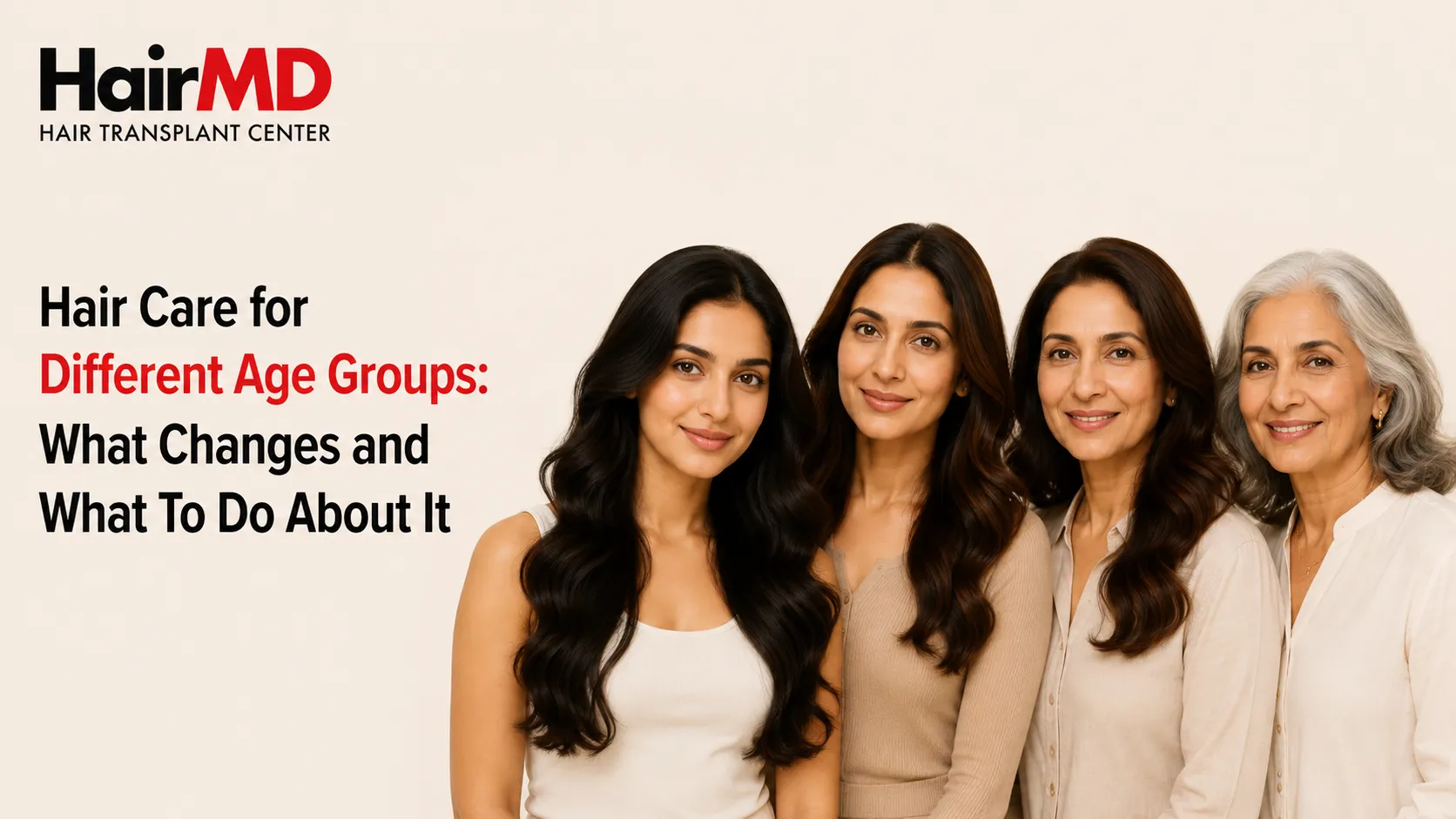
Hair needs change as you move through your 20s, 30s, 40s, and 50s. Understanding these age-related changes can help you choose the right hair care routine, protect hair health, and address thinning or hair loss early.
Hair care advice is rarely age-specific, most of it assumes a single set of concerns applies to everyone. In reality, the hair challenges facing a 22-year-old woman dealing with her first episode of excessive shedding are fundamentally different from those of a 45-year-old man with 10 years of progressive androgenetic alopecia, or a 55-year-old woman navigating postmenopausal hormonal hair thinning.
Hair biology changes meaningfully at each life stage. Understanding what is happening at the follicle level during each decade, and what is early versus what is expected, allows you to act at the right time rather than too late or unnecessarily.
What’s covered in the article?
- How Does Hair Care Change With Age?
- In Your 20s: Peak Hair, and When to Start Watching?
- In Your 30s: The Most Complex Decade
- In Your 40s: When to Take Hair Loss Seriously
- In Your 50s and Beyond: Hormonal Transition and Aging Hair
- The One Principle That Applies Across Every Age
- Frequently Asked Questions
- Conclusion
How does hair care change with age?
In your 20s, hair is typically at peak density and growth rate, the focus is on building good habits and catching early signs of androgenetic alopecia if present. In your 30s, hormonal fluctuations (pregnancy, postpartum, perimenopause begins for some), nutritional gaps, and sustained stress become significant, this decade often brings the first meaningful hair thinning.
In your 40s, declining estrogen (women) or sustained DHT exposure (men with AGA) produces visible changes in density and shaft diameter; early medical treatment matters significantly. In your 50s+, postmenopausal estrogen loss in women accelerates thinning; hair grows more slowly, sheds more, and requires adapted care, including richer moisture, gentle handling, and clinical support for significant loss.
In Your 20s: Peak Hair, and When to Start Watching?
For most people, the 20s represent peak hair density, shaft diameter, and growth rate. Anagen (active growth) phase is at its longest; follicle stem cell populations are robust; hormonal environment (particularly estrogen in women) is protective.
What Is Normal in Your 20s
- Daily shedding of 50–100 hairs, a normal part of the hair cycle
- Hair growing approximately 1–1.5 cm per month
- Slight seasonal variation in shedding (many people notice more shedding in autumn, this is normal)
The Important 20s Warning Signs
Early androgenetic alopecia (AGA): AGA is genetic and can begin as early as 17–18 in men with strong family history. In women, it more commonly presents in the late 20s as a widening parting or slight reduction in ponytail volume. Early AGA is often dismissed as “stress” or “hormonal”, but a trichoscopy showing early follicle miniaturisation at the temples or crown is diagnostic.
Why acting in your 20s matters for AGA: The medical treatments for AGA (minoxidil, finasteride for men) work best when follicles are miniaturising, not after they have become dormant. A patient who begins treatment at Norwood Grade 1–2 can halt progression and maintain density for years. A patient who waits until Grade 4–5 is managing a much more established condition with limited reversal potential.
20s Hair Care Focus
| Priority | What To Do |
| Build the habit baseline | Correct washing frequency for scalp type, microfibre towel, heat protectant, detangle from ends |
| Nutrition foundation | Adequate protein (0.8–1g/kg), iron-rich foods, Vitamin D (especially in urban India where deficiency is common) |
| Early AGA monitoring | If family history of pattern baldness, examine hairline and parting annually; see a dermatologist if you notice temple recession or parting widening |
| Manage stress shedding | A stressful exam period, illness, or rapid weight loss can trigger telogen effluvium at any age, recognise it as temporary and address the trigger |
| Scalp health | Address dandruff promptly; do not let seborrheic dermatitis go untreated |
In Your 30s: The Most Complex Decade
The 30s bring the most varied and diagnostically complex hair changes. Multiple factors converge: established careers and high stress levels, pregnancy and postpartum physiology for many women, the first clear emergence of AGA in genetically predisposed individuals, and the beginning of nutritional depletion from sustained dietary gaps.
What Changes in Your 30s
For women:
Pregnancy and postpartum hair loss: During pregnancy, elevated estrogen and progesterone extend the anagen phase, hair is at its most lush in the second and third trimester. After delivery, the hormonal reversal is rapid, estrogen drops significantly, and the large proportion of hairs held in extended anagen all enter telogen simultaneously. The result: significant shedding beginning 2–4 months postpartum, which can be alarming but is almost always fully reversible by 6–12 months.
PCOS-related hair thinning: Polycystic ovary syndrome, very common in Indian women, elevates androgenic hormones including DHT, which can cause diffuse hair thinning on the scalp alongside facial hair growth. Unlike standard AGA, this responds to hormonal management (spironolactone, combined oral contraceptives with anti-androgenic profiles) in addition to minoxidil.
Perimenopause begins: For some women, perimenopause, the transition phase with fluctuating estrogen levels, begins in the mid-to-late 30s. Estrogen’s protective effect on follicles starts to wane. This may appear initially as increased shedding around menstruation.
For men:
The 30s are when most men with genetic predisposition to AGA have noticeable progression, often moving from early-stage Norwood 2 to 3 or beyond. The critical decision point is whether to begin treatment. Most men who begin minoxidil and/or finasteride in their early-to-mid 30s maintain meaningful density; most who wait until their mid-40s are managing more advanced loss.
30s Hair Care Focus
|
Priority |
What To Do |
|
Postpartum hair loss (women) |
Recognise it as temporary; ensure iron and Vitamin D are replenished; consider minoxidil 2% adjunct for faster recovery if distressing |
|
AGA progression monitoring (men) |
Annual trichoscopy assessment if AGA evident; begin treatment early if progressing |
|
PCOS hair loss (women) |
Assess androgens (DHEAS, testosterone, LH:FSH ratio), hormonal management often more effective than topical treatment alone |
|
Nutritional recovery |
The demands of career, family, and pregnancy deplete ferritin and B12 in many women; blood panel check is valuable |
|
Stress management |
Chronic stress sustains cortisol elevation, prolongs telogen effluvium, and disrupts the hair cycle. Address the source, not just the symptom |
In Your 40s: When to Take Hair Loss Seriously
The 40s bring consistent, progressive changes for both sexes, and the window for effective medical management of AGA starts to narrow for those who haven’t yet acted.
What Changes in Your 40s
For women:
Perimenopause is common in the 40s, estrogen fluctuates significantly before beginning its sustained decline. As estrogen drops, its protective buffering of DHT’s effect on the follicle decreases. Women who were not showing significant hair thinning in their 30s may notice it accelerating in their mid-to-late 40s.
Changes in hair character are also common: hair may become finer in shaft diameter (reduced sebum also means less natural conditioning), drier, and slower-growing. These are partly AGA-related and partly general aging of the follicle stem cell population.
For men:
By the mid-40s, men with AGA who haven’t treated it have often progressed to Norwood 4–5. At this stage, medical treatment can halt further progression but is less effective at recovering miniaturised follicles. The honest clinical picture: treatment in the 40s is worth doing, stopping further loss is still valuable, but the expectation of meaningful density reversal is lower than in the 20s and early 30s.
40s Hair Care Focus
| Priority | What To Do |
| Female AGA assessment | Trichoscopy to distinguish female AGA from perimenopausal telogen effluvium, they co-exist and need different management |
| Medical treatment for AGA | If not already treating AGA, begin, minoxidil, spironolactone (women), finasteride (men); PRP or GFC for additional density support |
| Scalp moisture adaptation | Sebum production decreases in the 40s; scalp may become drier; adjust shampoo frequency and introduce scalp oils |
| Hair character adaptation | Finer, drier hair needs lighter styling products; heavy oils or gels can flatten hair. Volumising products and avoiding heavy conditioners on the roots helps |
| UV protection | The scalp receives significant cumulative UV over decades; SPF scalp products and hats reduce ongoing keratin and colour degradation |
In Your 50s and Beyond: Hormonal Transition and Aging Hair
The 50s mark a distinct shift, particularly for women, where the post-menopausal hormonal environment produces some of the most significant hair changes of any life stage.
What Changes in Your 50s+
For women, postmenopausal hair changes:
After menopause, estrogen production from the ovaries ceases. Estrogen’s protective role in hair biology, prolonging anagen, opposing DHT, maintaining follicle size, is substantially diminished. The result, for many women:
- Diffuse thinning across the crown and top of the scalp (female AGA pattern, also called FPHL, Female Pattern Hair Loss)
- Finer individual hair shafts
- Slower growth rate (anagen phase shortens)
- Increased shedding per cycle
- Dry, brittle hair (reduced sebum from decreased androgen influence on sebaceous glands)
Approximately 40–50% of women over 50 have clinically significant female pattern hair loss. This is a distinct condition from telogen effluvium and requires specific management.
For men, advanced AGA and aging follicle:
Men with AGA who have not been treating it through their 40s often have established baldness by their 50s. In the 50s, the scalp safe zone (donor area for potential hair transplant) is reassessed for density and stability. For men without significant AGA, natural aging of the follicle still produces slightly finer, slower-growing hair.
Aging follicle biology (both sexes):
From the 50s onward, the follicle stem cell niche, the population of cells responsible for initiating each new anagen cycle, naturally reduces in size and activity. This contributes to:
- Slower hair growth (anagen phase shortens from ~5–7 years in the 20s to ~3–4 years by the 60s)
- Progressively finer shaft diameter
- Grey or white hair as melanocyte stem cells are exhausted (not relevant to hair density but a common concern)
50s+ Hair Care Focus
|
Priority |
What To Do |
|
Female pattern hair loss (women) |
Minoxidil 5% (approved in India); discuss systemic options (spironolactone, HRT in appropriate cases) with dermatologist |
|
Scalp moisture |
Sebum production declines further; use gentle, moisturising shampoo; weekly scalp oil treatment; reduce wash frequency |
|
Shaft fragility |
Aging hair is drier and more prone to breakage; reduce heat styling frequency; use rich conditioners; avoid harsh chemical processes |
|
Hair transplant consideration |
For both sexes with significant established loss and stable donor area, FUE hair transplant remains an effective option |
|
Nutrition in older adults |
B12 absorption decreases with age; Vitamin D requirement increases; protein intake often decreases, a blood panel is valuable |
|
Scalp protection |
The scalp has less protective sebum and thins with age, SPF scalp protection and minimising UV exposure becomes more important |
The One Principle That Applies Across Every Age
Whatever your age, the single most impactful decision you can make about hair loss is to act on early signs rather than waiting.
The biological window during which medical treatment is most effective is when follicles are miniaturising but still present and active, not after established baldness. That window is different for everyone, but it is earlier than most people act.
A trichoscopy assessment takes 30 minutes. It tells you whether follicle miniaturisation is present, at what stage, whether your shedding is the temporary type or the progressive type, and whether treatment is worth starting now.
The question is not “is my hair bad enough to see a doctor?”, it is “is my hair changing?” If it is, earlier assessment leads to earlier answers and earlier action during the window when action matters most.
HairMD Hair Loss Treatment, By Age and Stage
HairMD’s dermatologists treat patients across every age group and hair loss stage. With over 250 patients seen daily across 7 Pune centres, our team, including Dr. Dhanraj Chavan, Dr. Sachin Pawar, and Dr. Dhananjay Chavan, offers the full spectrum of clinical options:
| Age Group / Stage | Recommended HairMD Treatment |
| 20s, early AGA detected | Medical management (minoxidil / finasteride) + PRP to halt progression early |
| 30s, postpartum / hormonal shedding | Nutritional assessment + GFC therapy to accelerate recovery |
| 30s, AGA progressing | Medical treatment + PRP or GFC for density support |
| 40s, AGA advancing, donor still viable | GFC therapy + Exosome therapy + evaluate for FUE transplant |
| 40s, female perimenopausal thinning | Minoxidil + anti-androgen therapy + PRP |
| 50s+, postmenopausal female hair loss | Minoxidil 5% + GFC therapy + hormonal management in collaboration with gynaecologist |
| 50s+, established AGA in men | FUE Hair Transplant for permanent coverage + medical maintenance |
| Any age, alopecia areata | Intralesional steroids + PRP; JAK inhibitors for severe cases |
Your hair is changing. Find out what’s driving it, and what to do about it. Book a consultation a
t HairMD, 15+ years of expertise, 4,157+ successful hair transplants, and a trichoscopy assessment at every new patient consultation.
Frequently Asked Questions
At what age does hair loss typically start?
Androgenetic alopecia, the most common cause of progressive hair loss, can begin as early as the late teens in men with strong family history. In women, it more commonly presents in the 30s to 40s, often accelerating after menopause. Telogen effluvium (stress or nutritional-triggered shedding) can occur at any age. There is no single age, the answer depends on the type of hair loss.
How does hair change after 40?
From the late 30s and through the 40s, estrogen decline in women reduces the follicle’s protection against DHT, producing gradual thinning, particularly at the parting and crown. Sebum production also decreases, making hair drier. In men with AGA, the 40s often represent continued progression from earlier stages. Hair shaft diameter gradually decreases and growth rate slows across both sexes from the 40s onward.
Can postmenopausal hair loss be treated?
Yes, postmenopausal female hair loss (female pattern hair loss) is treatable, though not curable. Minoxidil 5% applied topically is the first-line treatment with established evidence. Anti-androgen therapy (spironolactone) can be effective. Hormone replacement therapy (HRT) may reduce the rate of postmenopausal hair thinning in appropriate candidates, this requires discussion with a gynaecologist or endocrinologist alongside a dermatologist. PRP and GFC therapy support density. Hair transplantation is an option for established loss with stable donor area.
Is it normal to lose more hair in your 30s?
It can be normal, and it can also signal a condition worth investigating. Postpartum hair loss (in women after pregnancy), nutritional deficiency hair loss, and the first appearance of androgenetic alopecia all commonly present in the 30s. The important distinction: if shedding lasts more than 3–4 months or is accompanied by visible thinning at the parting or temples, a clinical assessment is worthwhile. Most causes of hair loss in the 30s are treatable when identified early.
Does hair grow slower with age?
Yes, the anagen (active growth) phase of the hair cycle shortens with age. In the 20s, individual hairs may remain in active growth for 5–7 years; by the 50s–60s, this may be reduced to 3–4 years. The result is that maximum achievable hair length shortens, and overall hair density gradually decreases with each cycle, even without AGA. This is a normal part of follicle aging, separate from pathological hair loss conditions.
DO YOU KNOW?
Nearly 250 Patients Visit HairMD
Everyday For Various Hair Concerns
(20+ Years Of Expertise. 4157+ Successful Hair Transplant at HairMD)
Meet Our Dermatologists




Conclusion
Hair needs change as you move through your 20s, 30s, 40s, and 50s. Some changes are a normal part of ageing, while others can indicate conditions such as androgenetic alopecia, nutritional deficiencies, hormonal changes, or excessive shedding.
The most important step is to pay attention to changes in hair density, shedding, texture, or scalp health and seek professional advice early. Early assessment can help identify the cause and provide better options for protecting existing hair.
If you are noticing increased hair fall or thinning at any age, a dermatologist can assess your scalp and recommend care based on your age, hair condition, and underlying cause.
Noticing changes in your hair? Get a professional hair and scalp assessment at HairMD and find the right treatment for your stage of life.
Further Reading
Redensyl vs Minoxidil vs GFC for Hair Loss: Which One Is Right for You?
Redensyl, minoxidil, or GFC therapy for hair loss? HairMD Pune dermatologists explain how each works, who each is for, and how to choose.
How to Prevent Hair Loss: The Ultimate Guide
Explore the ultimate guide to preventing hair loss and maintaining healthy, strong hair.
Do Dermatologists Recommend Inositol and Choline for Hair Loss?
Discover the potential of inositol and choline for hair loss. Learn how these nutrients may benefit follicle health & prevent thinning.
Finding the Right Doctor for Hair Loss Solutions
Searching for What Kind of Doctor Treats Hair Loss? Learn how dermatologists at Hairmd diagnose the cause & offer proven treatments for hair thinning.
Have thoughts? Please let us know
We are committed not only to treating you, but also educating you.