

PRP for Telogen Effluvium: Does It Actually Work?


Written by HairMD Content Team | Medically Reviewed by Dr. Dhanraj Chavan On August 18, 2026


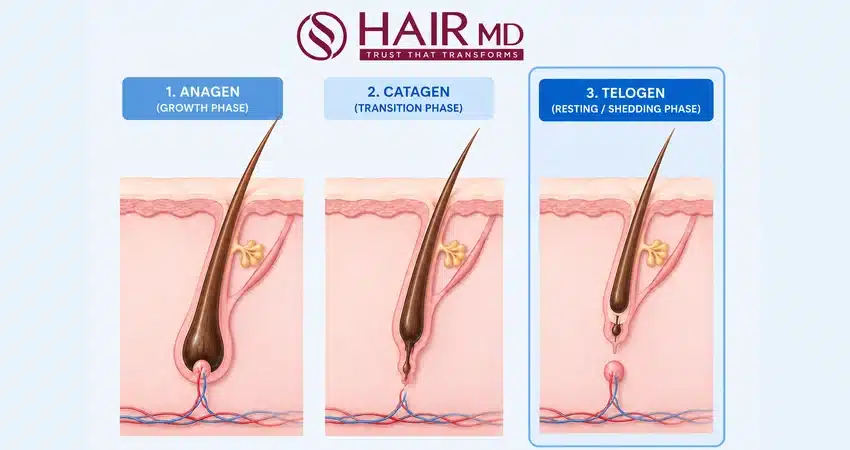
Telogen effluvium is a form of temporary, diffuse hair shedding that happens when a stress to the body pushes many follicles into their resting phase at once. PRP, or platelet-rich plasma, is a treatment that uses concentrated platelets from your own blood to support follicle activity. The honest answer on whether PRP helps telogen effluvium is that it can support recovery in some cases, but it is not the first-line fix and it does not replace finding the cause.
Most telogen effluvium settles on its own once the trigger is addressed. This guide explains what the condition is, when PRP is worth considering, and how Dr. Dhanraj Chavan approaches it at HairMD India.
What’s covered in the article?
- Key Takeaways
- Key Facts About Telogen Effluvium and PRP
- What Is Telogen Effluvium?
- What Causes Telogen Effluvium?
- Does PRP Work for Telogen Effluvium?
- When PRP Makes Sense for Telogen Effluvium?
- How PRP Works and What a Course Looks Like?
- How HairMD India Approaches Telogen Effluvium
- What Timeline and Results to Expect?
- As Verified By
- Conclusion
- Frequently Asked Questions
Key Takeaways
- Telogen effluvium is temporary, diffuse shedding triggered by a physical or emotional stress to the body.
- It usually recovers on its own within 3 to 6 months once the trigger is corrected.
- The first step is always to identify and treat the cause, such as iron deficiency, thyroid issues, illness, or stress.
- PRP is a supportive, add-on treatment, not a cure for telogen effluvium.
- The strongest evidence for PRP is in pattern hair loss, with more limited evidence in telogen effluvium.
- PRP is most useful when shedding is chronic, slow to recover, or overlaps with pattern hair loss.
- Realistic expectations and correcting the underlying cause matter more than any single treatment.
-
Key Facts About Telogen Effluvium and PRP
| Attribute | Detail |
|---|---|
| What it is | Temporary, diffuse hair shedding from a body stress |
| Nature | Usually self-limiting, not scarring |
| Typical recovery | 3 to 6 months after the trigger is corrected |
| Common triggers | Illness, fever, childbirth, crash diets, iron or thyroid issues, stress |
| First-line treatment | Identify and correct the underlying cause |
| Role of PRP | Supportive add-on, not a standalone cure |
| Strongest PRP evidence | Pattern hair loss, less so for telogen effluvium |
| Best PRP candidates | Chronic shedding or telogen effluvium with pattern hair loss |
What Is Telogen Effluvium?
Telogen effluvium is a temporary form of hair shedding where a large number of follicles shift into their resting phase, called telogen, earlier than normal. A few months later those resting hairs are released together, which shows up as noticeably more hair on the pillow, in the shower, and on the comb. The shedding is diffuse, meaning it is spread across the whole scalp rather than in patches.
The key feature is that the follicles themselves are not damaged. They have simply been pushed into rest, so once the body recovers, they cycle back into growth. This is why telogen effluvium is described as self-limiting for most people, and why it does not usually cause permanent baldness on its own.
It is different from pattern hair loss, which is a gradual thinning driven by hormones and genetics. Telogen effluvium is a sudden increase in shedding tied to a trigger, and it affects female hair loss patterns especially, though men experience it too.
What Causes Telogen Effluvium?
Telogen effluvium is set off by a stress to the body that disrupts the hair cycle. Common triggers include a high fever or serious illness, surgery, childbirth, a sudden crash diet, and significant emotional stress. The shedding usually starts two to three months after the trigger, which is why the cause is not always obvious at first.
Nutritional and hormonal factors are frequent drivers. Iron deficiency, thyroid imbalance, and low vitamin D can all push follicles into rest, and these overlap with nutritional hair loss. Certain medications and rapid weight loss are also known causes.
A common recent example is shedding after a viral illness, including after COVID, which pushed many people into telogen effluvium two to three months after infection. In these cases the shedding looks alarming but the follicles are intact, and recovery follows once the body has healed and any deficiency is corrected.
Because the trigger sits months in the past, a proper history and blood tests are the most useful tools. Correcting an iron or thyroid problem often does more for recovery than any topical or in-clinic treatment.

Does PRP Work for Telogen Effluvium?
To recap so far: telogen effluvium is temporary, trigger-based shedding that usually recovers once the cause is fixed, and the follicles are not permanently damaged. This is the context for understanding where PRP fits, because it changes what PRP can realistically add.
The honest position is that PRP has its strongest evidence in pattern hair loss, where studies link it to improved density and reduced shedding. For telogen effluvium specifically, the direct evidence is more limited, because the condition often resolves on its own regardless of treatment. So PRP is best understood as a support that may help the scalp recover, not as a proven cure for the shedding itself.
That does not make PRP useless here. By delivering concentrated growth factors to the scalp, PRP can support follicle activity during recovery. Where it is most reasonable is in chronic telogen effluvium that drags on, or when the shedding has unmasked an underlying pattern hair loss that would benefit from PRP anyway.
When PRP Makes Sense for Telogen Effluvium?
PRP is worth considering in a few specific situations rather than as a default. The first is chronic telogen effluvium, where shedding continues beyond six months and the scalp is slow to recover even after the trigger is addressed. The second is when telogen effluvium overlaps with pattern hair loss, which is common in people who already had early thinning.
In these cases, PRP is used alongside correcting the cause, not instead of it. It is one part of a plan that also includes fixing nutrition, managing stress, and treating any thyroid or hormonal issue. For patients who want a regenerative option, HairMD India also offers GFC growth-factor therapy and mesotherapy for hair, and the right choice is decided at consultation.
Where PRP is not the answer is simple, recent telogen effluvium with a clear one-off trigger, since that usually recovers on its own. A good clinician will say so rather than start treatment you do not need.
How PRP Works and What a Course Looks Like?
PRP treatment draws a small sample of your blood, spins it in a centrifuge to concentrate the platelets, and injects that plasma into the scalp. The platelets release growth factors that support tissue repair and follicle activity. Each session takes 30 to 45 minutes, is well tolerated, and has no downtime.
A typical course is 3 to 4 sessions spaced about a month apart, followed by maintenance if needed. When PRP is used for telogen effluvium, it runs alongside the main treatment of correcting the trigger. You can read more about the PRP therapy process and see PRP patient reviews from HairMD India patients.
Results are gradual and depend heavily on whether the underlying cause has been fixed. PRP cannot hold back shedding that is still being driven by an untreated iron deficiency or thyroid problem, which is why the workup comes first.
How HairMD India Approaches Telogen Effluvium
At HairMD India, the first step for diffuse shedding is a proper diagnosis, not immediate treatment. Dr. Dhanraj Chavan reviews the history to find a trigger and orders blood tests to check iron, thyroid, and vitamin levels. Correcting these is the foundation of recovery.
Only after the cause is identified and being managed does the discussion move to supportive treatments. If shedding is chronic or overlaps with pattern hair loss, PRP or other regenerative options may be added. Documented outcomes for diffuse shedding can be seen in the clinic’s hair-loss patient results and verified reviews.
This order matters. Starting PRP while ignoring an untreated cause wastes time and money, so a plan that treats the root first is both more effective and more honest.
What Timeline and Results to Expect?
Most telogen effluvium improves within 3 to 6 months of the trigger being corrected, and full density often returns over the following months. Regrowth appears as short, fine hairs at first, which thicken as the cycle normalises. Patience matters here, because the hair cycle takes several months to reset fully.
When PRP is added for chronic or overlapping cases, any benefit builds gradually over the course of sessions rather than appearing suddenly. Comparison photos every few weeks are the most reliable way to judge real change, since day-to-day shedding varies.
As Verified By
- DermNet describes telogen effluvium as diffuse shedding triggered by illness, stress, or other body changes, and confirms it is usually reversible.
- The American Academy of Dermatology confirms that stress and illness can cause temporary hair shedding that recovers once the trigger passes.
- A clinical review of telogen effluvium causes and management supports identifying and correcting the underlying trigger as the core treatment.
- A study of PRP for hair loss documents improved density in pattern hair loss, where the evidence is strongest.
- Further evidence on PRP as an adjunct in hair restoration supports its supportive role alongside primary treatment.
Conclusion
Telogen effluvium is temporary, diffuse shedding that usually recovers once the cause is corrected, so the first and most important step is finding that cause. PRP is a supportive add-on, not a cure, and it makes the most sense for chronic shedding or when telogen effluvium overlaps with pattern hair loss. Used honestly and alongside proper diagnosis, it can help the scalp recover, but it is not a substitute for treating the trigger.
If you are shedding more than usual and want to understand why, an assessment with Dr. Dhanraj Chavan can identify the cause and set the right plan. Book a consultation at HairMD India, Pune. All internal links verified.
Frequently Asked Questions
Can PRP cure telogen effluvium?
No, PRP does not cure telogen effluvium. The condition is usually temporary and recovers once its trigger, such as iron deficiency, thyroid imbalance, illness, or stress, is corrected. PRP is a supportive add-on that may help the scalp recover in chronic cases, but treating the underlying cause is what actually resolves the shedding.
Does telogen effluvium go away on its own?
Yes, most telogen effluvium resolves on its own within 3 to 6 months once the trigger is addressed. The follicles are pushed into rest rather than damaged, so they cycle back into growth after the body recovers. Chronic cases that continue beyond six months should be assessed, as they may need further investigation and support.
When is PRP worth trying for shedding?
PRP is most reasonable for chronic telogen effluvium that does not recover after the trigger is fixed, or when the shedding overlaps with pattern hair loss. In these cases it is used alongside correcting the cause, not instead of it. For simple, recent shedding with a clear one-off trigger, PRP is usually unnecessary because recovery happens naturally.
What actually causes telogen effluvium?
Telogen effluvium is triggered by stress to the body, including high fever, serious illness, surgery, childbirth, crash diets, and significant emotional stress. Nutritional and hormonal factors such as iron deficiency, thyroid imbalance, and low vitamin D are common drivers. The shedding usually starts two to three months after the trigger, so the cause is not always obvious.
How long does PRP take to show results for hair?
PRP results are gradual and build over a course of 3 to 4 sessions spaced about a month apart. For telogen effluvium, any benefit depends heavily on whether the underlying cause has been corrected first. Regrowth appears as fine, short hairs that thicken over the following months, so comparison photos every few weeks are the best way to track change.
Should I fix my diet before starting PRP?
Yes, correcting nutrition is a priority before or alongside PRP. Iron deficiency, low vitamin D, and thyroid problems are common causes of diffuse shedding, and PRP cannot hold back hair loss that is still being driven by an untreated deficiency. At HairMD India, blood tests and correcting these come first, with PRP added as support where appropriate.
DO YOU KNOW?
Nearly 250 Patients Visit HairMD
Everyday For Various Hair Concerns
(15+ Years Of Expertise. 4157+ Successful Hair Transplant)
Meet Our Dermatologists

Further Reading
PRP Safety: Side Effects & Who Should Avoid It
PRP hair treatment safety – common side effects, who should avoid PRP, and how HairMD Pune keeps the procedure safe for suitable patients.
Beard Hair Transplant: Can Beard Hair Be Used for Hair Transplant? | HairMD
Yes, beard hair can be used for hair transplant but only in specific cases. HairMD dermatologists explain when it’s used, how many grafts it yields, its advantages and limitations.
Can Hair Loss Be Reversed?
Wondering if hair loss can be reversed? Discover effective treatments for regrowing your hair!
PRP vs Minoxidil for Hair Loss: Which Works?
PRP vs minoxidil for hair loss – how each works, results, cost, and which suits you, plus whether to combine them, from HairMD Pune.
Have thoughts? Please let us know
We are committed not only to treating you, but also educating you.