

Is Alopecia Areata Contagious? Here’s the Truth


Written by HairMD Content Team | Medically Reviewed by Dr. Dhanraj Chavan On July 10, 2023


What’s covered in the article?
- What is Alopecia Areata?
- Why does Alopecia Areata occur?
- When do I suspect having Alopecia Areata?
- Why is Alopecia Areata not contagious?
- Conclusion
What is Alopecia Areata?
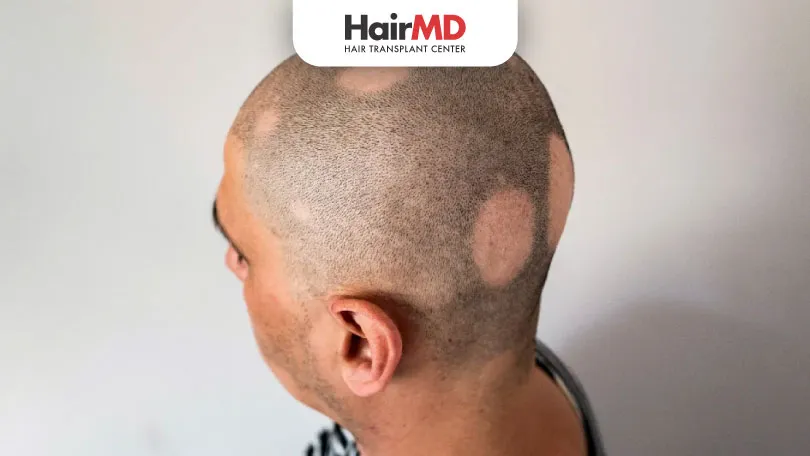
Alopecia areata is a type of hair loss that occurs when your immune system mistakenly attacks the hair follicles of your body tissue, may it be on your scalp or elsewhere on the body, thus suppressing or stopping hair growth.
Why does Alopecia Areata occur?
Alopecia areata is an autoimmune condition, which means that your immune system becomes overactive and attacks the body’s own cells.
The immune cells gather around the affected hair follicles and attack them, failing to recognize them as the body’s own, causing mild inflammation which leads to weakening of the hair roots and falling out of hair, causing bald patches.
The reason for this is not known, but infection, certain medications, environmental factors and sudden extreme stress could act as possible triggers, inducing an overactive reaction from the body’s immune system.
When do I suspect having Alopecia Areata?
If you’ve ruled out other causes of hair loss like nutritional deficiencies, hormonal imbalance, lifestyle factors, infections and more, then you should get a consult from your trichologist or dermatologist to probe deeper into your hair fall troubles.
Also, you’re more susceptible to it if there is a history of someone suffering from it in your family or if you yourself suffer from an allergic condition or other autoimmune conditions like diabetes, anaemia, thyroid disorders, vitiligo, lupus, etc.
Why is Alopecia Areata not contagious?
As we’ve learned, alopecia areata is a mistaken immune response. Because it is not caused by any virus or bacteria, there is no organism to spread it. So it cannot be contagious to others or even to other parts of your own body.
Alopecia areata is neither painful, nor contagious; it causes no loss of body function and no interference with school, work, and social life. But it can be the cause of sudden and severe shedding of hair, affecting your self-image and confidence. Getting it consulted, diagnosed and treated at the earliest is recommended so that you may preserve your precious locks.
DO YOU KNOW?
Nearly 250 Patients Visit HairMD
Everyday For Various Hair Concerns
(20+ Years Of Expertise. 4157+ Successful Hair Transplant at HairMD)
Meet Our Dermatologists




Conclusion
Further Reading
Dermapen Scalp Microneedling Results in Pune
Real HairMD Pune patient results from Dermapen scalp microneedling for hair – what to expect, sessions, and before and after outcomes.
Fotona & LLLT Laser Hair Cost in Pune 2026
Fotona and LLLT laser hair treatment cost in Pune 2026 – per-session pricing, packages, and what affects the cost at HairMD Pune.
How to Prevent Hair Loss: The Ultimate Guide
Explore the ultimate guide to preventing hair loss and maintaining healthy, strong hair.
PRP Pre & Post Care Protocol | HairMD Pune
PRP for alopecia areata – what the research says about regrowth, how it compares to other options, and when it may help, from HairMD Pune.
Have thoughts? Please let us know
We are committed not only to treating you, but also educating you.