

PRP for Alopecia Areata: What the Research Says?


Written by HairMD Content Team | Medically Reviewed by Dr. Dhanraj Chavan On September 26, 2026


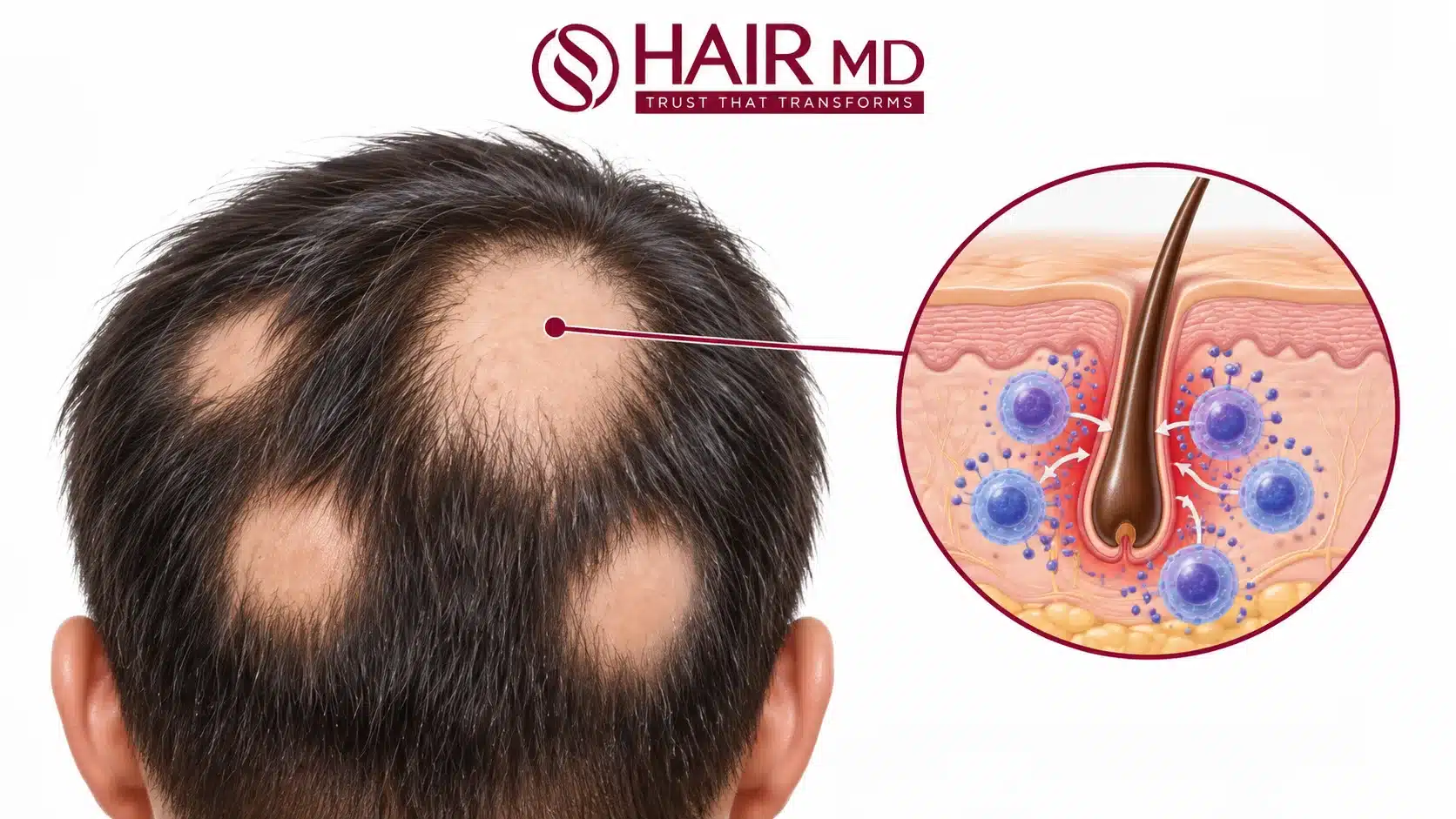
PRP therapy for alopecia areata is the use of a concentrate of your own blood platelets, injected into bald patches, to help calm the immune attack on the follicles and support regrowth. Alopecia areata is an autoimmune condition, which makes it very different from ordinary pattern hair loss, so the evidence for PRP here needs its own honest look.
The short version is that research shows modest and mixed results: PRP can help some patchy cases and offers a steroid-free option, but it is not a cure and not clearly better than standard treatment. This guide explains what the studies actually found and how Dr. Dhanraj Chavan uses PRP for alopecia areata at HairMD India in Pune.
Key Takeaways
- Alopecia areata is an autoimmune condition where the immune system attacks hair follicles, causing patchy hair loss.
- Standard first-line treatment is usually corticosteroid injections, with other options for more extensive cases.
- Research on PRP for alopecia areata is mixed, showing modest benefit in some patchy cases.
- Trials suggest PRP works about as well as steroid injections in some patients, but not clearly better.
- PRP is best seen as a steroid-free option or an add-on, not a first-line cure.
- PRP does not switch off the autoimmune cause, so alopecia areata can still relapse.
- At HairMD India, PRP for alopecia areata is used selectively, alongside proven treatments.
What’s covered in the article?
- Key Takeaways
- Key Facts About PRP for Alopecia Areata
- What Is Alopecia Areata?
- How Alopecia Areata Is Usually Treated?
- Can PRP Help Alopecia Areata? What the Research Says?
- When PRP Might Be Considered for Alopecia Areata?
- What PRP Cannot Do for Alopecia Areata?
- Combining PRP with Standard Treatment
- How PRP for Alopecia Areata Works in Practice?
- The HairMD India Approach
- As Verified By
- Conclusion
- Frequently Asked Questions
Key Facts About PRP for Alopecia Areata
Attribute |
Detail |
|---|---|
| Condition type | Autoimmune, causing patchy round bald spots |
| Standard first-line care | Intralesional corticosteroid injections |
| PRP role | Emerging, steroid-free option or add-on, not first-line |
| Evidence strength | Mixed and modest, from small randomized trials |
| Versus steroids | Comparable in some trials, not clearly superior |
| Best-suited cases | Limited patchy alopecia areata |
| Not a cure | Autoimmune cause remains, so relapse is possible |
| Reviewed by | Dr. Dhanraj Chavan, MD Dermatology, HairMD India Pune |
What Is Alopecia Areata?
Alopecia areata is an autoimmune condition in which the immune system mistakenly attacks the hair follicles, causing hair to fall out in small, round, coin-sized patches. It most often affects the scalp, but it can involve the beard, eyebrows, or any hair-bearing area, and in some cases it spreads to larger areas. It is different from pattern hair loss, which is driven by hormones and genetics rather than the immune system.
The condition is unpredictable, which is one of its most difficult features. Patches can regrow on their own, stay stable, or spread, and the course varies a lot from person to person. You can read a fuller explanation in our guide to alopecia areata symptoms, causes, and treatments and this deeper look at the causes behind the condition.
How Alopecia Areata Is Usually Treated?
Because alopecia areata is autoimmune, the main treatments aim to calm the immune attack rather than simply stimulate hair. For limited patchy disease, corticosteroid injections into the patches are the usual first-line treatment, and they often work well. Topical steroids, minoxidil, and other measures may be added depending on the pattern and the person.
For more extensive or stubborn cases, dermatologists may use topical immunotherapy, and newer oral medicines called JAK inhibitors are now approved for severe alopecia areata. The right choice depends on how much hair is involved, the person’s age, and how the condition behaves. This is why a proper diagnosis and a tailored plan matter far more than any single treatment, as explained in our complete guide to hair loss causes and treatments.
Can PRP Help Alopecia Areata? What the Research Says
This is where honesty matters, because PRP for alopecia areata has real but modest evidence. An early and often-cited randomized trial found that PRP improved hair regrowth in patchy alopecia areata more than a corticosteroid and more than placebo, which generated a lot of interest. Later split-scalp trials also found that both PRP and steroid injections improved the standard severity score from baseline.
However, the bigger picture is more measured. A systematic review and meta-analysis of randomized trials concluded that PRP has limited efficacy in alopecia areata and, when pooled, did not show a significant difference compared with steroid injections. In other words, PRP appears to help some people and works roughly as well as steroids in parts of the evidence, but it is not clearly superior, and the studies are small. The landmark half-head randomized trial and a later split-scalp trial are worth knowing, and PRP has also been studied as an add-on to immunotherapy for alopecia areata.
When PRP Might Be Considered for Alopecia Areata?
Given the evidence, PRP is best thought of as an option for specific situations rather than a routine choice. It may suit people with limited patchy alopecia areata who prefer a steroid-free approach, or who have not done well with, or want to reduce, repeated steroid injections. It is also sometimes used as an add-on alongside standard treatment rather than instead of it.
It is not the right tool for every case. Extensive alopecia areata, or the forms that affect the whole scalp or body, generally need immunotherapy or newer systemic medicines rather than PRP. A dermatologist can judge whether your pattern fits, and our PRP candidacy guide explains how suitability is assessed.
What PRP Cannot Do for Alopecia Areata?
Setting honest limits is as important as describing the benefits. PRP does not switch off the underlying autoimmune process, so even when a patch regrows, alopecia areata can return in the same or a different area. It is a support for regrowth, not a permanent fix for the immune cause.
Results also vary and can be slow, and PRP will not guarantee full regrowth, especially in longstanding or widespread patches. Because alopecia areata sometimes regrows on its own, it can be hard to know how much credit any treatment deserves in a given person. This is exactly why realistic expectations, set with a doctor, matter so much, and why we explain the typical PRP results timeline before anyone starts.
Combining PRP with Standard Treatment
Because PRP is not a clear winner on its own, some of its most sensible use is alongside proven treatments rather than instead of them. In practice, this can mean using corticosteroid injections as the main treatment for a patch while adding PRP to support regrowth, or pairing PRP with topical immunotherapy in more resistant cases. A randomized trial of PRP combined with immunotherapy explored exactly this kind of pairing. The logic is that different treatments target different parts of the problem, so combining them may do more than any single approach alone.
This combined approach also fits how alopecia areata actually behaves. The condition is unpredictable and can relapse, so a flexible plan that can be adjusted over time often serves people better than betting everything on one treatment. A dermatologist decides the mix based on how much hair is involved and how it responds, then reviews it at each visit. The goal is steady, realistic progress rather than a single dramatic fix.
How PRP for Alopecia Areata Works in Practice?
When PRP is used for alopecia areata, a small blood sample is drawn, spun in a centrifuge to concentrate the platelets, and the plasma is injected into the affected patches. It is typically given as a course of sessions spaced a few weeks apart, often combined with standard treatment rather than used alone. The idea is that the growth factors in the plasma help calm inflammation and encourage the resting follicles to re-enter the growth phase.
Because it uses your own blood, PRP is generally well tolerated, with mild, short-lived soreness or redness at the injection sites. It still needs proper screening first, and it is not suitable for everyone. For a broader view of what the treatment can offer, see our overview of the benefits of PRP for hair loss and the honest success-rate picture.

The HairMD India Approach
At HairMD India, alopecia areata is diagnosed carefully first, because the plan depends on how much hair is involved and how the condition is behaving. Dr. Dhanraj Chavan generally starts with proven treatments such as corticosteroid injections and excimer laser for patchy disease, and considers PRP as a steroid-free option or an add-on in suitable cases. This keeps the plan evidence-led rather than treatment-led.
Care is available across HairMD India’s Pune locations, including Pune Station, Baner, Kharadi, Prabhat Road, Pimple Saudagar, and NIBM, so follow-up stays convenient over a course. Honest counselling is part of the process, including the fact that alopecia areata can relapse and that regrowth happens in stages. The aim is to match the treatment to the evidence and to your specific pattern.
As Verified By
The points in this article align with DermNet on alopecia areata, a systematic review and meta-analysis on PRP as a steroid-free option for alopecia areata, a landmark half-head randomized trial of PRP, a split-scalp randomized trial, and a trial of PRP combined with immunotherapy.
Conclusion
PRP for alopecia areata is a genuinely promising but modest option, not a breakthrough cure. The research shows it can help some patchy cases and performs roughly as well as steroid injections in parts of the evidence, while a pooled analysis found only limited efficacy and no clear advantage over steroids. It is best used selectively, as a steroid-free choice or an add-on, with realistic expectations and proper medical guidance.
If you have alopecia areata and want to know whether PRP fits your case, Dr. Dhanraj Chavan and the team at HairMD India can assess it honestly. Book a consultation with HairMD India in Pune to discuss your options.
Frequently Asked Questions
Does PRP work for alopecia areata?
The evidence is mixed but shows modest benefit for some people with patchy alopecia areata. Several small randomized trials found PRP improved regrowth, and in some it worked about as well as steroid injections. However, a pooled meta-analysis found only limited efficacy and no clear advantage over steroids, so PRP is a reasonable option for selected cases rather than a guaranteed solution.
Is PRP better than steroid injections for alopecia areata?
Not clearly, because some individual trials found PRP performed as well as, or in one case better than, corticosteroid injections, yet the combined evidence showed no significant difference between them. This means PRP is mainly useful as a steroid-free alternative or an add-on, rather than a proven upgrade. A dermatologist can advise which approach suits your pattern and history.
Can PRP cure alopecia areata?
No, PRP does not cure alopecia areata. The condition is autoimmune, and PRP does not switch off the immune process that attacks the follicles, so hair can fall out again even after a patch regrows. PRP may support regrowth in some cases, but ongoing management and realistic expectations are important, because relapse is always possible with this condition.
How many PRP sessions are needed for alopecia areata?
PRP for alopecia areata is usually given as a course of sessions spaced a few weeks apart, with the exact number depending on the response and how much hair is involved. It is often combined with standard treatment rather than used alone. Your dermatologist will set the schedule after assessing your patches and will review progress, since results vary from person to person.
Is PRP safe for alopecia areata?
PRP is generally well tolerated because it uses your own blood, so there is no risk of an allergic reaction or disease from a donor. The main side effects are mild and short-lived, such as tenderness, redness, or minor bruising at the injection sites. It still needs proper screening first, and it is not suitable for everyone, which is why a medical assessment always comes before treatment.
Who should not use PRP for alopecia areata?
PRP is generally avoided for very extensive alopecia areata, such as loss of all scalp or body hair, which usually needs immunotherapy or newer systemic medicines instead. It is also unsuitable for people with certain blood disorders, active infections, or some chronic illnesses. A dermatologist checks your medical history and the extent of your hair loss to decide whether PRP is an appropriate option.
DO YOU KNOW?
Nearly 250 Patients Visit HairMD
Everyday For Various Hair Concerns
(15+ Years Of Expertise. 4157+ Successful Hair Transplant)
Meet Our Dermatologists


Further Reading
Hair Transplant Cost in Pune for 2026
Find affordable 2026 hair transplant costs in Pune with expert results by Dr. Dhanaraj Chavan. Transparent pricing and flexible payments.
Beard Hair Transplant: Can Beard Hair Be Used for Hair Transplant? | HairMD
Yes, beard hair can be used for hair transplant but only in specific cases. HairMD dermatologists explain when it’s used, how many grafts it yields, its advantages and limitations.
PRP vs Minoxidil for Hair Loss: Which Works?
PRP vs minoxidil for hair loss – how each works, results, cost, and which suits you, plus whether to combine them, from HairMD Pune.
PRP After Hair Transplant: When & Why | HairMD Pune
PRP after a hair transplant protects grafts and strengthens native hair. Learn when to start, how many sessions, and what to expect at HairMD Pune.
Have thoughts? Please let us know
We are committed not only to treating you, but also educating you.