

PRP Therapy Results Timeline: What to Expect Month-by-Month in Pune


Written by HairMD Content Team | Medically Reviewed by Dr. Dhanraj Chavan On April 01, 2026


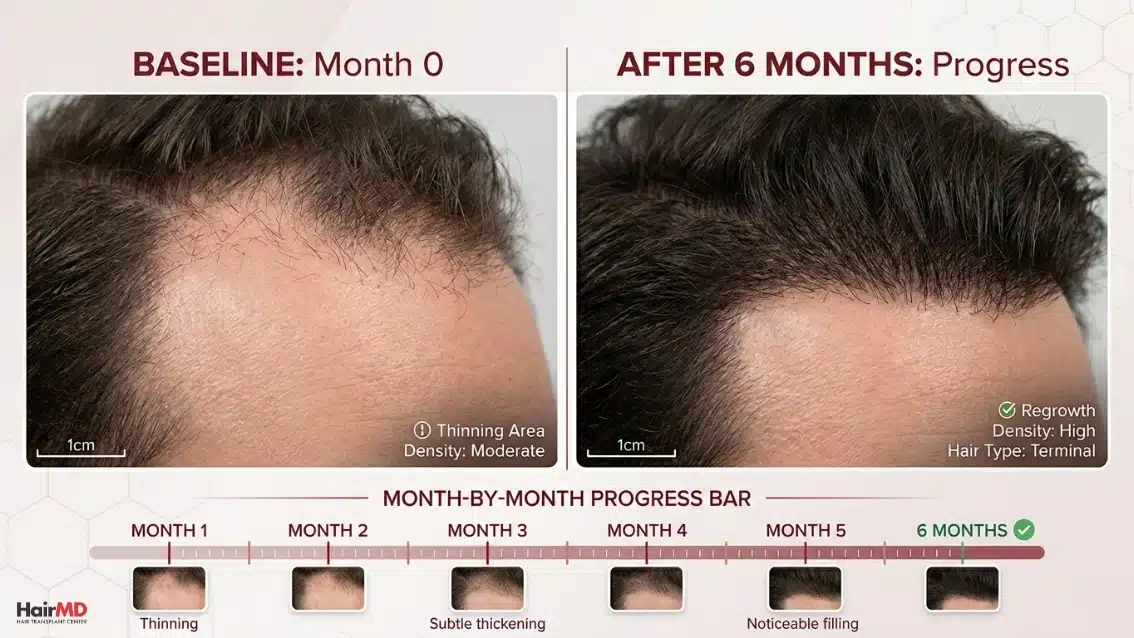
Most people starting PRP therapy for hair loss expect to see results within weeks. When nothing visible happens in the first month, they assume the treatment has failed. That assumption accounts for more abandoned treatment courses than any other factor we see at HairMD India.
PRP therapy results follow a predictable six-phase timeline. The biology of hair growth cannot be rushed – a dormant follicle needs time to reactivate, push through its resting phase, and produce a visible hair shaft. That process takes a minimum of three months. Peak results at five to six months. Maintenance phase after that.
This guide gives you the complete month-by-month breakdown, based on clinical data and the patterns Dr. Sachin Pawar has observed across 2,500+ hair restoration procedures at HairMD India Pune. You will know exactly what to expect at each stage, what is a good sign, and how to track your own progress objectively.
What’s covered in the article?
- Key Takeaways
- How PRP Therapy Stimulates Hair Growth?
- Month 0-1: What Happens Right After Your First PRP Session?
- Month 2-3: The Quiet Phase
- Month 3-4: First Visible Changes Begin
- Month 4-6: Active Growth and Peak Results
- Month 6+: Maintenance Phase and Long-term Results
- Factors That Affect Your PRP Timeline in Pune
- What if You Do Not See Results? Honest Answers
- Frequently Asked Questions
- Start Tracking Your Progress From Day One
Key Takeaways
- PRP results follow a six-phase timeline – most patients see first visible improvements at months 3-4, not weeks 1-2
- Initial shedding in the first month is normal and expected – it signals follicle reactivation, not treatment failure
- Peak results occur at months 5-6, with clinical studies showing 30-35% improvement in hair density at this stage
- Maintenance sessions every 4-6 months are needed to preserve results – without them, density gains gradually decline over 12-18 months
- Early-stage hair loss (Norwood Grade 2-4) responds best to PRP; patients with completely bald patches will see limited results
How PRP Therapy Stimulates Hair Growth?
Before getting into the timeline, it helps to understand what PRP is actually doing inside your scalp – because this explains why results take months rather than days.
PRP (platelet-rich plasma) is prepared from your own blood. A small sample is drawn (around 32 ml), centrifuged to concentrate the platelets, and then injected directly into the scalp in the treatment area. Those concentrated platelets release growth factors – including PDGF, VEGF, and IGF – that signal dormant hair follicles to shift from their resting phase (telogen) back into an active growth phase (anagen).
What is PDGF, VEGF and IGF? What do they do?
PDGF stands for Platelet-Derived Growth Factor, VEGF stands for Vascular Endothelial Growth Factor and IGF stands for Insulin-like Growth Factor
These factors:
- Stimulate dermal papilla cells
- Enhance angiogenesis
- Promote transition of follicles from telogen → anagen phase
Why results take months, not weeks?
Hair grows at roughly 1-1.5 cm per month. A follicle that has been dormant first needs to complete its resting phase, then begin anagen, then grow a hair shaft long enough to be visible above the scalp surface. From follicle activation to visible hair, you are looking at a minimum of 8-12 weeks.
This is why the first two months after starting PRP feel like nothing is happening. Things are happening – just entirely beneath the surface. A randomised placebo-controlled trial published on PubMed Central measured hair density at 6 weeks, 3 months, and 6 months, finding significant improvement at all three checkpoints versus baseline. The follicles were responding from the beginning. The visible results just took time to surface.
Month 0-1: What Happens Right After Your First PRP Session?
The first session is straightforward. Your blood is drawn, spun down, and the platelet-rich portion is injected into the scalp with a fine needle. The procedure takes 45-60 minutes. Most patients describe the sensation as a mild tingling or pressure – not significantly painful.
Normal reactions in the first two weeks
You may notice mild redness, mild tightness, or tenderness at the injection sites for 12-24 hours. Some patients experience minor swelling across the forehead, which typically resolves within a day. These are normal inflammatory responses that are actually part of the healing process.
You do not need to stay home from work. Most patients resume normal activity the same day. Avoid vigorous scalp massage, harsh shampoos, and direct sun exposure for the first one day.
What initial shedding actually means?
Here is the part that catches most patients off guard: in the first two to four weeks, you may notice increased hair shedding. More hair on your pillow. More coming out in the shower.
This is called reactive shedding, and it is a sign the treatment is working. PRP accelerates the transition of hair follicles from telogen (resting) into anagen (active growth). To do that, the old hair shaft in the resting follicle has to be released and shed before the new growth cycle can begin. The follicle is not dying – it is resetting.
Not every patient experiences this. But if you do, do not stop treatment. Speak to your doctor at HairMD India if you are concerned, but understand that this shedding phase is well-documented and temporary.
Month 2-3: The Quiet Phase
Month two is the hardest part of the PRP journey. The shedding from month one has stopped, but there is nothing visible to show for the treatment yet. This is when most patients start to doubt.
What is happening under the surface?
While your mirror shows nothing, your scalp is in active preparation. The growth factors from PRP injections are promoting new blood vessel formation around follicles, improving nutrient delivery to the follicle bulb, and stimulating cell proliferation. Your second session will typically be scheduled around week four to six, with the third following at week eight to twelve. This spacing is deliberate – consecutive sessions compound the growth factor stimulus before the effect of the first injection wanes.
Signs your PRP is working before you can see it
- Reduced daily shedding – If you were losing 150+ hairs per day before, many patients notice a drop to under 100 by month two. Track this by collecting shed hairs after showering for a few consecutive days.
- Scalp texture change – Some patients report their scalp feeling less tight or dry. This reflects improved microcirculation.
- Existing hair feels different – Hair that was thinning or breaking easily may start to feel stronger and less brittle.
For a detailed look at what PRP treatment involves before your sessions, the HairMD blog has a full explainer.
Month 3-4: First Visible Changes Begin
This is where the timeline becomes rewarding.
To recap: PRP therapy at HairMD India Pune works by delivering concentrated growth factors to hair follicles in the targeted scalp area. It applies to patients with sufficient existing follicular activity – typically Norwood Grade 2-5 or Ludwig Grade 1-2. The indicators to watch are shedding rate, hair texture, and scalp health. The sections below cover what visible improvement looks like and what drives variation in results between patients.
At months three to four, most patients notice changes they can see and measure. Clinical studies put improvement at this stage at roughly 10-20% increased hair density compared to baseline, with texture improvements often appearing before volume changes.
What 10-20% density increase looks like in practice?
This does not sound dramatic on paper, but reads differently in the mirror. The part line looks slightly narrower. Shorter, finer hairs appear in the crown area that were not there before – these are new hairs in early anagen, not yet at full diameter. One study tracking patients at three months found a mean improvement of 20.5% in hair count and 31.3% in hair thickness versus baseline.
Hair texture changes before volume changes
The change in hair strength is usually the first thing patients notice. Hairs that were snapping when combed feel more resilient. PRP stimulates the follicle and the surrounding dermal papilla cells – improvement shows in hair quality before it shows in quantity.
If you want to track your PRP treatment success rate objectively, months 3-4 are when to start comparing progress photos against your baseline under the same lighting.
Month 4-6: Active Growth and Peak Results
Months four through six are the payoff phase. New hair shafts have grown long enough to fully integrate with existing hair. The density improvement becomes clearly visible to others, not just to you under harsh bathroom lighting.
Clinical data from a Frontiers in Medicine study found the pull test became negative in over 95% of patients treated with PRP at six months – meaning active hair loss had effectively stopped. The majority of patients in that study reached their best improvement by month six. Johns Hopkins Medicine confirms that scalp PRP results are most noticeable at six months.
At HairMD India, patients typically report improvement in the 30-35% range in treated areas by the end of this phase, based on trichoscopic measurement. This aligns with the broader clinical literature.
What the 30-35% improvement milestone means?
This is not uniform across the scalp. Areas where hair follicles are still partially active respond better than areas where follicles have been dormant for years. The frontal hairline, crown, and mid-scalp typically show the clearest improvement. The hairline edge, where follicles are often in a more advanced state of miniaturization, tends to show less dramatic change.
Patients who combined PRP with GFC (Growth Factor Concentrate) therapy or topical treatments during this period typically see more pronounced results at the six-month mark. The mechanisms are complementary rather than redundant.
Month 6+: Maintenance Phase and Long-term Results
By month six, you have completed your initial treatment course (typically three sessions spaced four to six weeks apart). The question now is not whether PRP worked – it is how to keep it working.
PRP results are not permanent. The growth factors from injections do not stay in your scalp indefinitely, and androgenetic alopecia is a progressive condition driven by DHT sensitivity that PRP does not permanently alter. Without maintenance, hair density gains typically begin declining gradually over the following 12-18 months.
How long PRP results last without maintenance?
A 2024 systematic review published in Skin Research and Technology covering 21 studies and 628 participants found that follow-up periods of six months or less were the most common in the research, making long-term durability data limited. Separately, one study found 80% of patients retained their hair benefits one year after their last treatment. Another found density beginning to decline six months after completing a treatment course.
The variation comes down to individual DHT sensitivity, overall scalp health, and whether patients are using adjunct treatments such as topical minoxidil.
HairMD’s recommended maintenance schedule
At HairMD India, the standard recommendation following a completed initial PRP course is one maintenance session every four to six months. This schedule keeps growth factor levels elevated enough to sustain the anagen phase in treated follicles.
Some patients doing well at six months extend to annual maintenance. Others with more aggressive hair loss patterns benefit from quarterly sessions. This is a conversation to have with Dr. Dhanraj Chavan or Dr. Sachin Pawar at your six-month review. You can also compare PRP maintenance against mesotherapy for hair loss as a complementary or alternative approach in the maintenance phase.

Factors That Affect Your PRP Timeline in Pune
Two patients at the same clinic, with the same doctor, on the same protocol, can have noticeably different six-month outcomes. These are the main variables.
Hair loss grade and follicle health
This is the biggest predictor. PRP activates dormant or miniaturizing follicles – it cannot regenerate follicles that have been completely destroyed. Patients at Norwood Grade 2-4 for male hair loss and Ludwig Grade 1-2 for female hair loss achieve the best outcomes. At Grade 5 and above, PRP can slow further loss and improve density in partially active areas, but no new growth will be seen on already bald areas.
Age, platelet quality, and nutritional status
Younger patients tend to see faster results because early-stage follicular miniaturization responds better, and because platelet concentration declines with age. At HairMD, platelet count is checked before treatment to confirm the prepared PRP is at a therapeutic level.
Iron and protein deficiency are common underlying contributors to hair loss in patients – particularly women. PRP cannot compensate for a follicular environment lacking the raw materials for hair growth. Addressing nutritional gaps alongside treatment produces measurably better results.
What if You Do Not See Results? Honest Answers
Check your timeline first. If you are asking this at month two or three, you are asking too early. Visible results before month three are rare. If you are at month five or six with no change in shedding rate, texture, or any measurable metric, that warrants a conversation with your doctor.
Who does not respond well to PRP?
- Patients at Norwood Grade 6-7, where most follicles in affected areas are no longer viable
- Those with active autoimmune conditions affecting hair (alopecia areata responds differently and needs a modified protocol)
- Patients with unaddressed nutritional deficiencies – particularly iron or protein or Vitamin B12
- Anyone who completes only one session – three sessions minimum is required to assess response
If PRP does not produce results after a full course, FUE hair transplant is the permanent alternative for suitable candidates. Adding dermaroller microneedling to subsequent PRP sessions may improve outcomes for partial responders.
When to contact HairMD between sessions?
- Persistent pain at injection sites beyond three days
- Signs of infection: warmth, pus, fever
- Swelling that has not resolved within a week
- Sudden significant worsening of hair loss beyond the normal shedding phase
You can also read verified patient reviews for PRP at HairMD India to see how other patients experienced their own timelines.
Frequently Asked Questions
When do PRP hair loss results become visible?
Most patients see the first visible signs at months 3-4 – new fine hairs in treated areas and existing hair feeling thicker. Significant density improvement typically becomes clear by months 5-6. Expecting results before month three leads many patients to stop an effective treatment too early.
Is initial shedding after PRP normal?
Yes. Reactive shedding in weeks 1-4 is a recognised part of the process. PRP shifts follicles from the resting phase (telogen) into active growth (anagen), and the old hair shaft has to shed before the new cycle begins. Mild to moderate shedding in the first month is expected. If it is severe or persists beyond week four, contact your doctor.
How many PRP sessions are needed to see results?
Three sessions spaced four to six weeks apart is the standard initial course at HairMD India. Single sessions or two-session courses are not sufficient to assess whether PRP is working. After the initial course, most patients see results by month five to six. Maintenance sessions every four to six months preserve those results long-term.
Can PRP results be permanent?
No. PRP stimulates the hair growth cycle but does not permanently alter the DHT sensitivity driving androgenetic alopecia. Without maintenance, density gains typically begin declining 12-18 months after completing the initial course.
What happens if I miss a maintenance session?
Missing a session by a few weeks is unlikely to cause noticeable regression. Going more than 12 months without a maintenance dose typically results in gradual density decline over the following six months. Book as soon as you can rather than waiting for your next scheduled appointment.
Does PRP work better for men or women?
PRP works for both. In men, it is most effective for androgenetic alopecia at Norwood Grade 2-4. In women, it works well for female pattern hair loss at Ludwig Grade 1-2, diffuse thinning, and post-partum hair loss. A 2024 meta-analysis covering 628 women confirmed significant positive outcomes across multiple female hair loss types. A broader PMC review of PRP research found 84% of all studies reported a positive PRP effect for hair loss.
Can PRP be combined with other treatments for faster results?
Yes, and combination therapy consistently outperforms PRP alone. Common combinations at HairMD India include PRP with topical minoxidil, PRP with dermaroller microneedling, and PRP with GFC growth factor concentrate therapy. If you are already on minoxidil, do not stop – the two treatments work on different mechanisms and their effects compound.
How do I track my PRP progress at home?
Consistent monthly photography under the same lighting is the most reliable method. Take shots of the crown, frontal hairline, and any areas of concern. Alongside photos, count shed hairs for three consecutive days at months one, three, and six – a significant drop in daily shed count is one of the earliest measurable signs that PRP is working. HairMD provides a downloadable PRP Progress Tracker to guide your monthly documentation.
DO YOU KNOW?
Nearly 250 Patients Visit HairMD
Everyday For Various Hair Concerns
(20+ Years Of Expertise. 4157+ Successful Hair Transplant at HairMD)
Meet Our Dermatologists

Start Tracking Your Progress From Day One
PRP therapy for hair loss works – but it works on a timeline that requires patience and consistency. The patients who get the best results are those who complete the full initial course, take their progress photos from month one, and show up for maintenance sessions once the initial treatment is done.
If you are in Pune and considering PRP, or if you have already started and want to know whether your timeline is on track, the team at HairMD India can review your current progress and adjust your protocol if needed.
Further Reading
Dermapen Scalp Microneedling Results in Pune
Real HairMD Pune patient results from Dermapen scalp microneedling for hair – what to expect, sessions, and before and after outcomes.
Fotona & LLLT Laser Hair Cost in Pune 2026
Fotona and LLLT laser hair treatment cost in Pune 2026 – per-session pricing, packages, and what affects the cost at HairMD Pune.
How to Prevent Hair Loss: The Ultimate Guide
Explore the ultimate guide to preventing hair loss and maintaining healthy, strong hair.
PRP Pre & Post Care Protocol | HairMD Pune
PRP for alopecia areata – what the research says about regrowth, how it compares to other options, and when it may help, from HairMD Pune.
Have thoughts? Please let us know
We are committed not only to treating you, but also educating you.