

PRP Hair Treatment in Wakad: Benefits, Results & Who It’s For?
Written by HairMD Content Team | Medically Reviewed by Dr. Dhanraj Chavan
Updated on February 04, 2026
If you live in Wakad and are experiencing early hair thinning or increased hair fall, you may have come across PRP hair treatment as a non-surgical option. But what exactly does PRP do, who does it work best for, and what kind of results can you realistically expect?
This article explains how PRP therapy works, when it’s recommended, how Wakad residents typically plan treatment, and how it compares with other hair restoration options.
PRP Hair Treatment at a Glance
- PRP uses your own blood-derived growth factors
- It is non-surgical and minimally invasive
- Best suited for early to moderate hair thinning
- Helps reduce hair fall and improve hair thickness
- Works best when done in multiple sessions
-
What’s covered in the article?
- What Is PRP Hair Treatment?
- How PRP Helps With Hair Loss?
- Who Is PRP Hair Treatment Best For?
- PRP Results: What Timeline Should You Expect?
- PRP vs Hair Transplant: How Are They Different?
- Local Considerations for Wakad Residents
- Frequently Asked Questions
- How Wakad Residents Can Continue Their Research?
What Is PRP Hair Treatment?
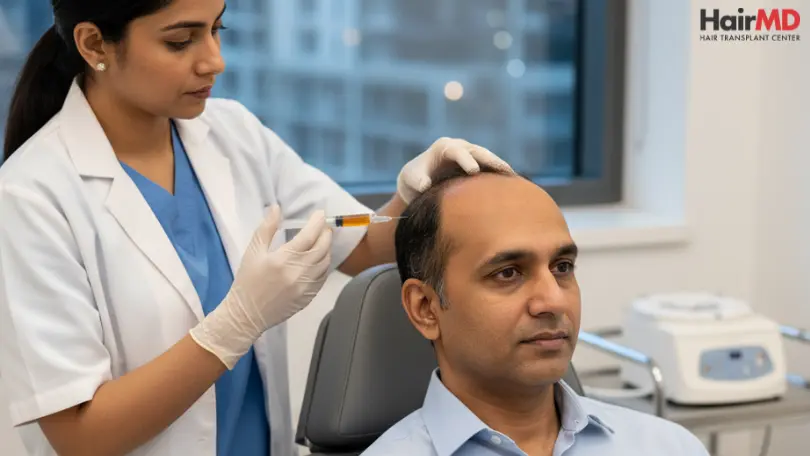
PRP (Platelet-Rich Plasma) therapy is a treatment where a small amount of your blood is drawn, processed to concentrate growth factors, and then injected into targeted areas of the scalp.
These growth factors help:
- Improve blood supply to hair follicles
- Strengthen weakened follicles
- Support the hair growth cycle
PRP does not create new hair follicles. Instead, it helps improve the health and performance of existing ones.
How PRP Helps With Hair Loss?
PRP therapy is commonly recommended when hair follicles are still alive but weakened.
It can help by:
- Reducing excessive hair shedding
- Improving hair shaft thickness
- Slowing the progression of pattern hair loss
- Supporting scalp health
For Wakad residents noticing gradual thinning rather than visible bald patches, PRP is often considered a first-line treatment before surgical options.
Who Is PRP Hair Treatment Best For?
PRP tends to work best for people who:
- Are in early or moderate stages of hair loss
- Have diffuse thinning rather than complete baldness
- Want a non-surgical approach
- Are looking to maintain existing hair
PRP may be less effective if:
- Hair loss is advanced
- Bald areas have no active follicles
- Hair fall is due to untreated medical conditions
In such cases, PRP may still be used as a supportive treatment, but not as a standalone solution.
PRP Results: What Timeline Should You Expect?
PRP results are gradual and vary from person to person.
A typical timeline looks like this:
- After 1–2 sessions: Reduced hair fall for many patients
- After 3–4 months: Improved hair texture and thickness
- After 6 months: Visible improvement in density for suitable candidates
PRP is usually done as a series of sessions, followed by maintenance treatments depending on individual response.
PRP vs Hair Transplant: How Are They Different?
PRP and hair transplant serve different purposes.
PRP therapy:
- Strengthens existing hair
- Slows hair loss progression
- Non-surgical
- Replaces lost hair in bald areas
- Suitable for advanced hair loss
- Permanent follicle relocation
For many Wakad patients, PRP is recommended:
- Before a transplant (to improve scalp health)
- After a transplant (to support existing hair)
Learn more about surgical options here:
- Hair Transplant Treatment
Local Considerations for Wakad Residents
- PRP therapy fits well into busy lifestyles.
Wakad residents often choose PRP because:
- Sessions are short
- No downtime is required
- Normal activities can resume the same day
Many patients schedule sessions around workdays or weekends, with minimal disruption to daily routines.
Frequently Asked Questions
Is PRP hair treatment painful?
PRP involves small injections, but discomfort is usually mild and temporary.
How many PRP sessions are needed?
Most patients are advised a series of sessions, followed by maintenance depending on response.
Can PRP stop hair loss completely?
PRP can slow hair loss and improve hair quality but cannot stop genetic hair loss entirely.
Is PRP better than GFC?
PRP and GFC both use growth factors, but GFC delivers a more concentrated formulation. Suitability depends on individual diagnosis.
How Wakad Residents Can Continue Their Research?
PRP is often researched by people in Wakad who are noticing early thinning and want to understand whether a non-surgical medical option may help preserve active follicles. It can be useful in the right situation, but it is not automatically the best fit for every type or stage of hair loss.
The next step is usually not to rush into treatment, but to understand whether PRP, GFC, medication-based support, or transplant planning makes sense for the current pattern of thinning.
To continue reading, review the Wakad area page, compare PRP with the GFC article from the same area, or explore the main PRP treatment page for a broader medical overview.
Medical Disclaimer:
This article is for informational purposes only and does not replace professional medical advice. Treatment suitability varies by individual diagnosis.
For a broader understanding of hair loss treatments and options available across different areas, you can explore hair restoration services in Pune.