

FUE Hair Transplant: What Happens on the Day of Surgery?


Written by HairMD Content Team | Medically Reviewed by Dr. Dhanraj Chavan On July 13, 2026


Summary
An FUE hair transplant is a surgical procedure that removes individual hair follicles from a donor area (usually the back of the scalp or beard) and implants them into thinning or bald zones. The procedure takes 6-8 hours for 2,000-3,000 grafts and is performed under local anaesthesia only – no general anaesthesia is required.
At HairMD Pune, all FUE procedures are led by Dr. Sachin Pawar, MBBS MS Surgery, who has completed 2,500+ surgeries since focusing exclusively on hair transplant in 2016. Graft survival rates at HairMD are 95-98%. Most patients return to desk work within 7-10 days.
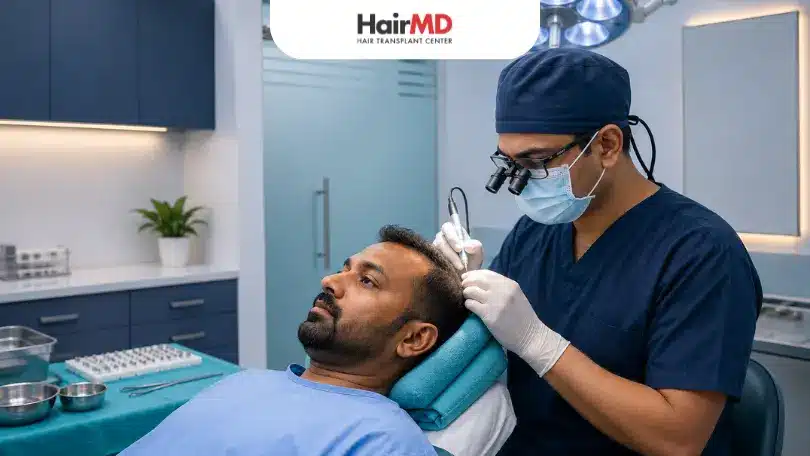
An FUE hair transplant is a surgical procedure that extracts individual follicular units from the donor area using a micro-punch tool and implants them into thinning or bald regions of the scalp under local anaesthesia. The patient remains awake throughout. No general anaesthesia is used. The procedure lasts 6-8 hours for most patients requiring 2,000-3,000 grafts.
Most patients researching hair transplant surgery look at before-and-after photos and final results. Far fewer understand what the actual procedure day involves – step by step, from arrival through to going home. This article covers every phase in sequence so you know exactly what to expect.
What’s covered in the article?
- Summary
- FUE Procedure: Key Facts at a Glance
- Before the Procedure Begins
- Step 1: Local Anaesthesia
- Step 2: Follicular Unit Extraction
- Step 3: Graft Sorting and Preparation
- Step 4: Pre-Made Slits (Recipient Site Creation)
- Step 5: Implantation
- After the Procedure: Day 1
- FUE vs FUT: The Key Difference
- Why Patients Choose HairMD for FUE in Pune?
- Frequently Asked Questions
FUE Procedure: Key Facts at a Glance
| Attribute | Detail |
|---|---|
| Procedure Type | Surgical (outpatient – no hospital stay) |
| Anaesthesia | Local anaesthesia only |
| Duration | 6–8 hours (2,000–3,000 grafts) |
| Grafts Per Session | 1,500–3,500 (depends on donor density and bald area) |
| Graft Survival Rate | 95–98% (HairMD clinical data) |
| Downtime | 7–10 days for most patients |
| Visible Hair Growth | 6–8 months post-surgery |
| Final Result Timeline | 12–18 months |
| Surgeon at HairMD | Dr. Sachin Pawar, MBBS, MS Surgery, 2,500+ FUE procedures |
As verified by: International Society of Hair Restoration Surgery (ISHRS) surgical standards for FUE; American Academy of Dermatology (AAD) hair transplant guidelines.

Before the Procedure Begins
Patients arrive at HairMD at 10 am. A pre-operative review covers three things: confirming the graft count, donor examination under trichoscope, approving the hairline design, and completing the anaesthesia consent form.
Dr. Sachin Pawar marks the hairline on the scalp with a surgical marker. The patient reviews and approves the design before any procedure begins. This step is not optional – the hairline determines the entire aesthetic outcome and cannot be corrected once grafts are implanted.
Hair in the donor area (typically the back and sides of the scalp) is trimmed to approximately 1mm length at the clinic. Patients do not need to shave their head at home before arriving.
Step 1: Local Anaesthesia
HairMD uses nerve block techniques that reduce the total number of injections required and minimise discomfort. Patients sit comfortably throughout and can watch a film, listen to audio, or rest during the procedure.
Once anaesthesia takes effect, the patient feels no pain during extraction or implantation. Anaesthesia is topped up as needed throughout the session.
Step 2: Follicular Unit Extraction
This is the longest phase. The doctor uses a micro-punch tool (0.8-1.0mm diameter) to score the skin around each follicular unit in the donor area and extract the graft intact. Each follicular unit contains 1-4 hairs. A 2,500-graft session means 2,500 individual extractions.
Grafts are extracted in a dispersed, randomised pattern across the donor area. This prevents visible thinning in any single zone and preserves the natural appearance of the donor region.
Extracted grafts go under microscopic examination and each grafts count is registered in the tab.They are placed immediately into a holding solution to maintain viability. A study published in the Journal of Cutaneous and Aesthetic Surgery found that graft survival rates decline when follicular units remain outside the body for more than 6 hours. HairMD’s operating protocol keeps total out-of-body time under 4 hours across all sessions.
The extraction phase runs approximately 3-4 hours for a 2,000-2,500 graft session. A scheduled break is taken at the midpoint.
Calculate how many grafts you need for your hair loss pattern

Step 3: Graft Sorting and Preparation
While extraction continues, a trained technician sorts the extracted grafts under magnification. Single-hair grafts are set aside for the hairline. Two- and three-hair grafts go to the mid-scalp. Four-hair grafts are placed in the crown, and remaining grafts are placed in frontal to crown area as per the guidance of Dr. Sachin Pawar and generally he aims at locations where density is the priority.
Sorting grafts by follicular unit size directly affects the natural appearance of the final result. A hairline built with multi-hair grafts looks unnatural regardless of graft count. Clinics that skip the grading step produce higher visible density but less realistic results.
Step 4: Pre-Made Slits (Recipient Site Creation)
After administering local anaesthesia, the first surgical step is recipient site creation (pre-made slits). This is one of the most critical stages of the hair transplant procedure because it determines the position, angle, direction, and density of every transplanted hair.
At HairMD Clinic, all pre-made slits are created exclusively by Dr. Sachin Pawar using a sterile 20G (20-gauge) needle, which allows for highly precise and minimally traumatic recipient sites.

Step 5: Implantation
Graft implantation is the final surgical stage of the hair transplant procedure. During this phase, each follicular unit is carefully implanted into the pre-made recipient sites created by Dr. Sachin Pawar.
Grafts are implanted into slits one by one. The implantation team uses either forceps or a Choi implanter pen to seat each graft at the correct depth without damaging the follicle. Graft survival at this stage depends on how each unit is handled. Compression or crushing of the follicle causes transection – the follicle is damaged and will not produce hair.
At HairMD Clinic, implantation is performed using the SAVA Implanter by experienced Senior Hair Transplant Technicians under the continuous, direct supervision of Dr. Sachin Pawar. This ensures precise graft placement while maintaining the highest standards of safety and graft survival.
At HairMD, implantation is performed only by trained staff under Dr. Sachin Pawar’s direct supervision. No graft implantation is delegated to unsupervised technicians. A 2,500-graft implantation takes approximately 2-2.5 hours.
By the end of this phase, the recipient area appears slightly red with small grafts visible at the surface. This is expected and resolves as healing progresses.
The American Academy of Dermatology confirms that FUE hair transplant produces permanent hair growth when grafts are harvested from the permanent donor zone (the back and sides of the scalp below the occipital ridge), as these follicles are genetically resistant to DHT-driven miniaturisation.
After the Procedure: Day 1
The procedure ends with written post-operative instructions. Patients leave with a light bandage over the donor area. The recipient area is left uncovered.
Mild forehead swelling on days 2-4 is common. It is caused by anaesthetic fluid tracking forward due to gravity – it resolves on its own within a few days and is not a sign of infection. Redness in the recipient area typically clears within 5-7 days.
Patients receive a short course of antibiotics, anti-inflammatory medication, and a pain reliever for the first 5 days. Minoxidil and finasteride are usually reintroduced at the 2-week mark.
Complete post-operative care guide for hair transplant patients
Transplanted hair enters a shedding phase (shock loss) between 3-6 weeks after surgery. This is a normal, expected response – the follicle enters a resting phase before initiating new growth. New hair growth begins at 3-4 months. Why does transplanted hair fall out after surgery?
Full density is assessed at 12-18 months. Most patients see 60-70% of their final result by month 9. A research review published in Dermatologic Surgery confirms that peak graft maturation occurs at 12-14 months post-FUE for the majority of patients.
Why minoxidil and finasteride are prescribed after hair transplant
FUE vs FUT: The Key Difference
FUE extracts individual follicular units without a linear incision, leaving only small circular marks in the donor area. FUT removes a strip of scalp that is then divided into grafts, leaving a single linear scar. FUE has a shorter recovery, less post-operative discomfort, and is preferred by patients who wear their hair short.
Detailed FUE vs FUT comparison for Pune patients
HairMD performs FUE exclusively. For patients with Norwood grade 2-7 who need low or very high graft counts, during the initial consultation, Dr. Sachin Pawar carefully evaluates the patient’s pattern of hair loss, donor hair availability, scalp characteristics, long-term hair restoration goals, and future progression of baldness.
Based on this comprehensive assessment, he determines whether the desired result can be safely achieved in a single session or whether a staged, multi-session approach would provide a better long-term outcome.
For patients with extensive baldness or limited donor reserves, dividing the procedure into two planned sessions is often the safer and more effective option than attempting an excessively large transplant in a single day. A staged approach helps preserve the health of the donor area, maintains adequate blood supply to the recipient scalp, optimizes graft survival, reduces surgical fatigue, and allows each session to achieve natural density without compromising the quality of the result.
Dr. Sachin Pawar discusses this treatment plan in detail during the consultation so that patients understand the expected number of grafts, realistic outcomes, and the long-term strategy for achieving natural, permanent hair restoration.
The NHS notes that most reputable hair transplant clinics perform either FUE or FUT – but not all clinics explain the technical difference or how it affects recovery and scarring. Asking your surgeon which method they perform and why is a valid part of your consultation.
Why Patients Choose HairMD for FUE in Pune?
Dr. Sachin Pawar has focused exclusively on hair transplant surgery since 2016, completing over 2,500 FUE procedures. All extractions and channel creation at HairMD are performed by Dr. Sachin Pawar personally – not delegated to technicians working without supervision.
HairMD’s 95-98% graft survival rate reflects consistent adherence to out-of-body time protocols, graded implantation technique, and post-operative monitoring. The clinic’s results gallery documents outcomes across Norwood grades 2-6 for male patients and Ludwig grades 1-3 for female patients.
Frequently Asked Questions
Is FUE hair transplant painful?
The local anaesthesia injections at the start of the procedure are the most minor painful part. Most patients describe them as a mild stinging sensation lasting 10-15 minutes. Once anaesthesia takes effect, the procedure is painless.
How long does a FUE procedure take at HairMD?
Most FUE sessions at HairMD take 6-8 hours, depending on the graft count required. A 1,500-graft session takes approximately 5-6 hours. A 3,000-graft session takes 7-8 hours. Scheduled breaks are built into each session. The clinic provides meals and refreshments on the day of the procedure so patients are comfortable throughout.
Can I go home the same day after FUE?
Yes. FUE at HairMD is an outpatient procedure – no hospital admission is required. Patients leave the clinic 1-2 hours after the procedure ends, once post-operative instructions are completed and the donor area is dressed. A responsible adult should accompany the patient home. Patients should not drive themselves on the day of surgery.
When will I see hair growth after FUE?
Transplanted hair sheds 2-6 weeks after surgery during the shock loss phase – this is normal and expected. New hair growth begins at 3-4 months. Most patients see visible improvement in coverage by month 6. Full density is assessed at 12-18 months, as graft maturation continues through the first year.
What is graft survival rate and what affects it?
Graft survival rate is the percentage of transplanted follicles that establish blood supply and produce permanent hair growth. At HairMD, the rate is 95-98%. Key factors that affect survival include: time the graft spends outside the body (HairMD keeps this under 4 hours), handling technique during implantation, patient health on the day of surgery, and post-operative care in the first 7 days. Transection (crushing or cutting the follicle during extraction or implantation) is the most preventable cause of poor graft survival.
Is FUE hair transplant suitable for women?
FUE is suitable for some female patients, depending on the type and pattern of hair loss. Women with traction alopecia, localised scarring alopecia, or frontal fibrosing alopecia with a stable donor area are often good candidates. Women with diffuse androgenetic alopecia (Ludwig pattern) may not have adequate donor density for FUE. Dr. Sachin Pawar assesses female candidacy thoroughly at the initial consultation before recommending surgery.
DO YOU KNOW?
Nearly 250 Patients Visit HairMD
Everyday For Various Hair Concerns
(20+ Years Of Expertise. 4157+ Successful Hair Transplant at HairMD)
Meet Our Dermatologists

Further Reading
Dermapen Scalp Microneedling Results in Pune
Real HairMD Pune patient results from Dermapen scalp microneedling for hair – what to expect, sessions, and before and after outcomes.
Fotona & LLLT Laser Hair Cost in Pune 2026
Fotona and LLLT laser hair treatment cost in Pune 2026 – per-session pricing, packages, and what affects the cost at HairMD Pune.
PRP Pre & Post Care Protocol | HairMD Pune
PRP for alopecia areata – what the research says about regrowth, how it compares to other options, and when it may help, from HairMD Pune.
PRP for Alopecia Areata: What Research Says
PRP for alopecia areata – what the research says about regrowth, how it compares to other options, and when it may help, from HairMD Pune.
Have thoughts? Please let us know
We are committed not only to treating you, but also educating you.