

PRP Therapy for Female Hair Loss: What Women Need to Know in Pune


Written by HairMD Content Team | Medically Reviewed by Dr. Dhanraj Chavan On April 07, 2026


PRP therapy (platelet-rich plasma) is a non-surgical hair loss treatment that uses your own blood’s growth factors to stimulate dormant hair follicles. It is clinically used for female pattern hair loss, hormonal hair thinning, PCOS-related shedding, and postpartum hair loss. HairMD India in Pune offers PRP therapy as part of its dedicated female hair loss programme.
The treatment involves drawing a small amount of blood, spinning it in a centrifuge to concentrate the platelets, and injecting the platelet-rich plasma directly into thinning areas of the scalp. Growth factors in PRP – including VEGF, EGF, and FGF – stimulate the hair follicle at the cellular level, extending the anagen (growth) phase and improving hair density and thickness.
PRP therapy is most effective for women with Ludwig Grade I-II female pattern hair loss and active hair follicles. It is not recommended during pregnancy or active breastfeeding.
Results typically become visible within 3-6 months of the first session, with most protocols requiring 3-6 sessions spaced 4 weeks apart. HairMD India serves patients across Pune, including Baner, Hinjewadi, Kothrud, Koregaon Park, Aundh, and Wakad.
What’s covered in the article?
- Quick Facts: PRP Therapy for Female Hair Loss
- Key Treatment Attributes
- Why Women Lose Hair Differently?
- What Is PRP and How Does It Work for Women?
- Which Women Are the Right Candidates?
- What to Expect – The PRP Session at HairMD India
- PRP for PCOS and Hormonal Hair Loss in Pune
- PRP After Pregnancy – What Postpartum Women Need to Know?
- GFC vs PRP – Which Is Better for Female Hair Loss?
- As Verified By
- The Right First Step Is a Proper Diagnosis
Quick Facts: PRP Therapy for Female Hair Loss
- PRP uses your own blood’s platelets to stimulate hair follicle growth.
- Effective for female pattern hair loss, PCOS shedding, and postpartum thinning.
- 3-6 sessions required, spaced 4 weeks apart; results visible by 3-6 months.
- Growth factors (VEGF, EGF, FGF) extend the hair growth phase and improve density.
- Not recommended during pregnancy or active breastfeeding.
- Maintenance sessions every 6-12 months help sustain results.
- HairMD India, Pune offers PRP therapy as part of a dedicated female hair loss programme.
Key Treatment Attributes
|
Attribute |
Detail |
|
Treatment Name |
PRP Therapy (Platelet-Rich Plasma) |
|
Session Duration |
45-60 minutes |
|
Sessions Needed |
3-6 sessions (spaced 4 weeks apart) |
|
Results Visible |
3-6 months from first session |
|
Maintenance |
Every 6-12 months |
|
Best For |
Ludwig Grade I-II female pattern hair loss; PCOS, postpartum, hormonal thinning |
|
Not Recommended |
Pregnancy, breastfeeding, active scalp infection, platelet disorders |
|
Unrealistic Expectations |
Expecting immediate or permanent results; looking for complete regrowth in bald areas |
|
Available At |
HairMD India, Pune (Baner, Hinjewadi, Kothrud, Koregaon Park, Aundh, Wakad) |
Why Women Lose Hair Differently?
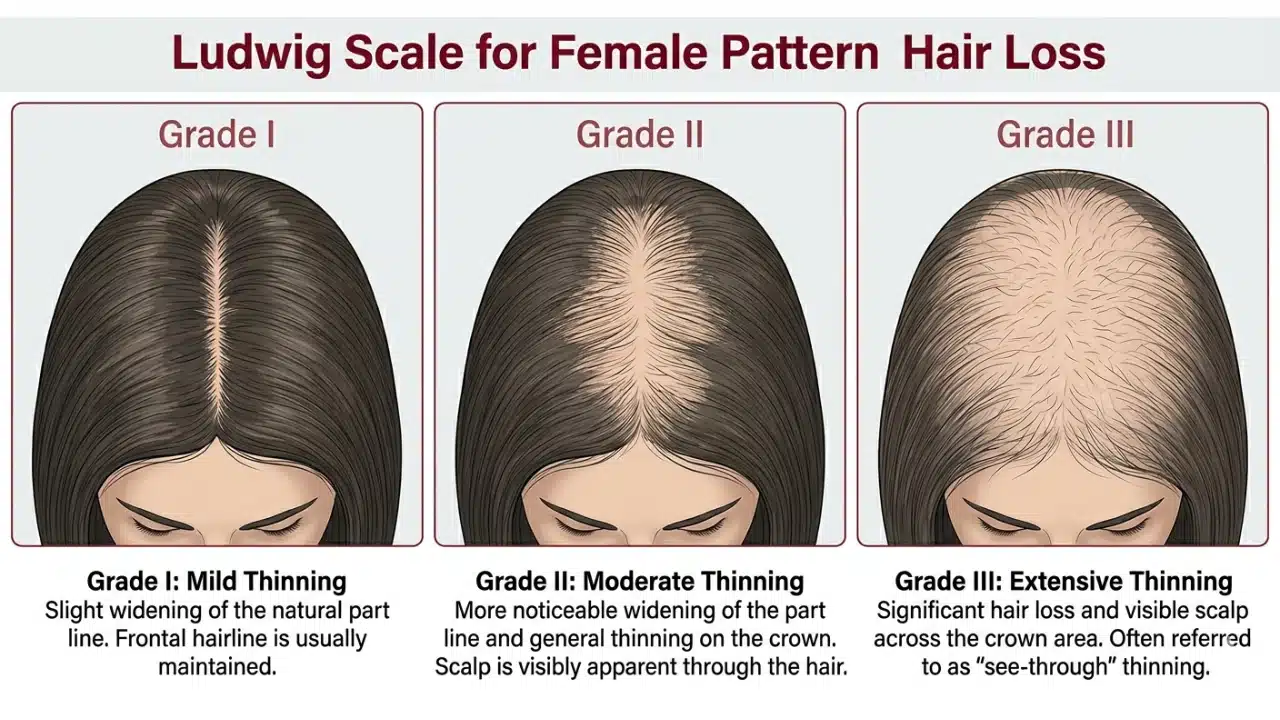
Female hair loss patterns differ from male hair loss in one key way: women rarely develop a receding hairline. Instead, hair thins diffusely across the crown, widening part lines, or along the top of the scalp – what the Ludwig scale classifies as Grade I to III.
The causes are more varied than in men, and often overlap. Androgenetic alopecia – the hormonal, genetic form – is the most common driver, but PCOS, postpartum oestrogen drops, perimenopause, thyroid disorders, iron deficiency, and chronic stress can all trigger significant shedding.
Because of this multifactorial nature, female hair loss tends to be more gradual, complex, and variable than male pattern baldness. Iron deficiency and stress specifically cause telogen effluvium – a diffuse shedding type that looks alarming but is often reversible once the underlying cause is addressed.
Recognising the Signs
The early signs of female pattern hair loss include a widening part, more hair on the pillow or in the shower drain, and visible thinning at the crown. Unlike men, most women retain their frontal hairline even as hair density drops. Starting PRP therapy early – at Ludwig Grade I or II – significantly improves treatment outcomes.
What Is PRP and How Does It Work for Women?
PRP therapy works by concentrating the platelets already present in your blood and delivering them directly to your scalp. The process takes 45-60 minutes: blood is drawn from your arm, spun in a centrifuge to isolate the platelet-rich plasma, and injected into areas of thinning across the scalp.
Platelets release growth factors – VEGF (vascular endothelial growth factor), EGF (epidermal growth factor), and FGF (fibroblast growth factor) – that signal hair follicles to shift from the resting phase back into active growth. Specifically, PRP increases blood supply to the follicle, prolongs the anagen (growth) phase, reduces follicle miniaturisation, and improves hair thickness and density over time.
PRP therapy is particularly suited to women because it is non-hormonal and does not interfere with contraception, thyroid medication, or other treatments women commonly manage alongside hair loss. At HairMD India, Pune, the PRP hair treatment is conducted under dermatologist supervision and adapted to each patient’s hair loss stage and underlying cause.
Important: PRP does not create new hair from scratch. It revives existing weak follicles – making hair stronger, thicker, and healthier over time. Women with fully miniaturised follicles or advanced baldness will see limited benefit.
Which Women Are the Right Candidates?
To recap: PRP therapy at HairMD India Pune uses concentrated platelet growth factors to stimulate follicle activity in women with female pattern hair loss, hormonal thinning, PCOS, or postpartum shedding. The key decision factors are hair loss stage (Ludwig Grade I-II is optimal), active follicles, and ruling out contraindications. The sections below cover the procedure, PCOS and postpartum guidance, and costs.
PRP therapy for female hair loss produces the best results for women in the early to moderate stages of loss. The ideal candidate has Ludwig Grade I or Grade II female pattern hair loss – meaning the part is visibly wider or there is crown thinning – but the hairline is intact and follicles are still active. You can review before and after results for female patients at HairMD India to see what outcomes look like at different stages.
Women with PCOS-related hair thinning, postpartum diffuse shedding, or hormonal fluctuations from perimenopause are strong candidates. These causes share one critical feature: the follicle is weakened but not destroyed, which means PRP’s growth factor stimulation can make a measurable difference. Candidates also tend to see better results when underlying causes – such as nutritional deficiencies, stress-related shedding, or mild hormonal imbalance – are already being identified and managed alongside PRP.
PRP therapy is not recommended during pregnancy or breastfeeding. It is also not suitable for women with active scalp infections, blood clotting disorders, or very advanced hair loss (Ludwig Grade III with severely miniaturised follicles). Women on blood thinners should discuss suitability with their HairMD India dermatologist before proceeding. Realistic expectations also matter: candidates should have a healthy scalp, be willing to commit to multiple sessions, and understand that results build gradually over months.
What to Expect – The PRP Session at HairMD India
A PRP session at HairMD India follows a three-step protocol: blood draw from the arm, centrifuge processing to isolate the platelet-rich plasma, and scalp injection at points of thinning. The session takes 45-60 minutes and requires no downtime.
Before injections begin, a numbing cream is applied to the scalp to reduce discomfort. During the injections, most women feel mild pricking or pressure – the procedure is generally well tolerated. Most women notice mild tenderness at injection points for 24-48 hours after the session, and the scalp may feel slightly warm immediately after.
Strenuous activity and hair washing are avoided for 24 hours. There is no recovery period – most patients return to normal activity the same day. Mild redness, swelling, or slight soreness of the scalp may occur for a few hours.
The standard PRP protocol for female hair loss is 3 sessions spaced 4 weeks apart. Visible reduction in shedding begins around 4-6 weeks, with hair density and thickness improvements evident by the 3-6 month mark. Maintenance sessions every 6-12 months help sustain the results, with your HairMD India dermatologist advising on timing based on your response to the initial course.
PRP for PCOS and Hormonal Hair Loss in Pune
PCOS-related hair loss is one of the most common causes of female hair thinning in Pune, particularly among women aged 20-40. PCOS elevates androgen levels, making follicles sensitive to DHT – which progressively miniaturises them, producing thinner strands until growth stops. PRP therapy addresses this follicle damage directly, flooding the scalp with growth factors that counteract miniaturisation – making it one of the most effective non-hormonal options for PCOS-related hair thinning.
This treatment works alongside, not instead of, PCOS management. Women managing PCOS with metformin, hormonal contraception, or lifestyle changes will see better and longer-lasting PRP results when the underlying hormonal environment is also addressed. A comprehensive guide to PCOS hair loss treatment is available for women managing this condition.
Two of our patients shared their experience after PRP therapy at HairMD India. Nishita Patankar noted: “By the 3rd session results were visible.” Sayali Khondapure, treated by Dr. Sujata, shared: “The scalp area got good results.” Both experienced the diffuse, hormone-driven thinning typical of PCOS-related female hair loss before starting treatment.
PRP After Pregnancy – What Postpartum Women Need to Know
Postpartum hair loss is driven by a sharp drop in oestrogen after delivery, which pushes follicles simultaneously into the telogen (resting and shedding) phase – a condition called postpartum telogen effluvium.
It peaks at 3-4 months after birth and resolves naturally by 6-12 months for most women. Those with an underlying tendency toward female pattern hair loss can see shedding persist longer – our guide on postpartum hair loss causes and treatment covers when to seek help.
PRP therapy is appropriate for postpartum women once breastfeeding has finished and hormone levels have stabilised – typically at least 6 months after delivery. Starting PRP while hormones are still fluctuating is less effective because the telogen effluvium trigger is still active.
Women who begin PRP therapy in the 6-12 month window postpartum often see strong results. The follicles are weakened but not lost, and PRP’s growth factor stimulation helps accelerate return to the anagen phase and restore the hair density lost during shedding.
GFC vs PRP – Which Is Better for Female Hair Loss?
Both PRP therapy and GFC (growth factor concentrate) use growth factors to stimulate hair follicles, but they differ in how those growth factors are extracted and concentrated. PRP is prepared from your own whole blood using centrifugation – it is well-established, widely studied, and cost-effective, particularly for women in the early stages of female pattern hair loss. The limitation is that platelet concentration is not always standardised, which means results can vary between patients and sessions.
GFC takes a more targeted approach: only purified growth factors are extracted and injected, with no red blood cells or white blood cells in the solution. This produces a more concentrated, more consistent preparation. For women with diffuse thinning or those who have not responded fully to a standard PRP course, GFC often delivers faster and slightly better outcomes – and tends to cause less inflammation and post-injection discomfort.
A detailed comparison of GFC vs PRP for hair loss is available if you want to go deeper on the differences.
At HairMD India, the choice between PRP and GFC is made by the treating dermatologist based on hair loss stage, scalp condition, and treatment history:
- PRP – better for early hair loss, budget-friendly, proven option with extensive clinical data
- GFC – better for faster results, more consistent outcomes, and moderate to advanced female hair loss
Women are assessed individually – the right choice depends on your specific hair loss pattern, how far it has progressed, and your treatment goals.
As Verified By
- International Society of Hair Restoration Surgery (ISHRS) – PRP as an established non-surgical hair loss treatment: PRP for Hair Loss – ISHRS
- PubMed Central / NIH – “Platelet-Rich Plasma in Female Androgenic Alopecia: A Comprehensive Systematic Review and Meta-Analysis” (PMC8204330): Read the study
- Healthline – PRP for Hair Loss: Efficacy, Safety, and Cost: Read article
- Dermatology Times – PRP Therapy Shows Promise for Female Hair Loss: Read article
- Frontiers in Medicine – Treatment of Androgenetic Alopecia Using PRP to Target Dysregulated Mechanisms and Pathways: Read study
Frequently Asked Questions
Is PRP effective for female hair loss?
Yes. Clinical studies show PRP therapy increases hair density, reduces shedding, and improves hair thickness in women with female pattern hair loss and hormonal hair thinning. A 2021 systematic review published in PMC found significant improvements in hair count and density in women with androgenetic alopecia after PRP treatment.
Results are strongest when treatment starts at Ludwig Grade I or II, while hair follicles are still active. Women with advanced loss and fully miniaturised follicles see limited results.
How many PRP sessions do women need for hair loss?
The standard protocol is 3 sessions spaced 4 weeks apart, followed by a review at 3-6 months. Some women with moderate to advanced female pattern hair loss may need a 6-session initial course.
Maintenance sessions every 6-12 months sustain hair density. Your HairMD India dermatologist will advise on the right protocol for your hair loss stage and cause.
Can PRP treat PCOS-related hair loss?
Yes – but it works best as part of a combined approach. PRP improves hair growth locally by stimulating weakened follicles, but hormonal control is essential for long-term results. Without managing the underlying PCOS, the same androgen-driven miniaturisation will continue.
PCOS causes elevated androgens that miniaturise hair follicles over time, and PRP’s growth factors directly counter that process at the follicle level. For best results, PRP for PCOS hair loss works alongside hormonal or lifestyle management of PCOS itself. Read HairMD India’s guide on PCOS and hair loss causes and reversal for more detail.
Is PRP safe – are there any side effects?
Yes – PRP is generally very safe, especially because it uses your own blood, so the risk of allergy or rejection is extremely low. Common side effects include mild scalp tenderness, temporary redness, and faint sensitivity at injection points for 24-48 hours.
Serious complications are rare. PRP is not suitable for women with platelet disorders, active scalp infections, or those on blood thinners – your dermatologist will screen for these at the initial consultation.
How long do PRP results last for women?
Results from an initial 3-session PRP course typically last 12-18 months. Hair density improvements become visible from 3-6 months and are maintained with follow-up maintenance sessions every 6-12 months.
Without maintenance, results gradually diminish as the follicle stimulation fades. Most women at HairMD India continue with annual or biannual sessions to sustain the improvements achieved in the first course.
Is PRP safe during pregnancy or breastfeeding?
No. PRP therapy is not recommended during pregnancy or active breastfeeding. Hormonal changes during these periods can interfere with results and make outcomes unpredictable, and the injections themselves are not advisable during pregnancy.
Women who are postpartum and have finished breastfeeding can discuss PRP with their HairMD India dermatologist once hormone levels have stabilised – typically around 6 months after delivery.
What is the cost of PRP hair treatment in Pune?
PRP hair treatment cost at HairMD India, Pune varies based on the session protocol, extent of hair loss, and clinic branch. A single session typically costs between Rs. 3,000 and Rs. 8,000, and package pricing for a 3-session course offers better value than individual sessions. A detailed breakdown is available on the PRP therapy cost and results page.
An exact cost is confirmed after a dermatologist consultation, which maps the treatment plan to your specific hair loss stage and goals.
DO YOU KNOW?
Nearly 250 Patients Visit HairMD
Everyday For Various Hair Concerns
(20+ Years Of Expertise. 4157+ Successful Hair Transplant at HairMD)
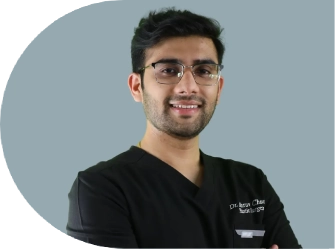
Meet Our Dermatologists


The Right First Step Is a Proper Diagnosis
PRP therapy is a well-researched, non-surgical option for women with female pattern hair loss, PCOS-related thinning, postpartum shedding, and hormonal hair changes. Results build over months – but for women with active follicles and early-to-moderate loss, it delivers measurable improvement in hair density and thickness without hormonal intervention.
Hair loss is not a single condition. It can result from hormonal issues like PCOS, nutritional deficiencies, stress, thyroid disorders, or genetic factors – and often from a combination of these. Starting PRP without identifying the exact cause often leads to poor or temporary results. Treatment that addresses the right cause from the start delivers outcomes that last.
The most important first step is a proper diagnosis. At HairMD India, Pune, your consultation includes a medical history review, scalp examination, and targeted blood tests – covering iron, B12, vitamin D, thyroid function, and hormone levels – to determine the root cause before any treatment begins. From there, a personalised treatment plan is built around your specific hair loss stage and goals.
Book a consultation at HairMD India, Pune – Contact HairMD India
Further Reading
Alopecia Barbae: Causes and Effective Treatments for Bald Patches in Your Beard
Discover the causes of alopecia barbae and the best treatments for bald patches in the beard. Get expert advice from HairMD clinics, Pune
Is Rosemary Oil Enough for Hair Regrowth? When to Consider Something Stronger
Six months of rosemary oil and still losing hair? HairMD dermatologists explain when rosemary oil works, when it is not enough, and what to try next.
Redensyl vs Minoxidil vs GFC for Hair Loss: Which One Is Right for You?
Redensyl, minoxidil, or GFC therapy for hair loss? HairMD Pune dermatologists explain how each works, who each is for, and how to choose.
Dermapen Scalp Microneedling Results in Pune
Real HairMD Pune patient results from Dermapen scalp microneedling for hair – what to expect, sessions, and before and after outcomes.
Have thoughts? Please let us know
We are committed not only to treating you, but also educating you.