

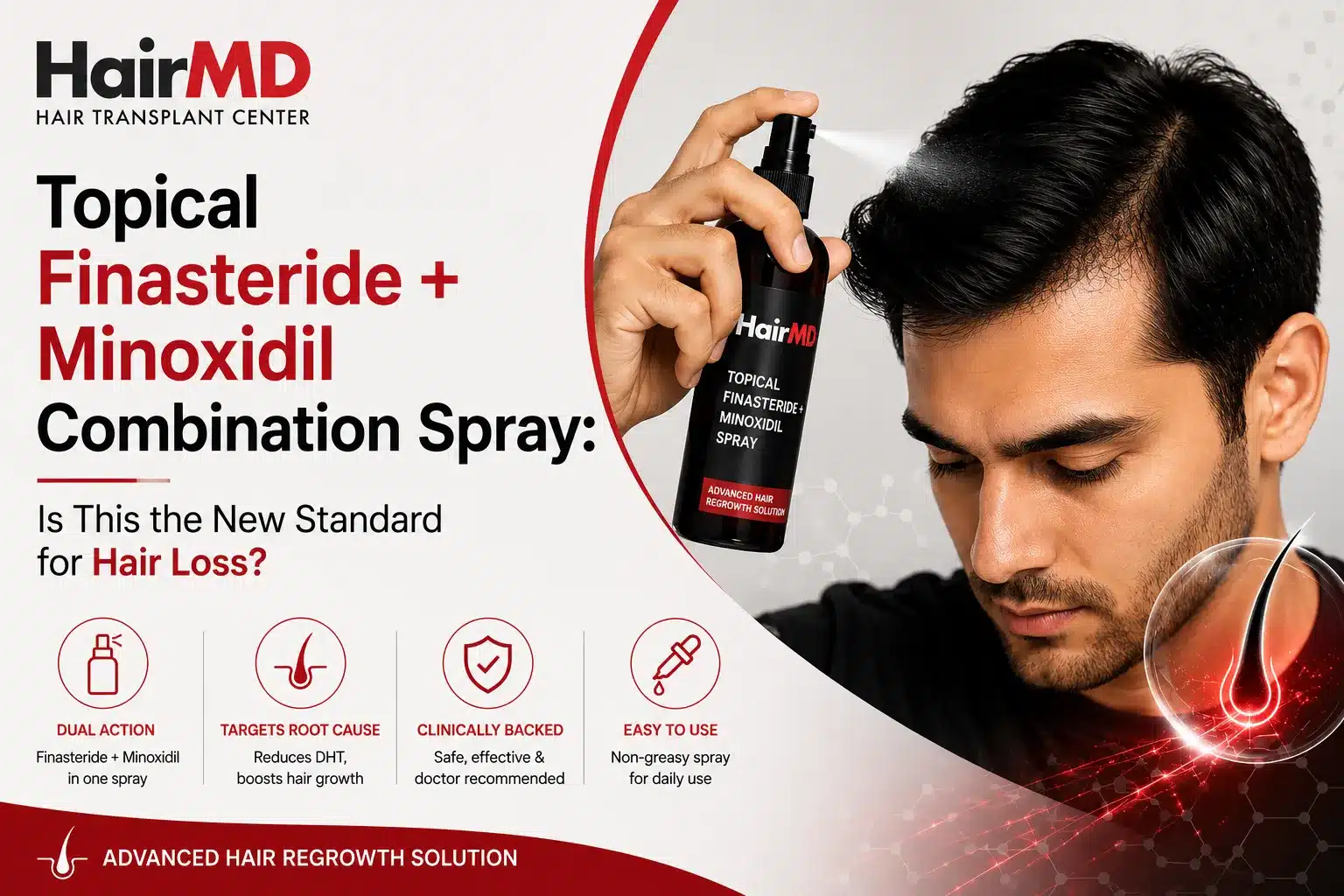
Topical Finasteride + Minoxidil Combination Spray: Is This the New Standard for Hair Loss?


Written by HairMD Content Team | Medically Reviewed by Dr. Dhanraj Chavan On June 30, 2026


Medical Disclaimer: This article is for informational purposes only. Consult a qualified dermatologist for personalised medical advice.
Losing hair can be frustrating, but newer treatments are making hair restoration easier and safer. Learn how topical finasteride and minoxidil combination spray works, who should use it, expected results, and whether it’s the right solution for your hair loss.
In 2025–26, a fixed-dose combination spray containing both topical finasteride and minoxidil is changing that equation and quickly becoming the preferred approach at hair loss clinics across India, including here at HairMD Pune. This article explains what the combination spray is, how it works, who it’s appropriate for, and what you can realistically expect from it. Whether you’re newly diagnosed with androgenetic alopecia or switching from oral finasteride, this is worth understanding properly before your next consultation.
What’s covered in the article?
- What Is the Topical Finasteride + Minoxidil Combination Spray?
- How Is Topical Finasteride Different from Oral Finasteride?
- Why Combining Both Drugs Works Better?
- Who Is a Good Candidate?
- What to Expect: The Results Timeline?
- Side Effects: What’s Reduced and What Remains
- How We Approach This at HairMD Pune?
- Cost and Availability in Pune (2026)
- Frequently Asked Questions
- Conclusion
What Is the Topical Finasteride + Minoxidil Combination Spray?
Fine hair texture refers: to the diameter of individual hair strands. Some people are born with genetically fine, thin hair shafts. The follicle density is normal , you have the correct number of follicles, they simply produce thinner-diameter strands. This type cannot be significantly changed. You can improve the appearance through styling and volumising products, but the fundamental strand diameter is genetically fixed.
Thinning from hair loss: refers to reduced hair density , fewer visible hairs per square centimetre of scalp than you used to have, due to follicle miniaturisation or excess shedding. This type can often be improved with the right treatment.
How to tell which type you have: Compare the top of your head now versus 2–3 years ago in photographs. If your parting has visibly widened, or scalp is visible where it was not before, you have thinning from hair loss. If density has always been the same and hair has never been different, you likely have naturally fine texture.
How Is Topical Finasteride Different from Oral Finasteride?
Oral finasteride (1mg daily) has been the gold standard for male pattern hair loss since 1997. It works by inhibiting the enzyme 5-alpha reductase, which converts testosterone into DHT (dihydrotestosterone) the hormone responsible for shrinking hair follicles in genetically susceptible men.
It works well. But systemic absorption means the drug circulates throughout your body, suppressing DHT not just in your scalp but everywhere. This is why a subset of men on oral finasteride (estimated 1–5% in clinical trials) report sexual side effects including reduced libido, erectile dysfunction, or ejaculatory changes.
Topical finasteride changes this significantly.
Studies including landmark research by Caserini et al. and subsequent trials published in journals including the Journal of the American Academy of Dermatology have shown that topical finasteride at 0.1–0.25% achieves:
- Scalp DHT suppression of 60–70% (comparable to oral finasteride)
- Systemic DHT reduction of only 10–15% (versus 60–70% with oral finasteride)
- Plasma drug levels roughly 4–6% of what oral finasteride produces
In plain terms: the scalp gets most of the benefit, and the rest of your body sees far less of the drug. The risk profile for sexual side effects is substantially lower though not entirely eliminated, which is worth acknowledging honestly.
Why Combining Both Drugs Works Better?
Finasteride and minoxidil work through completely different mechanisms. They don’t compete they complement each other.
Finasteride addresses the root hormonal cause: it slows or stops DHT-driven follicle miniaturization. Think of it as stopping the problem from getting worse.
Minoxidil stimulates follicles that are already dormant or in decline to re-enter active growth. It also dilates scalp blood vessels, improving nutrient delivery to hair follicles. Think of it as waking up what’s still there.
Used together, they tackle androgenetic alopecia on two fronts simultaneously. Multiple studies comparing monotherapy (either drug alone) to combination therapy have consistently shown greater hair count improvement, faster response, and better patient satisfaction with the combination.
“When a patient comes in with early-to-moderate androgenetic alopecia, I’m now almost always discussing the combination approach first. The convenience of a single daily application, combined with the superior efficacy data and improved side effect profile compared to oral finasteride the clinical case is compelling. The key is matching the right candidate and setting realistic expectations upfront.”
Dr. Dhanraj Chavan, Dermatologist & Hair Loss Specialist, HairMD Pune
Who Is a Good Candidate?
The combination spray is most appropriate for:
- Men with androgenetic alopecia (Norwood scale I–V) particularly those in early to moderate stages where follicles are still viable
- Men considering finasteride but concerned about systemic side effects topical delivery offers a meaningful risk reduction
- Men currently on oral finasteride who want to discuss switching to reduce systemic exposure
- Men who have tried minoxidil alone and plateaued adding the anti-DHT component often reignites response
- Women with female pattern hair loss in specific cases, under dermatologist supervision (see below)
What About Women?
This is important to address carefully. Topical finasteride is not recommended for women who are pregnant or planning to become pregnant, as finasteride can cause birth defects in male fetuses. In post-menopausal women or women of non-childbearing age with female pattern hair loss, topical finasteride combined with minoxidil can be prescribed under close dermatologist supervision.
Women of childbearing age should discuss this with their doctor honestly. It is not a blanket contraindication, but it requires careful counselling and reliable contraception.
Not Suitable For:
- Patients with complete follicle loss (scarring alopecia, extensive DUPA) drugs cannot restore dead follicles
- Patients with known hypersensitivity to either ingredient
- Anyone under 18 years of age
- Pregnant women or women attempting conception
What to Expect: The Results Timeline?
Hair loss treatment requires patience. This is one of the most important things to understand before starting any medical therapy.
| Timeframe | What’s Typically Happening |
|---|---|
| Weeks 1–8 | Possible initial shedding (telogen effluvium) this is normal and indicates the drug is working |
| Months 2–4 | No visible change; drug is suppressing DHT and stimulating dormant follicles |
| Months 4–6 | Initial new growth visible; existing hair may feel thicker or have improved texture |
| Months 6–12 | Measurable improvement in hair density; results become photographically visible |
| 12–18 months | Peak response period; majority of achievable benefit is visible by now |
Most patients see meaningful improvement by 6–9 months. Results vary based on age, stage of hair loss, how long the condition has been progressing, and individual response.
An important caveat: if you stop using the combination spray, the benefits reverse over 6–12 months. This is maintenance treatment, not a cure. Hair loss caused by DHT will resume if DHT suppression stops.
Side Effects: What’s Reduced and What Remains?
Significantly Reduced with Topical Delivery:
- Sexual side effects (libido changes, erectile dysfunction) systemic DHT is only modestly reduced
- Systemic hormonal effects relevant particularly for younger patients
Possible with Topical Finasteride (Lower Incidence Than Oral):
- Mild scalp irritation or itching at the application site
- Skin dryness or flaking often related to the vehicle (alcohol-based solutions)
- Contact dermatitis in sensitive individuals
Specific to Minoxidil Component:
- Initial shedding in the first 4–8 weeks (temporary, expected)
- Scalp itch or flaking more common with solution than foam
- Facial hypertrichosis (fine hair growth on forehead or temples) particularly if product runs down during application; can be managed with correct technique
Rarely Reported:
- Systemic side effects from topical finasteride are rare but not impossible, particularly if applied to broken skin or in very high volumes
At HairMD, we monitor patients at 3 and 6 months after starting combination therapy, adjusting formulation or concentration based on individual response and tolerability.
How We Approach This at HairMD Pune?
At our clinics across Pune, patients asking about the combination spray typically come in one of two situations: they’ve heard about it from a friend or social media, or they’re already on oral finasteride and want to know if switching makes sense.
Our standard approach:
- Trichoscopy assessment first we use scalp dermoscopy to assess hair follicle density, miniaturization patterns, and scalp health before prescribing. This tells us whether medical treatment is likely to be effective, or whether we need to discuss surgical options.
- Ruling out other causes we check blood work (ferritin, thyroid, hormones) to ensure we’re treating androgenetic alopecia and not missing a reversible nutritional or systemic cause.
- Prescribing and demonstrating application technique correct application makes a significant difference. The spray should be applied to a dry scalp, distributed across thinning areas, and massaged in gently. Washing hands after application is essential.
- Monitoring at 3 and 6 months we take baseline clinical photographs and repeat trichoscopy at follow-up to objectively measure response. This also helps patients see progress that isn’t always obvious in the mirror.
Pune’s warm and humid climate especially during the monsoon (June–September) can affect scalp oiliness and absorption. We sometimes adjust application timing or switch to a lighter vehicle formulation for patients who find the standard solution too heavy during summer months.
Cost and Availability in Pune (2026)
The combination spray is available in India both as commercially produced products and as compounded prescriptions. Costs vary:
- Commercial combination products (Tugain-F, Mintop FT and similar): ₹600–₹1,200 per bottle (typically a 2–3 month supply)
- Compounded prescriptions (custom concentration formulated by licensed pharmacies on dermatologist prescription): ₹800–₹2,000 per month depending on concentration and volume
At HairMD Pune, we guide patients on the most appropriate formulation for their specific case commercial products are suitable for many, while others benefit from a customised concentration, especially women or patients who’ve had reactions to vehicle ingredients.
This is significantly more cost-effective than long-term PRP sessions or surgical intervention for early-stage androgenetic alopecia.
FAQs
Can I switch from oral finasteride to the topical combination spray?
Yes, and many patients choose to do this. We typically recommend a direct switch (stopping oral the day you start topical) rather than a gradual overlap. Discuss this with your dermatologist some patients experience a brief period of increased shedding during the transition, which settles within 6–8 weeks.
Do I need a prescription for topical finasteride in India?
Yes. Finasteride in any form is a prescription drug in India. Do not purchase it from unverified online sources formulation quality and concentration accuracy matter significantly with topical finasteride.
Can women use this combination spray?
Post-menopausal women and women with no pregnancy risk can be prescribed topical finasteride under dermatologist supervision. It is not appropriate for women who are or may become pregnant. Your doctor will assess candidacy individually.
How long do I need to use it?
Indefinitely, for continued benefit. Hair loss caused by DHT will resume after stopping treatment. Many patients accept this as a long-term maintenance therapy, similar to using medication for blood pressure or diabetes.
I’m 26 and just starting to thin. Should I start combination therapy now?
Early intervention generally produces better long-term outcomes treating before significant follicle miniaturisation occurs means more follicles to save. However, a proper diagnosis confirming androgenetic alopecia (not nutritional deficiency or another reversible cause) should always come first.
Can I use this after a hair transplant?
Yes in fact, we frequently recommend the combination spray as post-transplant maintenance. The transplanted hair is permanent, but native (non-transplanted) hair in the rest of the scalp continues to be susceptible to DHT. Medical treatment protects that hair.
DO YOU KNOW?
Nearly 250 Patients Visit HairMD
Everyday For Various Hair Concerns
(15+ Years Of Expertise. 4157+ Successful Hair Transplant)
Meet Our Dermatologists




Conclusion
The combination spray is a powerful tool for the right patient, but candidacy assessment and correct formulation selection matter significantly. Self-medicating with internet-sourced topical finasteride is not the same as evidence-based prescription treatment monitored by a dermatologist.
Book a trichoscopy consultation at HairMD Pune to find out whether the combination spray is right for you and what to expect from it realistically.
HairMD Clinic Locations in Pune: Baner | Kharadi – Hadapsar | Pimple Saudagar | NIBM | Pune Station
Book a consultation or call your nearest HairMD clinic to speak with a hair specialist.
Further Reading
How to Prevent Hair Loss: The Ultimate Guide
Explore the ultimate guide to preventing hair loss and maintaining healthy, strong hair.
PRP Pre & Post Care Protocol | HairMD Pune
PRP for alopecia areata – what the research says about regrowth, how it compares to other options, and when it may help, from HairMD Pune.
PRP for Alopecia Areata: What Research Says
PRP for alopecia areata – what the research says about regrowth, how it compares to other options, and when it may help, from HairMD Pune.
Do Dermatologists Recommend Inositol and Choline for Hair Loss?
Discover the potential of inositol and choline for hair loss. Learn how these nutrients may benefit follicle health & prevent thinning.
Have thoughts? Please let us know
We are committed not only to treating you, but also educating you.