

How to do a hair transplant if your donor area has no hair?


Written by HairMD Content Team | Medically Reviewed by Dr. Dhanraj Chavan On January 10, 2026


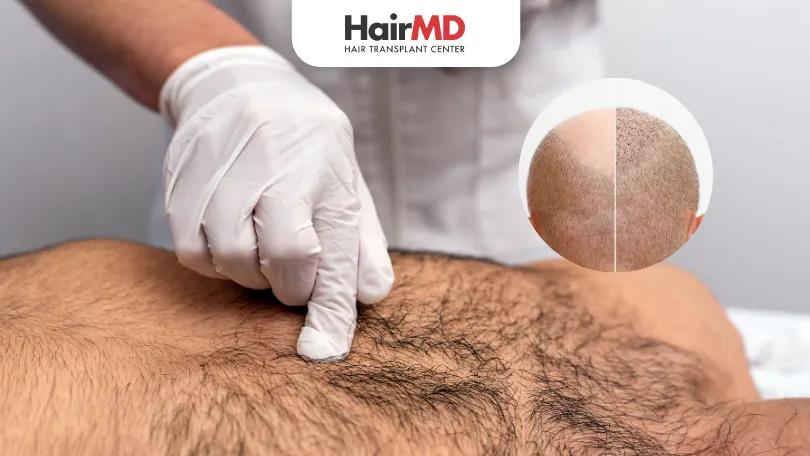
Many patients ask me, ‘Doctor, can a hair transplant be done if my donor area has very little hair?’
The answer depends on science, planning, and realistic expectations.
A common question I hear in my practice is, “Doctor, can I get a hair transplant if my donor area is weak or has no hair?”
The straightforward answer is that a traditional hair transplant is not possible without a viable donor area. Hair transplantation is a process of relocating hair, not creating it.
However, if your scalp donor area is depleted, advanced techniques allow us to use alternative sources like beard or body hair.
This is a specialised procedure reserved for specific cases of advanced baldness.
Quick Summary
- Donor Area is Finite: A hair transplant relocates hair from a permanent zone (usually the back and sides of the head) to bald areas. This supply is limited.
- Donor Depletion: This occurs when the donor area is over-harvested, thinned by aggressive balding (like DUPA), or damaged, leaving insufficient grafts for future needs.
- Body Hair Transplants (BHT): If scalp donor hair is unavailable, we can use hair from the beard, chest, or back. Beard hair is the most robust and compatible alternative.
- Suitability is Key: BHT is not for everyone. It is a solution for severe baldness (Norwood Scale 6-7) or for repairing previous, poorly executed transplants.
- Prevention is Crucial: The best strategy is to protect your donor area from the start by choosing an experienced surgeon who plans for your long-term hair loss progression.
What’s covered in the article?
- Why is a Healthy Donor Area So Important?
- What is Donor Depletion and Why Does It Happen?
- Can I Improve My Donor Area?
- What if I Don’t Have Enough Hair for a Transplant?
- How Bald is Too Bald for a Hair Transplant?
- What About Hair Cloning? Is It a Viable Option?
- Making the Right Choice for Your Future
- Frequently Asked Questions
- Conclusion
Why is a Healthy Donor Area So Important?
Think of your donor area as a bank account of hair.
This zone, located at the back and sides of your head, is genetically programmed to resist the effects of Dihydrotestosterone (DHT), the hormone responsible for male pattern baldness.
We can withdraw “funds” (hair grafts) from this bank to “deposit” them where they are needed most.
In my 10+ years of experience as a FUE surgeon at HairMD, I have always emphasised that the success of a transplant hinges on the quality and quantity of this donor supply.
A healthy donor area has high density, meaning lots of hair follicles are packed closely together. This allows us to extract a significant number of grafts without making the area look visibly thin.
The principle is simple: we are moving DHT-resistant hair to a DHT-sensitive area.
If the hair we move isn’t genetically strong, the transplant will eventually fail.
That’s why assessing the donor area is the very first step in any consultation at our hair transplant clinics in Pune and Pimpri Chinchwad.
What is Donor Depletion and Why Does It Happen?
Donor depletion, or an “exhausted donor area,” is a state where the permanent zone can no longer provide a sufficient number of healthy grafts for a transplant.
It is one of the most challenging situations we face in hair restoration.
There are three primary causes:
- Over-Harvesting: This is the most common and preventable cause. It happens when an inexperienced or aggressive surgeon removes too many grafts in a single session or from too small an area. This can create a “moth-eaten” appearance, leaving the back of the head looking patchy and thin.
- Advanced Androgenetic Alopecia: In some men, the area of balding is so extensive that even the “safe” donor zone is affected. A condition called Diffuse Unpatterned Alopecia (DUPA) causes thinning all over the scalp, leaving no truly stable donor area.
- Previous Surgical Damage: Outdated techniques like “punch grafting” or poorly executed strip surgery (FUT) can scar the donor area, rendering the follicles unusable for future extraction with Follicular Unit Extraction (FUE).
I often see patients who were lured by promises of “unlimited grafts for a low price.”
They arrive at our HairMD clinic with a depleted donor area and unrealistic expectations for a second procedure.
It is far more difficult to repair a depleted donor area than to perform a primary transplant correctly.
A responsible Hair surgeon will always prioritise the long-term health of your donor supply over short-term density.
Can I Improve My Donor Area?
This is a question filled with hope, but the answer requires careful management of expectations.
You cannot create new hair follicles in the donor area. However, you can improve the quality of the existing hair.
Here’s what I advise my patients:
- Medical Management: For patients with early signs of thinning in the donor area (like DUPA), medical treatments can be very effective. Finasteride (oral) and Minoxidil (topical) can help stabilise hair loss and thicken existing miniaturised hairs, making the donor area appear more robust.
- Platelet-Rich Plasma (PRP) Therapy: PRP injections for Hair Transplant can stimulate blood flow and provide growth factors to the follicles, potentially increasing the calibre (thickness) of each hair shaft. While it doesn’t create new hair, thicker strands can improve the overall donor density.
These steps can sometimes make a previously unsuitable candidate eligible for a limited transplant. However, they are not a solution for severe depletion from over-harvesting.
What if I Don’t Have Enough Hair for a Transplant?
This is where modern hair restoration science offers a lifeline.
If your scalp donor area is exhausted, we can turn to Body Hair Transplantation (BHT). This involves harvesting follicular units from other parts of the body.
Beard Hair: The Best Alternative
The beard is, by far, the best non-scalp donor source.
- Robustness: Beard hairs are typically thicker than scalp hairs. A single beard graft can provide the coverage of two scalp grafts.
- Growth Cycle: The anagen (growth) phase of beard hair is long, meaning it grows to a decent length.
- Genetic Strength: Beard hair is also resistant to DHT.
In our practice at HairMD, we often use beard grafts to add density to the crown or mid-scalp. We avoid using them for the hairline, as their coarse texture can look unnatural at the front.
Chest, Back, and Other Body Hair
Hair from the chest, back, or even limbs can also be used. However, their characteristics are less ideal:
- Texture: They are often finer and curlier.
- Growth Cycle: Their anagen phase is much shorter, so they may not grow very long.
- Graft Quality: They typically exist as single-hair follicular units, offering less coverage per graft.
Body hair is the last alternative because chest and back hair have different characteristics compared to scalp hair-beard hair is the best alternative.
BHT is a highly specialised skill. The angle of extraction is different, and the skin texture varies. It should only be performed by the Best Hair surgeons with extensive experience in this specific technique.
To understand when and how beard and body hair can be used as donor sources, you can read our detailed guide on body hair transplant to the scalp.
How Bald is Too Bald for a Hair Transplant?
| Attribute | Minoxidil | Redensyl |
|---|---|---|
| Primary Active Ingredient | Minoxidil sulfate (vasodilator) | DHQG + EGCG2 (plant polyphenols) |
| Mechanism of Action | Increases blood flow, prolongs anagen phase | Activates follicle stem cells, reduces inflammation |
| FDA Approval Status | FDA-approved (1988) | Not FDA-approved (cosmetic ingredient) |
| Application Frequency | Twice daily (2% or 5% solution) | Once or twice daily (in serum form) |
| Results Timeline | 3-4 months for visible improvement | 3-4 months for visible improvement |
| Side Effect Profile | Scalp irritation, unwanted hair growth possible | Minimal side effects reported |
| Average Cost (India) | ₹250-800 per month | ₹649-1,199 per month |
The Norwood Scale, which grades male pattern baldness from Stage 1 to 7, helps us answer this.
- Ideal Candidates: Norwood Stages 3 to 5 are often the best candidates. They have clear areas of hair loss but still possess a strong donor area.
- Challenging Candidates: Norwood Stages 6 and 7 represent extensive baldness. For these patients, a full head of hair is not a realistic goal. The objective becomes strategic coverage—creating a mature, framed hairline and light coverage over the top to reduce the appearance of total baldness.
- The BHT Candidate: A patient at Stage 6 or 7 with a weak scalp donor area but a thick, dense beard is the primary candidate for a combined Scalp + BHT procedure.
What About Hair Cloning? Is It a Viable Option?
Hair cloning, or more accurately, “hair multiplication,” is the holy grail of hair restoration.
The concept involves taking a few donor hairs, multiplying them in a lab to create thousands of new follicles, and then implanting them.
While research is ongoing and promising, hair cloning is not commercially available in India or anywhere else in the world as of today.
There are many scientific hurdles to overcome, such as ensuring the cloned follicles retain their genetic “programming” to grow properly.
Any clinic claiming to offer this service today is not being truthful
Making the Right Choice for Your Future
Your donor hair is a precious, finite resource. The most important decision you can make is choosing a surgeon and clinic that respects this.
At HairMD, our philosophy is one of responsible restoration. We plan for your entire life, not just for one procedure. If you are concerned about your hair loss or a potentially weak donor area, the first step is a professional assessment.
Are you worried about your donor area?
Let an expert evaluate your situation. Book a consultation at our HairMD clinics. Together, we can create a realistic and sustainable plan for your hair restoration journey.
Frequently Asked Questions
Q: Can you run out of donor hair?
A: Yes. The scalp has a finite number of DHT-resistant follicles. An ethical surgeon will calculate how many grafts can be safely harvested over a lifetime without causing visible thinning in the donor area. This is why planning is so critical.
Q: Is a body hair transplant more painful?
A: The procedure is performed under local anaesthesia, just like a standard FUE transplant, so it is not painful. The recovery for the donor sites (e.g., beard or chest area) is usually quick, with minimal discomfort.
Q: Do beard and scalp hair look different when transplanted?
A: Yes, they have different textures and growth characteristics. This is why we strategically place beard grafts behind the hairline and among scalp hairs to add density, ensuring the final result looks seamless and natural.
DO YOU KNOW?
Nearly 250 Patients Visit HairMD
Everyday For Various Hair Concerns
(15+ Years Of Expertise. 4157+ Successful Hair Transplant)
Meet Our Dermatologists

Conclusion
A weak or depleted donor area does not automatically mean the end of your hair restoration journey—but it does mean that the approach must be realistic, precise, and medically sound.
Hair transplantation is about redistributing a limited resource, not creating new hair. When the scalp donor is insufficient, advanced solutions like beard or body hair transplantation can help in selected cases, but only with careful planning and correct expectations.
The most important decision you will make is not how many grafts you get, but who plans your donor strategy.
Responsible hair restoration focuses on long-term appearance, donor preservation, and natural results—not quick fixes or false promises. A proper evaluation by an experienced surgeon is the only way to know what is truly possible for your case.
Further Reading
Does Cold Water Really Help Your Hair? Separating Fact From Myth
You’ve heard that rinsing with cold water makes hair shinier and stronger.
What Should I Do About Dandruff and Scalp Issues?
Dandruff, seborrheic dermatitis, scalp psoriasis, and dry scalp, they look similar but need different treatments. HairMD dermatologists explain how to identify each and what actually works.
Does Heat Damage Really Ruin Your Hair? The Science Explained
Yes, heat damage is real, and mostly permanent. HairMD explains exactly how heat ruins hair at the structural level, at what temperatures damage occurs, and how to minimise it without giving up styling.
How to Get Healthier Hair Without Expensive Treatments?
You don’t need expensive salon treatments for healthier hair. HairMD dermatologists explain what actually improves hair health, from diet and scalp care to habits that protect hair from daily damage.
Have thoughts? Please let us know
We are committed not only to treating you, but also educating you.