



Written by HairMD Content Team | Medically Reviewed by Dr. Dhanraj Chavan On January 24, 2026


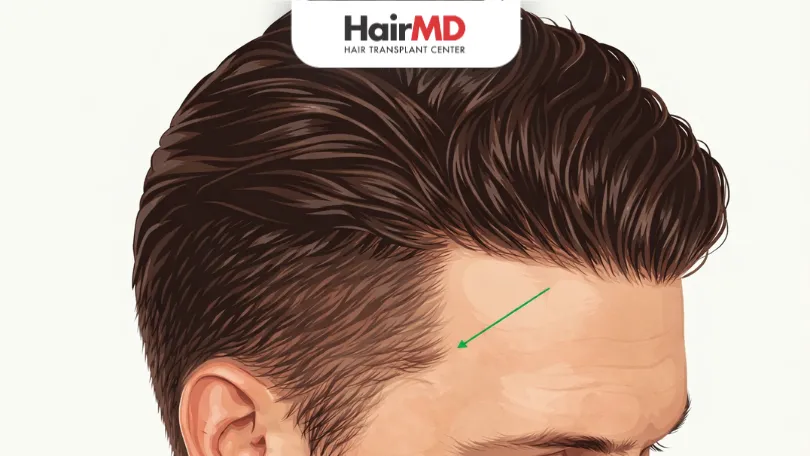
In my 17+ years of practice, I have learned that the difference between a good and a great hair transplant often lies in the details.
The most overlooked detail? The temple peaks.
These small, triangular points of hair are the cornerstones of a masculine hairline.
Reconstructing them properly is what separates a natural, undetectable result from a ‘pluggy’ or ‘wig-like’ appearance.
Ignoring them is a common mistake that can instantly signal to the world that you have had work done.
Quick Summary
- What are Temple Peaks? The small, triangular points of hair that connect the front hairline to the sideburns, framing the face.
- Why They Matter: Natural hairlines are not round. Temple peaks create the mature, masculine “M” shape and prevent the forehead from looking unnaturally wide.
- A Sign of Expertise: A surgeon’s ability to create soft, natural-looking temple peaks is a hallmark of artistic skill and experience.
- Graft Selection is Crucial: Only the finest, single-hair grafts should be used to create a soft, feathered look in the temple region.
- Don’t Skip the Temples: A low frontal hairline without reconstructed temples creates a disconnected, ‘combover’ appearance that looks unnatural.
What’s covered in the article?
- What Exactly Are Temple Peaks in a Hairline?
- Why Do Temple Peaks Matter So Much for a Natural Look?
- How Does Temple Design Separate a Natural from an Unnatural Transplant?
- Why Do Some Surgeons Neglect the Temple Peaks?
- What Is the Best Strategy for Recreating Temple Peaks?
- How Many Grafts Are Needed for the Temples?
- Frequently Asked Questions
- Conclusion
What Exactly Are Temple Peaks in a Hairline?
When you come for a consultation at our HairMD clinics in Pune or Pimpri Chinchwad, we spend a lot of time discussing hairline design And Explain To You How It Shoud Be As Per Age And With Scientific Measurements
The temple peaks, also known as fronto-temporal points, are the areas of hair that form the outer corners of your forehead. They are the transition zone between your vertical sideburns and your horizontal hairline.
In most men, even those without hair loss, these points naturally recede slightly with age, creating what is known as a mature masculine hairline.
They are not a sign of balding but a feature of a normal adult male hair pattern.
The artistry in hair transplantation lies in recreating these points with the right angle, density, and softness to perfectly frame your face.
Why Do Temple Peaks Matter So Much for a Natural Look?
Think of your hairline as a picture frame for your face.
If you only restore the top part of the frame and leave the sides bare, the entire picture looks off-balance.
In my experience, neglecting the temples is one of the biggest red flags of an inexperienced Hair Transplant surgeon.
Here’s why they are so critical:
- Facial Proportions: Rebuilding the temple peaks narrows the forehead, restoring a more youthful and balanced proportion to the face. A wide, expansive forehead can make a person look older and more bald than they actually are.
- Masculine Frame: A straight or rounded hairline is typically a feminine trait. The slight recession and sharp angles of the temple peaks are fundamental to a masculine look.
- Flow and Connection: The temples connect the front of the hair to the sides. Without them, there is an awkward, disconnected gap that makes it obvious hair has been added only to the top.
A patient came to me after having a procedure at another clinic. He was happy with the density on top but felt something was “wrong” with his look.
The problem was clear: the previous surgeon had created a low, dense frontal hairline but completely ignored his severely receded temples.
This created an unnatural “U” shape that made his forehead look as wide as his jaw.
He looked like he was wearing a hairpiece. We had to perform a correction procedure focused solely on rebuilding his temple peaks to restore a natural flow.
How Does Temple Design Separate a Natural from an Unnatural Transplant?
The temple area is unforgiving.
The skin is thin, and the hair there is naturally finer and less dense than the hair on top of your head.
You cannot simply transplant thick, multi-hair grafts and expect a good result.
Here’s how an expert approach differs:
| Feature | Natural Temple Design (HairMD Approach) | Unnatural Temple Design (Common Mistake) |
|---|---|---|
| Graft Choice | Single-hair grafts only. We use the finest hairs, often from the nape of the neck, for a soft, wispy transition. | Multi-hair grafts (2-4 hairs). This creates a harsh, “pluggy” wall of hair that looks artificial. |
| Hair Angle | Acute downward angle. The hairs are implanted almost flat against the skin, pointing downwards and backwards to mimic nature. | Upward or perpendicular angle. The hairs stick straight out, which is a dead giveaway of a transplant. |
| Density | Feathered and graded. The density is very light at the leading edge and gradually increases as it moves inwards. | Uniform high density. The temple has the same dense packing as the central hairline, which never occurs naturally. |
| Shape | Soft and irregular. The leading edge is not a hard line but a soft, slightly randomised pattern. | Hard and geometric. The temple point is a sharp, solid triangle, looking drawn on. |
An experienced & expert surgeon understands that the temple points are about creating an illusion of softness, not a wall of density.
Why Do Some Surgeons Neglect the Temple Peaks?
If temple peaks are so important, why are they often skipped? There are a few reasons, none of which are in the patient’s best interest.
- It’s Technically Difficult: Creating natural temples requires immense skill and patience. The angulation is tricky, and using only fine, single grafts is time-consuming. It’s easier for an inexperienced team to just pack grafts on top.
- It Consumes Grafts: Rebuilding temples can require 200-500 grafts per side. Some clinics, especially those offering “per graft” pricing, might avoid the temples to keep the total graft count (and price) down, delivering a suboptimal result.
- Fear of Future Hair Loss: A less experienced surgeon might worry that if the patient’s hair loss progresses, the newly created temple points will become isolated islands of hair. A skilled surgeon, however, plans for this by creating a mature, sustainable design that will continue to look natural even if hair loss advances.
What Is the Best Strategy for Recreating Temple Peaks?
At HairMD Clinic in Pune, our strategy for temple restoration is based on the principle of “organised chaos” to mimic nature perfectly.
- Assessment and Marking: We don’t use a stencil. I manually draw the temple points, considering the patient’s age, face shape, and degree of hair loss. A key landmark is the lateral canthus (the outer corner of the eye). A natural temporal point usually lies on a vertical line drawn up from this spot.
- Graft Harvesting: We specifically harvest the finest single-hair follicular units. Sometimes, we source these from the nape of the neck because they have a softer texture that is perfect for the temple area.
- Low-Density Feathering: We begin by implanting grafts at a very low density at the outermost edge. This creates a “transition zone” that prevents any harsh lines. The density is gradually increased as we move towards the main body of the hairline.
- Precise Angulation: Using fine implanters, we place the grafts at a very acute angle, directing them downwards and slightly backwards so they lie flat against the skin and blend seamlessly with the sideburns.
This meticulous approach ensures the result is not just dense, but also completely natural from every angle.
How Many Grafts Are Needed for the Temples?
The number of grafts required depends entirely on the degree of recession and the desired outcome.
- For mild blunting or reinforcement: 100-200 grafts per side may be sufficient to strengthen a weakening temple point.
- For moderate reconstruction: To rebuild a noticeably receded temple, it typically takes 250-400 grafts per side.
- For significant reconstruction: In cases of severe temporal recession (Norwood Stage 4-5), we may need 500 or more grafts per side to create a new, complete frame for the face.
It is crucial to remember that these grafts must be part of a holistic plan. We must always preserve enough donor hair for potential future procedures on the crown or mid-scalp.
Frequently Asked Questions
Q: Will transplanted temple hair look different from the rest of my hair?
A: No, because we use the finest single hairs harvested from your own donor area. By carefully selecting these grafts and implanting them at the correct angle and density, they blend in seamlessly.
Q: Can you make my temples perfectly straight and sharp?
A: We can, but we strongly advise against it. Nature is never perfectly geometric. A “razor-sharp” temple point often looks artificial. We aim for a soft, naturally defined shape that is more aesthetically pleasing.
Q: What happens if I lose more hair behind the new temple points?
A: This is a key consideration in our planning. We design a “mature” hairline that will look appropriate even if your hair loss progresses. The transplanted hair in the temples is permanent, and a good design will ensure it continues to frame your face naturally over time.
DO YOU KNOW?
Nearly 250 Patients Visit HairMD
Everyday For Various Hair Concerns
(15+ Years Of Expertise. 4157+ Successful Hair Transplant)
Meet Our Dermatologists

Conclusion
Your hairline is your signature. A hair transplant should restore it, not replace it with an artificial-looking substitute.
At HairMD, we believe the temple peaks are the soul of a natural hairline.
We don’t see them as an add-on; we see them as an essential component of a successful, confidence-restoring procedure.
Are you concerned about your hairline and want a result that looks completely natural?
Let’s talk about the details.
Book a consultation at our Pune or Pimpri Chinchwad Hair Transplant clinics. Together, we can design a hairline frame that is perfect for your face.
Further Reading
How to Prevent Hair Loss: The Ultimate Guide
Explore the ultimate guide to preventing hair loss and maintaining healthy, strong hair.
PRP Pre & Post Care Protocol | HairMD Pune
PRP for alopecia areata – what the research says about regrowth, how it compares to other options, and when it may help, from HairMD Pune.
PRP for Alopecia Areata: What Research Says
PRP for alopecia areata – what the research says about regrowth, how it compares to other options, and when it may help, from HairMD Pune.
Do Dermatologists Recommend Inositol and Choline for Hair Loss?
Discover the potential of inositol and choline for hair loss. Learn how these nutrients may benefit follicle health & prevent thinning.
Have thoughts? Please let us know
We are committed not only to treating you, but also educating you.